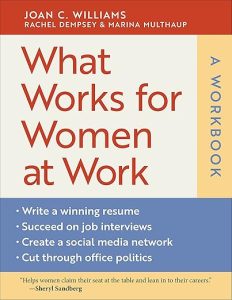
Prove-It-Again, the Tightrope, the Maternal Wall and the Tug of War. Four names for four things most working women have already experienced without having vocabulary for them, and giving them names is the reason Joan C. Williams matters. The audiobook runs ten hours and thirty-eight minutes, read by Nan McNamara, and before you buy it you need to know that the description attached to this listing is not describing the same product as the title.
The Title Is the Book, the Copy Is the Workbook
Joan C. Williams built this work on research rather than on anecdote, which is what separates it from the enormous shelf of advice aimed at professional women. The four patterns are not moods or attitudes, they are documented behaviors with consequences, and the book's central move is to treat each one as a problem with a response rather than as something to endure gracefully. That reframing is genuinely useful.
Bias here is described from the receiving end and answered from the tactical end. Prove-It-Again covers having to demonstrate competence repeatedly that colleagues demonstrate once. The Tightrope names the narrow band of behavior permitted between too soft and too aggressive. The Maternal Wall arrives with children, and the Tug of War describes what happens when women in an organization are set against each other. Naming them is half the work.
Read the description twice before ordering, because it is not written about this title. Every sentence of it describes What Works for Women at Work: A Workbook, the companion volume, with its interactive exercises, self-diagnostic quizzes and worksheets, and it closes by noting that the original book is now available in paperback. The title on the listing is the main book. The copy underneath it is selling the workbook.
McNamara Alone Sounds Like a Senior Colleague
Naming a pattern changes what you can do about it, and that is the case for hearing this rather than skimming it. The vocabulary is the deliverable. Once you can identify which of the four dynamics is operating in a meeting, the conversation afterward becomes a different conversation, and the material is repetitive enough by design that a listener absorbs the categories properly rather than nodding at them on a page.
Nan McNamara carries the recording alone, which suits a book that alternates between research summary and direct address. The register required here is neither dramatic nor conversational: it is the tone of a senior colleague explaining something you should have been told earlier. That is a long stretch of workplace strategy for a single voice, so the sample matters more than usual here, and it matters for pacing rather than for character work.
Gender Judo is the concept that stayed with me, and the description defines it plainly enough: doing a masculine thing in a feminine way to avoid the backlash that either alone would produce. It is a cynical piece of advice and Williams knows it, which is why the framing is honest about cost. The book is not arguing that this is fair. It is arguing that it works.
Advice on the practical questions is where the material gets concrete, and the description lists the ground covered: resumes, interviews, salary negotiation, professional networks, work-life balance and office politics. That is workbook territory rather than analysis, and it is the part that translates least well to audio, though the negotiation and politics material survives being heard better than any worksheet does.
A Paper Record Welded Onto an Audio Entry
Page counts do not belong on an audio listing, and this one carries 289 of them, along with a print book number and a university press credit. Those are artifacts of a paper record welded onto an audio entry, and they are worth noticing because they explain the mismatched description. Somebody assembled this page from a print catalog, and nobody checked what the buyer would actually receive.
Interactive exercises are the practical consequence of that mismatch. Self-diagnostic quizzes, hands-on toolkits and worksheets are advertised in the copy, and a recording cannot deliver a single one of them. No accompanying document is mentioned anywhere on the page, so if the exercises are what you came for, this format cannot supply them and the listing never says so.
Co-authors are missing as well. The publisher's own copy speaks of Williams and her co-authors without ever naming them, and the longer of the two responses, five stars in January 2018, names Rachel Dempsey and Marina Multhaup alongside her as co-creators. That response also dates the underlying material to 2014 with a revised edition in 2018, which is useful context nothing else on the page provides.
Vocabulary Is Power, Ten Hours a Defensible Trade
Working women in the middle of a career are the natural audience, particularly anybody who has been told to be more assertive by the same person who called her abrasive. Managers responsible for promotion decisions get more out of it than they expect, since the four patterns describe institutional behavior rather than personal failings. A brief five-star response from May 2021 offers two words of approval and no elaboration.
Buyers who want the workbook specifically should be careful here, since that is what the description promises and not what the title delivers. Anybody looking for encouragement rather than analysis should also reconsider, because the tone is diagnostic and occasionally bleak. This book is documenting a set of constraints, and its optimism is limited to what an individual can do inside them.
Williams is right that vocabulary is power, and ten hours spent acquiring four terms and a set of responses is a defensible trade. My reservation is entirely about how this page has been assembled. A buyer deserves to know whether they are getting the analysis or the exercises, and on the evidence in front of them, they cannot tell which one is about to arrive.
Before You Press Play
- Performance: Nan McNamara is the sole credited voice on a text that dramatizes nothing, so keeping long research passages clear is the entire job.
- What it covers: Four documented patterns of workplace gender bias, negotiation and self-presentation, institutional rather than personal explanations.
- Feel: Diagnostic, plainspoken, unsentimental.
- Our call: Valuable analysis and a vocabulary worth having, on a listing whose description is selling the companion workbook instead.
Good to Know
Is this audiobook the original book or the workbook?
The title says the original, the description describes the workbook, and nothing on the page resolves the contradiction. The copy talks throughout about interactive exercises and quizzes, then mentions that the main book is available in paperback. Check the sample against the first chapter before buying, because those are two genuinely different products.
What are the four patterns of gender bias?
Four named dynamics: having to prove competence again and again, a narrow band of behavior treated as acceptable, the penalty that arrives with motherhood, and the conflict engineered between women inside the same organization. Williams gives each one a name and a response, and the naming is what makes them arguable in a meeting.
Do the workbook exercises work in the audiobook?
They cannot, in any meaningful sense. Self-diagnostic quizzes and worksheets are designed for a pen, and no accompanying document is mentioned on this listing. If you want the hands-on material, buy it in a format you can write in. The analysis, the research and the tactical advice all survive being heard perfectly well.
Why does only one author appear on this listing?
The publisher's copy credits Williams alongside unnamed co-authors, while the byline on this entry shows a single name. At least two other people worked on the material by that account, and neither can be traced from anything here. Anyone wanting to follow their other work has nowhere to start.