
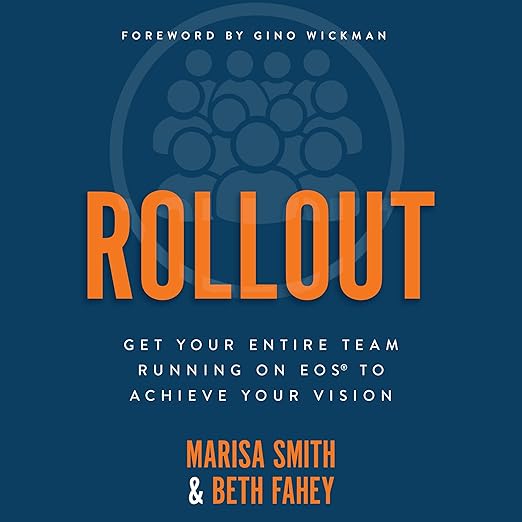
Two authors wrote this book and only one of them reaches the recording. The byline on the audiobook reads Marisa Smith, who also performs it, while the description introduces Beth Fahey as co-writer and three of the four written responses thank both by name. That gap between what the credits carry and what the copy describes is the first thing to know about Rollout, a 2026 manual aimed squarely at companies already running the Entrepreneurial Operating System and ready to push it past the leadership team.
This Book Bills Itself the Sequel to Traction
Rollout is a sequel, and one response headlines itself 'The Sequel to Traction' in reference to Gino Wickman's book, then describes this one as a title that 'picks up right where Traction leaves off'. That comparison does real work. This is not an introduction to the Entrepreneurial Operating System; it is the manual for the stage after adoption, when the leadership team is aligned, the vision is written down, and the rest of the company still has no working relationship with any of the tools.
Prerequisites get stated openly, which is more than most business titles manage. The description assumes from its first lines that you have mastered the basics, that your leadership team is already aligned, and that the remaining problem is distribution rather than design. Everything after that assumption is built on it. If your company has not adopted the system, a good half of the vocabulary will pass you by and the practical guidance will describe a situation you do not have yet.
Three promises organize the whole thing, and the selection is shrewd. Cascade the vision and the tools through every level of the company; overcome resistance to change, secure buy-in, and keep momentum alive; build accountability so the entire team works in alignment. Those happen to be the three places company-wide rollouts die, and naming them in that order suggests two people who have watched it happen from inside client companies rather than theorized about it from outside.
Only Half the Authorship Reaches Your Ears
Explanation is the real differentiator, according to the response posted on February 26, 2026, which credits the book with a dual approach: not only how to roll the system out across a whole company, but why the method works, by going into 'the psychology of organizational change'. The same entry sets the problem up crisply, observing that the leadership team is usually where these programs work and also where they stop. Anyone who has watched a process initiative evaporate two levels down will recognize that diagnosis.
Five hours and forty-three minutes is a well-judged length for a manual of this kind. Long enough to treat cascading a system across departments in real detail, short enough that whoever is actually running the rollout can finish it before the first planning meeting. The accompanying PDF matters more than usual here, because a book organized around tools and templates is only as portable as its worksheets, and the listing confirms a document lands in your library alongside the audio without saying a word about what it holds.
Narration comes from the author, which on an implementation manual is the correct call. Marisa Smith is one of the two Expert EOS Implementers who wrote it, and instructions delivered by the person who gives those instructions professionally carry an authority that no hired reader supplies. The cost is that only half the authorship reaches your ears. The co-writer's voice appears nowhere on the recording, and none of the written responses distinguishes which ideas came from which author.
A Review Posted a Day Before the Release
Authority is the quiet prerequisite nobody states. Rolling a system through an entire organization presumes you can convene the meetings, change the reporting rhythm, and insist that people keep using a tool after the novelty wears off. A department head listening to this without executive backing will find advice that assumes a mandate. The book is honest that patient, intentional leadership is required; it is less explicit that the leadership in question has to be yours.
Composition of the review pool is worth a look before the perfect score persuades you. One response comes from someone who works with EOS client companies and was already excited to hand the book to all of them, and it was posted on February 15, 2026, one day ahead of the recording's own release date. That is an audience of practitioners rather than skeptics, which is not a flaw, but it does mean the enthusiasm you can read comes from people already sold on the method.
Marketing register creeps in at the edges. The description closes on a line about this being transformation rather than implementation, a flourish none of the responses bother to echo, and the copy repeats the product name in a way that reads like a slogan under construction. Nothing in the actual content appears to trade on that, and the four written responses all describe something concrete and procedural, but the packaging asks for more credulity than the material does.
Smith's Book Makes No Attempt to Widen Its Circle
Owners and implementers are the target, and the March 11, 2026 response says so plainly, praising a guide that helps leaders understand 'both the why and the how' of putting the system in place throughout their companies. That is the reader this was written for: somebody with the authority to run a rollout and the patience to sequence it over quarters rather than weeks. If that describes your job, the book is addressed to you sentence by sentence.
Skip it if your company has never adopted the system, or if you wanted a general treatment of organizational change you could apply anywhere. The vocabulary here is proprietary and constant, the examples assume a specific set of tools already in use, and the psychology sections exist to serve that method rather than to stand on their own. Business listeners hunting for transferable change-management theory will get more from a book that was not built as a companion.
Only five ratings sit under this listing and four of them come with words attached, so the score is a small sample no matter how perfect it looks. Read the responses instead of the number: they are specific about which problem the book solves and consistent about who they think should read it. The book knows exactly who it is talking to, and makes no attempt whatsoever to widen that circle.
Common Questions
Can you follow this audiobook without any background in the Entrepreneurial Operating System?
Not comfortably. The description states outright that it assumes you have the basics down and a leadership team already aligned, and the guidance addresses distributing a method you have adopted rather than choosing one. A newcomer would be better served learning the system first and returning to this afterward.
Does the audiobook address a rollout that has already stalled?
Yes, explicitly. The description names three entry points: starting out, rebooting after a stalled attempt, and fine-tuning an implementation that already runs well. The middle case is the one most likely to send somebody looking for this book, and it is covered rather than treated as an edge situation.
What does the five-star average on this audiobook actually represent?
Five ratings in total, four of which come with written responses, and every written one sits at the maximum. That forces the single silent vote to be a five as well, since nothing lower could average out. It is an unblemished score built on a very small number of people.







