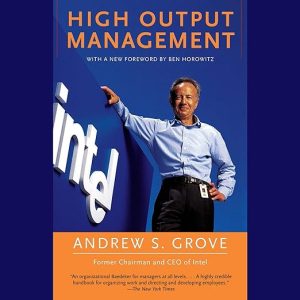
Five ratings sit under an average those same five ratings cannot produce. The listing displays 4.6. The five written write-ups printed below it grade this audiobook five, five, five, five and four, which comes to 4.8. Three of those five were also filed years before this April 2021 recording existed, the oldest of them more than six years ahead of it. So the number you are shopping against was awarded to a printed book by people who could not have heard Marc Cashman say a word of it.
Output Over Activity Is the Unfashionable Argument
Andrew S. Grove wrote this as employee number three at Intel and later as its chairman and chief executive, which is the credential the description leads with, and for once the credential earns its place. The argument underneath the book is unfashionably plain: a manager's job is output, not activity, and everything else follows from deciding what to measure. The February 2017 write-up, graded four stars, dates the material to 1983 and calls it still very relevant, which is a fair verdict.
Grove's framing has not aged the way management writing normally ages, because he built it on measurement rather than on culture. That same February 2017 complaint is not really about the book at all. It is that these ideas should be common knowledge by now and demonstrably are not, and that newly promoted managers keep repeating the same fundamental mistakes anyway. Whether you agree with that diagnosis is the fastest test of whether you need eight hours of this.
Handbooks Pay Out More on the Second Pass
Where the audio helps is repetition. This is a handbook, and handbooks pay out more on the second pass than the first. Eight hours and two minutes is short enough to run twice inside a month without resentment, and the chapters are self-contained enough to survive being heard out of order, which is not something I would say about most business titles of this vintage. The structure tolerates a distracted listener far better than the reputation suggests.
A Small Slice of Time, Enormous Returned Value
Leverage is the load-bearing idea, and it is the reason this book outlived its decade. The February 2015 write-up, graded five stars, states the thesis about as cleanly as anyone has: a manager's objective is to increase the output of the people around and below them, so the activities worth choosing are the ones with a multiplicative effect. The example that write-up reaches for is a small slice of a manager's time spent giving clear direction, returning enormous value across a whole team.
Sales managers, accountants, consultants and teachers are named in the description alongside chief executives and startup founders, and that list is not marketing reach. The techniques concern meetings, one-to-ones, forecasting and the mechanics of getting a decision actually made, none of which is specific to semiconductors. If you run a team of four in a school or a clinic, the frameworks land as squarely on your week as they ever did inside a chip company.
Marc Cashman reads it, in a Random House Audio production dated April 2021 for a text that predates a good share of its likely audience. The page also discloses a downloadable PDF of selected content, and on a handbook this dependent on worked examples that supplement is not a courtesy. Pull it into your library the day you buy, because some of this material was never designed to be heard, and you will want it open in front of you.
Sentences Doing Work Whole Books Usually Need
Twenty-four is the sum of the grades printed on this page, and twenty-four over five is 4.8, not the 4.6 the listing shows. Either whole-star votes exist that left no text behind them, or the counter has gone stale. It is a small discrepancy and an honest one to flag, because the figure a buyer weighs is not the figure the visible pool actually produces, and nobody is going to correct it for you.
Chronology is the larger caution. Three of those five write-ups predate the recording outright, which means their stars were awarded to paper and then pooled onto an audio listing. Nothing dishonest is happening; the grades are simply attached to a different object than the one in your cart. A buyer comparing this against a rival business title should mentally discount the average by however much they think format matters.
One December 2020 write-up, graded five stars, describes finishing the book and starting it again immediately, and quotes the Ben Horowitz foreword to explain why: sentences that do work other authors need entire books to accomplish. Take that as a warning about pace rather than as praise. A single pass at listening speed will not deliver what a reader who circled back twice got, and the density that makes it quotable also makes it easy to lose while your attention drifts.
Relisten Twice, Once to Survey, Once to Study
Managers newly promoted and quietly improvising are the obvious audience, and so are the individual contributors reporting to them, because the frameworks explain what your own manager is trying to do when their behavior looks arbitrary from below. A June 2025 write-up, graded five stars, arrived on a career coach's recommendation and calls the approach practical, clear and surprisingly applicable to modern teams, which is a fair summary of who benefits and why.
Steer clear if you want case studies from the last decade, or a book about distributed teams, hiring in a tight market, or anything downstream of the modern internet. None of that exists here. Steer clear too if you need narrative to stay engaged, because this states a principle, works an example and moves on, and the pleasure is entirely in the clarity rather than in any story being told.
Buy the audio if you genuinely intend to relisten, and download the companion PDF the same afternoon. Eight hours is a small toll for a working vocabulary you will use in meetings for the rest of your career, and the only real adjustment is expectation: let the first pass be a survey and the second one the study. Go in knowing the page describes an older object than the one you are about to hear.
Does this audiobook come with the companion PDF, and do you need it?
Yes, and you want it. The edition ships with a companion PDF pulled from the printed text, which the listing states outright. A handbook built on worked examples carries material that does not survive conversion to speech, and eight hours of listening goes considerably better with the reference open beside you rather than reconstructed from memory afterward.
Who is this audiobook for besides people who already manage teams?
Individual contributors get more from it than they expect, because it explains the logic behind decisions that look arbitrary from below. The description also aims it at accountants, consultants and teachers, and the framework travels: anyone whose own results depend on other people's time will find the vocabulary immediately useful.