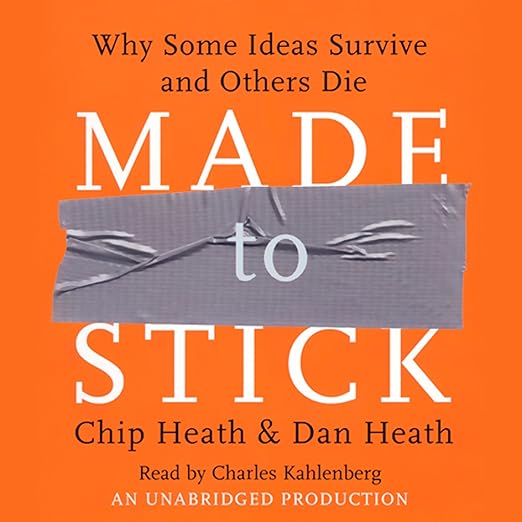
Before You Press Play
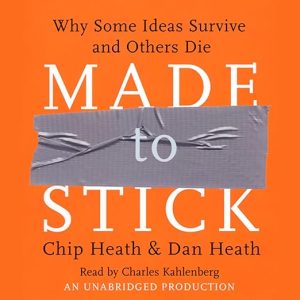
- Voice: One of the older recordings still on the shelf, a 2007 Random House Audio production credited to Charles Kahlenberg alone.
- Big ideas: Why some ideas survive retelling, six traits of a message that lands, storytelling used as evidence
- Atmosphere: Brisk, anecdotal and quietly persuasive
- Worth it?: Still the clearest book on why messages land, sitting behind a record that mislays both an author and an average.
A 2007 recording of a book about why some ideas survive and others vanish is a slightly comic object to meet in 2026, and this audiobook has survived rather well. Chip and Dan Heath set out to explain the anatomy of a sticky idea, working from urban legends, conspiracy theories and a Mark Twain line about how far a lie can travel before the truth gets its boots on. Six traits, they argue, account for all of it. The byline on this record credits only one of the two authors.
First, the Big Picture
Reviews are not a habit for the January 2013 five-star on this page, which made an exception in order to call this one of the best non-fiction books ever read, top five and possibly top three, and to identify exactly why: the power of the ideas combined with a clear, readable and lively presentation. That combination is the entire pitch. Books about communication fail to communicate with depressing regularity. This one demonstrates its own principles as it goes, which is either persuasive or circular depending on your mood.
The six traits form the spine, and the examples are what make them stick. A Nobel-winning scientist drinking a glass of bacteria to prove a point about stomach ulcers. The kidney theft ring hoax. Charities working what the book names the Mother Teresa Effect. A teacher whose classroom simulation actually reduced racial prejudice. A coach's lesson on sportsmanship, and a product vision at Sony. Each is deployed to isolate a single mechanism rather than to pad out a chapter.
Named concepts do a great deal of work too: the human scale principle, the Velcro Theory of Memory, curiosity gaps. Those labels are themselves part of the argument, since the book is busy proving that a concrete name outlives an abstract explanation. Whether or not you accept the framework wholesale, you will remember its components a week later, which is precisely the test it sets for itself in the opening chapter.
The Best Parts of Made to Stick
A buyer writing from Canada in August 2017 offers the most practical endorsement on the page: if you have trouble conveying your ideas, this will solve most of your communication problems, the read is simple and engaging, and it is a blast even though the topic sounds boring. That last clause carries the weight. Message design as a subject sounds like a seminar you were made to attend, and the delivery here is nothing of the kind.
Charles Kahlenberg has to carry a numbered taxonomy without any page furniture whatsoever. Six traits, three named principles and a running set of case studies arrive with no headings to glance at, no sidebars, no boxes, and this listing names no companion document. A print reader can flip back to check which trait they are on. A listener cannot do anything of the sort. That is the structural cost of taking this particular book by ear, and it is worth weighing before you choose the format.
What audio hands back is the case studies. Every example here is a story with a turn in it, and stories are the thing the format was built to deliver. At eight and a half hours the pace never sags, and the argument arrives in the shape the authors intended: mechanism, then anecdote, then the reason the anecdote worked. If you want the framework as a reference, buy the paperback. If you want to be persuaded the framework is right, listen to it.
A Few Reservations
The byline is the first problem. This record names Chip Heath by himself, though the description underneath it says Chip and Dan Heath, and buyers refer to the Heath brothers as a matter of routine. For a book whose entire subject is making an idea travel intact from one head to another, losing half the authorship in a catalog entry is an unfortunate demonstration of the thesis. It also breaks the search term most readers would reach for first.
The rating line does not survive inspection either. The page shows 4.6 across five ratings, and all five written responses carry five stars. Five top grades average five, not 4.6, so either the counter and the average are drawn from different pools, or the number attached here belongs to another edition entirely. On a title with this reputation, a total of five recorded ratings is itself the anomaly worth noticing.
Context matters for two of the responses before you weigh them. The oldest, five stars from March 2007, comes from a writer who declares both an acquaintance with the authors and the resulting bias in the same breath, then argues the case anyway: the ideas are evidence-based, and one author trained under Amos Tversky. The most recent, filed from Mexico in February 2024, is not written in English at all, praising the book from its introduction through to the end. A five-rating counter aggregating markets and languages is not a sample you can lean on.
The Right Listener for Made to Stick
Anybody whose job involves making other people remember something is the target here, and a November 2019 response from the Netherlands describes the use case precisely: great examples that make the six key qualities stickier, and a book very suitable for re-reading over and over. Teachers, fundraisers, product people, anyone who has watched a good idea die quietly in a meeting. The framework is general enough to travel and concrete enough to apply the same week.
Anyone who has already absorbed the six traits secondhand can probably pass. The framework has been summarized in a thousand places over nearly twenty years, and once the traits are familiar the book turns into a long and pleasant tour of examples supporting things you had accepted before starting. The other group to warn is anybody wanting research: this is a popularization, the citations stay in the background, and illustration does the persuading.
Few catalog entries fail their own book's thesis this completely. A record about ideas that survive retelling has mislaid an author, posted an average its own responses contradict, and filed itself under three genres simultaneously. The book underneath all that remains the clearest thing written on why some messages land and others evaporate. Take the book, and read the listing as an accidental case study in what happens when an idea gets copied badly.
Common Questions
Does the audiobook come with any written material to refer back to?
No supplementary document appears anywhere on the listing. That matters more than usual here, because the book runs on a numbered framework plus three named principles, and a listener has nothing to consult when a later trait turns up well after the one before it. Take notes, or keep a summary open beside you.
Is this a business audiobook or something wider than that?
Wider, though the record files it under careers first. The examples run through charities, classrooms, journalism and public health at least as often as through companies, and the argument concerns how any message survives being retold. Anyone who has to explain something to somebody else sits inside the intended audience.
Does the audiobook work if I only want the framework and not the stories?
Poorly. The stories are the delivery system, and the traits themselves are stated compactly enough that stripping the examples out would leave you holding a pamphlet. If a checklist is what you want rather than an argument, a summary will serve you better, and the book would probably approve of the shortcut.