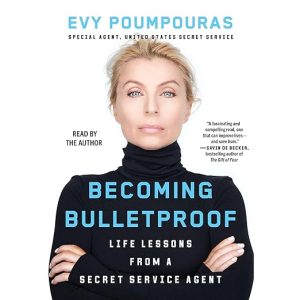
Secret Service training is the sales pitch, and it is a good one. Evy Poumpouras protected three presidents, holds the Medal of Valor as one of only five women ever to receive it, and reads this audiobook herself for Simon & Schuster Audio. What she is selling is not tradecraft but transfer: the claim that skills used to read a room at a state function work just as well on a colleague who keeps changing the subject. The star average on this page, meanwhile, cannot be produced by the votes sitting underneath it.
A Closer Look at Becoming Bulletproof
Reading people is the strongest material. Poumpouras breaks down how to tell what somebody wants from you, how to notice when an account is being managed, and how to run what the description calls a built-in BS detector without turning into the person who suspects everybody. That is an unusual skill set to find in a mainstream personal development title, and it comes from a career where being wrong carried a cost. The influence chapters work the same ground from the opposite direction, on how you are being perceived rather than on what you are perceiving.
One buyer posting in November 2025 at five stars, Kevin Stecyk, states the limitation more precisely than a critic could: the book seems to be reaching for a broader audience, and anyone who has read a few self-development titles will have met much of this material before. That same account is confident the author has a great deal more she could teach and openly wants the advanced version. It is a generous complaint and it is the correct one. A ten-hour book that never stops being accessible is a book that has decided who it is for.
Holding it all together is a redefinition of strength. The argument runs that toughness lives in the mind rather than the body, which lets a book with a Secret Service cover become a book about resilience, grit and having difficult conversations without flinching. That reframe is why the material lands with readers who have no interest in protective work, and it is also why the anecdotes are load-bearing. Strip out the presidential corridors and the advice starts to sound like everything else on the shelf.
What Makes Becoming Bulletproof Worth Hearing
Poumpouras reads it herself, and the argument for that is the argument the book makes about credibility. Advice on controlling how you are perceived arrives differently from the person whose job was controlling exactly that. A hired reader would deliver identical sentences and lose the authority, since the anecdotes are first-person accounts of standing in rooms most listeners will never enter. One October 2025 five-star, from Isabel, gives a useful measure of the effect: a self-described slow reader who took about two weeks over it and came away describing the book as help with the daily work of being a better person.
The format suits this content better than most business titles manage. Reading people gets taught through story, and story is what audio does. A chapter walking through an interaction beat by beat, what was said, what was noticed, what was decided, follows more easily spoken than diagrammed, and ten hours and twenty minutes gives every scenario room to be played out rather than summarized. The trade arrives when you want to find something again: a book of techniques without a printed index is one you re-listen to rather than consult.
Simon & Schuster Audio released the recording in April 2020 and credits no second voice, no interviewer and no framing material, which for a memoir-shaped instruction book is the right call. Beyond that credit, the page stays quiet. What does appear is that five people have rated this in the years since, which for a title from a house this size, by an author with a television profile, is a remarkably small number, and it forces every one of those five grades to carry weight it should never have had to.
Things to Know Before Starting Becoming Bulletproof
The star average cannot be assembled from the votes shown. Five whole-star ratings can produce only 4.6 or 4.8, since twenty-three points show one figure and twenty-four show the other, and the page displays 4.7. The five written grades on this listing add up to exactly twenty-four. So the number a buyer sees sits between two achievable values and matches neither, while the written pool points squarely at the higher of them. What is displayed understates what the people who actually wrote something thought.
One grade below the top makes it worse. One buyer posting in November 2024 at four stars had read the book already and was ordering a physical copy, and the deduction is entirely about the parcel: pure paper shipped without enough care, corners frayed on arrival. On the book itself that account is unreserved, calling the author a wonderful inspiration and pointing undecided buyers toward the free interviews she has given to podcasters and hosts. The only mark holding this average down was awarded to a cardboard box.
Reading is the default verb in this pool, which is worth noticing before you buy the audio. One buyer posting in April 2025 at five stars, Shauni, ordered the paperback, grew too impatient to wait for it and picked up the recording in the meantime, then described the plan as sitting down with the physical copy the moment it arrived. Another response counts the weeks the printed book took. Even the person who bought this recording treated it as a holding pattern rather than as the destination.
Who Evy Poumpouras Is Writing For
Somebody who has never read a personal development book is the ideal buyer, and the fit is close to perfect: the material is clear, the examples come from a career nobody else has had, and nothing assumes prior vocabulary. Beyond that, it suits people whose work involves sizing up strangers quickly, anyone rebuilding confidence after the wrong end of a manipulative relationship, and listeners who want their self-help shaped as memoir rather than as framework. Anyone whose job is to be believed by strangers will find the influence chapters unexpectedly practical.
Hold off too if you have already worked through the standard shelf, because anyone deep in this genre will recognize most of the framework and end up wanting the version written for people who know the basics already. It is a poor purchase as well for anyone hunting operational detail, since this is a book about states of mind rather than about protective technique. If a first-person account of guarding presidents strikes you as an odd foundation for advice about your own week, that instinct is worth trusting.
Common Questions
Does this audiobook teach actual Secret Service techniques?
It teaches what transfers. The observation methods, the approach to influence and the knack for spotting a story that has been tidied up all come out of that career, but the book is about mental states rather than protective procedure. Nobody finishes it able to run a detail. Plenty finish it noticing more in a meeting.
Is the audiobook worth choosing over the print edition?
For a first pass, yes, since the material is taught through scenes and scenes carry better spoken. For repeated reference, no. Robert, Jr's February 2026 five-star praises the authenticity of the author telling her own story, which names the recording's advantage exactly, but a recording remains a poor tool for going back to page ninety.
Do you need any background in security or psychology?
None whatsoever. The vocabulary is deliberately plain and every concept arrives attached to a story rather than to a study. That accessibility is the trade the book has made: it removes every barrier for a newcomer and costs depth for anyone who already reads widely in this category.