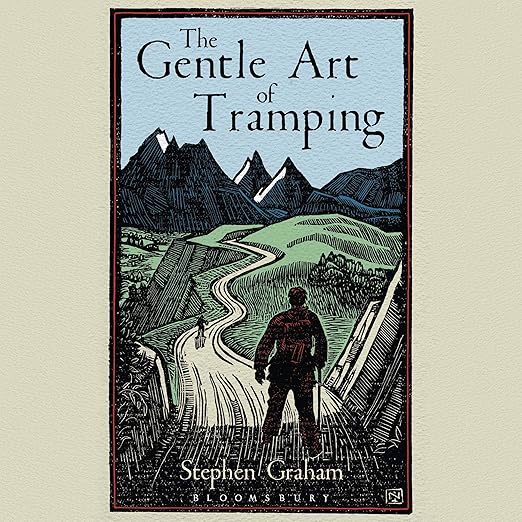
- Read by: Mike Grady reads Graham's 1926 prose with the quiet attentiveness the text demands, letting the unhurried philosophical passages breathe without imposing urgency the writing does not contain.
- At its heart: Walking as philosophy, the art of wandering, nature and human encounter
- Vibe: Meditative, gentle, restorative
- Short version: Stephen Graham's lost classic returns in audio as a genuine antidote to efficiency culture, and Grady's narration makes it sound like advice from someone who has actually lived this way.
Stephen Graham published The Gentle Art of Tramping in 1926, and the book disappeared from general circulation for most of the century that followed. Annie Dillard quoted from it in her Pulitzer Prize-winning Pilgrim at Tinker Creek, which is how several reviewers encountered it, but the book itself remained difficult to find in affordable editions. This audiobook from Bloomsbury, narrated by Mike Grady, restores it to the audience it deserves. At 5 hours and 15 minutes, the runtime fits the material: a gentle book, read at a gentle pace, on the subject of moving through the world without rushing toward a destination.
Graham's argument is essentially philosophical, dressed in practical outdoor prose. Tramping, as he uses the term, is not simply hiking. It is an orientation: toward nature, toward other travelers, toward nations and beauty and the unpredictable encounter. The adventure, he writes, is not the getting there, but the on-the-way. The surprise, not the expected. This is a manifesto for a way of moving through the world that the twenty-first century has done its best to eliminate, and listening to it in 2026 feels like opening a window that has been sealed shut for a long time.
Where This One Lands
What keeps this book from softening into sentiment is precisely what one reviewer identifies as its straightforward honesty. Graham was writing in an era when outdoor prose had not yet learned to aestheticize difficulty for an audience, and that absence of performative ruggedness gives the book a different texture than contemporary hiking memoirs. He describes meeting fellow wanderers with the same matter-of-fact observation he applies to landscape, and his instructions on how to be passive to the beauty of nature and active to its wildness carry practical weight rather than inspirational vagueness.
The philosophical range of the book is its most lasting quality. Graham moves from the mechanics of the road, what to carry, how to sleep rough, how to read weather, to questions about identity and what a life of movement makes possible in terms of knowledge and character. He is not arguing that everyone should tramp. He is arguing that the tramper's relationship to time and surprise and other people represents something worth understanding even for those who never leave their cities. Alastair Humphreys, the adventurer and microadventure advocate who called this book an absolute gem, responds to exactly this quality: the sense that Graham is not describing a sport but a way of seeing. The book rewards a slow reading, which makes it ideal material for an audiobook, where the pace is set externally and cannot be rushed.
Why The Gentle Art of Tramping Works as an Audiobook
Mike Grady's narration is well-matched to the material. The 1926 prose has a particular rhythm, careful and observational, and Grady reads it with the unhurried quality that the text requires. He does not impose urgency onto passages that are specifically about the value of not being urgent, which sounds obvious but requires genuine interpretive restraint from a narrator. The philosophical sections are read with the same pace as the practical ones, which is correct: Graham does not distinguish between them in importance, and neither does Grady.
Bloomsbury's decision to bring this book back in audio format is well-judged. The prose works exceptionally well spoken aloud. Graham writes in a voice that resembles a companion walking beside you rather than an authority addressing you from a podium, and Grady captures this quality. Listeners who have been putting off long walks because they seem impractical or self-indulgent may find this audiobook reorganizes their thinking on the subject. The DonB reviewer's note that for anyone thinking about getting started with hiking, this is a cool book understates both the ambition and the depth of what Graham is doing, but the observation about accessibility is accurate.
What Gives Us Pause
The book was written in 1926 and carries the assumptions of its era in some passages. Graham's observations about nations and peoples reflect early twentieth-century attitudes that readers will encounter and should contextualize accordingly. These moments are not the center of the book, but they are present, and listeners expecting a universally progressive text should be aware of the historical context before beginning.
The runtime of 5 hours and 15 minutes places this among shorter audiobook listens, which suits both its episodic structure and its philosophical subject matter. There is no narrative arc to track across the runtime. Instead, Graham proceeds by accumulation: each chapter adds another dimension to the tramper's way of being in the world, and the book rewards slow, segmented listening as much as continuous play. It is, in the most practical sense, a book to walk with. Putting it on during an actual walk and letting the ambient sound of footsteps accompany Graham's observations is an experience that suits the material better than almost any other listening context.
Who Should Listen to The Gentle Art of Tramping
This audiobook will resonate with walkers, hikers, and slow travelers who suspect that the point of movement has something to do with attention rather than achievement. Readers who encountered Graham through Dillard's quotation in Pilgrim at Tinker Creek, and wondered about the full text, will find this edition satisfying and more complete than the excerpt suggested. Listeners who want narrative momentum, a clear destination, or measurable adventure may find the philosophical register slower than they expected. Those willing to walk at Graham's pace will find a book that repays the patience generously, and that remains as relevant in 2026 as the publication date of 1926 suggests it should have been all along.
Does the 1926 publication date make this audiobook feel dated?
The core argument about wandering, attention, and the value of the on-the-way feels remarkably current. Some observations about nations and peoples reflect early twentieth-century attitudes and should be read in historical context, but these are peripheral to the main argument.
How does Mike Grady handle the older prose style in the audiobook?
Grady reads Graham's 1926 prose with patient, attentive delivery that suits the unhurried rhythm of the text. He does not modernize the pacing or impose energy the writing does not contain, which is the right interpretive choice for this material.