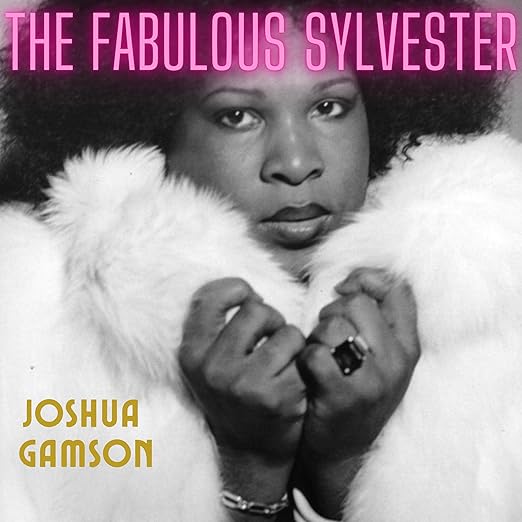
Sylvester James spent his childhood in a South Central Los Angeles church choir and ended his life as one of the most distinctive voices in the history of dance music. The Fabulous Sylvester, Joshua Gamson's audiobook biography of the disco sensation who sang in a dazzling falsetto, wore sequins without apology, and made the Castro district of San Francisco feel like the center of the universe for a generation of people who had never been allowed to be themselves before, is not a narrow music biography. It is a portrait of an era through the life of the person who embodied it most completely. Ron Butler narrates with an energy that honors the material: warm and celebratory where the story demands it, steady and present for the harder passages that the AIDS epidemic eventually requires of the narrative.
The Gospel Chorus Before the Cockettes
Gamson is a Yale-trained pop culture sociologist, and the combination of academic rigor and genuine love for the subject produces something unusual: a biography that can explain the cultural mechanics of why a Black gay man singing in falsetto became a superstar in a specific moment and place, while never losing sight of the fact that Sylvester himself was irreducibly himself, fabulous in ways that resist pure sociological explanation. The book traces him from the gospel chorus through his time with the Cockettes, the notorious theatrical troupe that became one of San Francisco's defining countercultural institutions, through his chart-climbing solo career and into the epidemic that took him in 1988.
Reviewer HE WHO FUNKS BEHIND THE ROWS, who read the book three separate times, described its capture of the times, people, and places that made Sylvester, San Francisco, the music, and the era such a golden and magical time, and that enthusiasm registers as genuine testimony to the book's ability to transport the listener. Reviewer Rosalind Ross, who attended the same Oakland church as Sylvester and met him personally, offered the more intimate verification: the book captures who he actually was, not just who he appeared to be on stage. Butler's narration carries this material with particular sensitivity in the church-to-stage trajectory that opens the biography, understanding the weight of what Sylvester was leaving and what he was moving toward.
Where Reality and Fantasy Overlap
At nearly twelve hours, this audiobook has the scope to do what Sylvester's story requires. The San Francisco sections, the Castro in the mid-1970s as a geography of liberation, the clubs and the community, the moment before the epidemic changed everything, are rendered with the kind of detail that makes you feel you are understanding a place and time rather than just hearing facts reported about it. Gamson's sociological training means that the larger forces shaping Sylvester's context are always in frame: what it meant for the gay liberation movement that this particular voice was also Black, what it meant for Black culture that this particular star was also openly gay, how the intersecting communities that claimed him navigated those tensions in real and sometimes painful ways.
The music itself is central, and Butler's narration of Gamson's descriptions of Sylvester performing makes a genuine case for seeking out the recordings after finishing the audiobook. The context that Gamson builds around the disco era, its relationship to liberation, its function as a space where identity could be performed differently from how the rest of the world required it to be, makes the recordings more meaningful than they would be encountered cold. Reviewer Melanie Gilbert, describing the space where reality and fantasy overlap that dance music creates, captures the quality Gamson gives to Sylvester's best work: he embodied a particular kind of freedom that the form made possible at a particular historical moment.
Gleeful Chaos in the Cockettes Chapters
The Cockettes material is some of the most vivid in the entire book, and it serves a structural function beyond its inherent entertainment. Sylvester's time with that theatrical troupe shaped his performance vocabulary in ways that his later mainstream success could not fully contain, and understanding where his stagecraft came from makes the career arc read differently than a simple rise-to-fame narrative would allow. Butler's narration finds the right pitch of gleeful chaos for these sections, which require energy without losing clarity.
Butler Slows Down for the Losses
The book does not shy from the AIDS epidemic's devastation or from the grief that attends the later chapters. The exuberance of the mid-book San Francisco sections intensifies the weight of what follows, and Gamson handles that tonal shift with genuine care. Listeners who come purely for the celebration of the disco era should know that the biography tells the full story, including its ending. Butler's narration navigates the shift in emotional register with appropriate gravity, slowing where the material requires slowness and never rushing through the losses to get back to the celebration.
The book is deeply place-specific in ways that listeners without familiarity with San Francisco's geography and political history may find slightly disorienting at moments. The Castro, the Fillmore, the neighborhoods of Sylvester's early Oakland life, these are given enough contextual explanation to follow, but listeners with existing knowledge of that geography and those histories will absorb the details more fully. The sociology sections, while never overwhelming the biographical narrative, do require sustained attention: Gamson is making arguments, not just telling stories, and those arguments reward engaged listening across the full twelve hours.
You Make Me Feel Mighty Real, Explained
This audiobook belongs in the collection of anyone interested in disco history, LGBTQ+ cultural history, the specific history of Black queer identity in American pop culture, or San Francisco in its most transformative decade. Music biographers, cultural historians, and readers whose tastes run to dual biography, one person whose life is also a window onto a larger era, will find Gamson's work exemplary. Listeners who know Sylvester primarily through You Make Me Feel Mighty Real and want to understand how that sound and that person came to exist will find the twelve hours genuinely rewarding in a way that has nothing to do with nostalgia and everything to do with understanding a fully realized human life. Butler's narration makes it an excellent pure listening experience even for those coming to the subject completely cold and without prior knowledge of the era.
Common Questions
Do you need to be familiar with Sylvester's music to appreciate this audiobook?
Not at all, though the book will almost certainly send you to his recordings afterward. Gamson provides enough musical context and description that listeners without prior knowledge of his catalog will understand his significance. Coming in cold often heightens the impact, the discovery of who Sylvester was lands with fresh force for those encountering him for the first time.
Is this audiobook more of a music biography or a cultural history of the 1970s?
Deliberately both. Gamson uses Sylvester's life as the organizing thread through a portrait of San Francisco's Castro district and the gay liberation movement of the 1970s. The biography is specific and detailed; the cultural history is wide-ranging. Listeners who want pure musical biography should know the book is always in conversation with larger social and political forces, and those conversations are among its most valuable passages.
How does Ron Butler handle the shift in tone when the AIDS epidemic becomes part of the story in this audiobook?
With consistent gravity and appropriate emotional weight. Butler maintains the warmth that characterizes the earlier sections without minimizing the devastation of the later ones. The tonal shift is one of the most demanding aspects of the narration, and he manages it without forcing the listener to absorb an abrupt break, the transition follows the book's own careful pacing through the change.
Is this audiobook appropriate for listeners who are new to LGBTQ+ history and culture?
Yes. Gamson writes accessibly for general audiences, and Butler's narration never assumes prior familiarity with the specific communities and cultural references that Sylvester inhabited. The book is an excellent entry point into the history it covers, the social context of Black queer identity in 1970s San Francisco, the role of disco in the liberation movement, the cultural geography of the Castro, precisely because it builds that context through one specific and extraordinary life.