Quick Take
- Narration: Dr. Kevin Hoffarth self-narrates with the measured, earnest authority of a physician who has genuinely lived through the clinical and personal experiences he describes; the self-narration is essential to the book’s credibility.
- Themes: Belief, stress, and subconscious perception as drivers of chronic disease, epigenetics and the mind-body connection, functional medicine’s missing chapter
- Mood: Thoughtful and quietly urgent, carrying both clinical precision and personal honesty
- Verdict: A rare functional medicine book that asks the deeper question beneath the lab results, where belief and physiology intersect is exactly the territory Hoffarth knows best, and his credentials make the argument land.
I finished this one on a Wednesday evening, having started it earlier that day on a long drive, and I found myself returning to a question one of the reviewers raises without quite naming: why does the same diet, the same sleep protocol, the same exercise regimen produce such different outcomes in different people? The answer Hoffarth offers is not mystical, but it is considerably more sophisticated than anything in the standard functional medicine playbook.
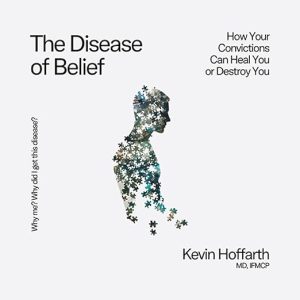
Dr. Kevin Hoffarth is an IFMCP, a certified practitioner through the Institute for Functional Medicine, and he narrates his own book. That combination, the clinical credential and the personal voice, is load-bearing for a text whose central argument requires you to trust the speaker’s authority while also believing in his humility about what he does not yet know.
Beyond the Protocol: What Standard Functional Medicine Misses
Hoffarth’s entry point is a question that will resonate with anyone who has gone through extensive testing, optimized every measurable biomarker, and still felt unwell: why? The Disease of Belief argues that modern medicine, including its more progressive functional medicine variant, tends to address the downstream expressions of chronic disease while remaining largely blind to its upstream origins in belief systems, stress responses, emotional patterns, and subconscious perception.
This is not a claim that diseases are imaginary or that positive thinking cures illness. Hoffarth is a physician with decades of clinical experience, and his argument is precisely the opposite of that: these psychological and subconscious factors influence physiology through real biological mechanisms, through the HPA axis, through inflammatory cascades, through the epigenetic modification of gene expression. The framework draws from neuroscience, epigenetics, functional medicine, and somatic therapy, and he is careful to indicate where the evidence is robust versus where it is emerging.
Biological Decoding and the Clinical Framework
Reviewer AIC’s reference to Biological Decoding is the most specific clinical content pointer in the available reviews, and it is worth unpacking. Biological Decoding proposes that specific types of psychological conflict correspond to specific types of disease through predictable biological pathways. It is a framework with some elements supported by emerging research on conflict-stress and disease correlates and others that remain contested in mainstream medicine. Hoffarth’s approach, as described by his reviewers, is to blend these ideas with real patient stories and his own clinical experience rather than presenting any single framework as definitively proven.
Reviewer David Smith, who describes himself as a patient of Hoffarth’s since 2021, offers a window into how the book functions in clinical context: as a philosophical and practical orientation for patients who are positioned as CEOs of their own health with the physician in a consultative role. That framing is deliberate and consistent with the book’s larger argument about the role of agency and belief in health outcomes.
Self-Narration as Clinical Authority
Five hours and twelve minutes is a workable runtime for this kind of material, and Hoffarth’s narration uses that time well. His delivery has the quality of someone explaining a complex clinical picture to a thoughtful patient, specific enough to be informative, patient enough to allow the ideas to land, and honest about the places where the map does not yet match the territory. The self-narration also means you are hearing a physician describe his own struggle, which reviewer Bethany identifies as one of the book’s distinctive qualities: the willingness to include personal vulnerability alongside clinical expertise.
Professional narration would deliver the same text more smoothly in some passages and would inevitably strip out the quality of earned knowledge that comes through when a practitioner speaks about their own clinical journey. That trade-off consistently favors self-narration for books of this kind.
The Reader This Book Is Looking For
Listeners who have pursued conventional medicine and functional medicine approaches without arriving at satisfying answers to their chronic symptoms will find this book addresses the question they have been carrying but perhaps not articulating. Hoffarth’s framing, that belief and subconscious pattern may constitute a missing chapter in the chronic illness story, is not comforting in the self-help sense, because taking it seriously requires looking at patterns that are uncomfortable to examine. But it is an honest extension of where the best functional medicine thinking is actually heading, and a physician willing to make that argument in print and read it aloud in his own voice is offering something genuinely unusual.
Frequently Asked Questions
Is Dr. Hoffarth arguing that chronic illness is psychosomatic in the dismissive sense, or is the mind-body connection he describes based in real biology?
The argument is grounded in real biological mechanisms including epigenetics, the HPA axis, inflammatory pathway regulation, and somatic stress responses. He is not suggesting illness is imaginary. He is arguing that the psychological and subconscious factors that influence these biological pathways are systematically underaddressed by both conventional and functional medicine.
What is Biological Decoding, and how central is it to the book’s framework?
Biological Decoding is a framework proposing that specific psychological conflicts correspond to specific disease patterns through biological pathways. It appears in the book as one component of Hoffarth’s integrated approach rather than as the entire argument. Some elements have support in stress-disease research; others remain contested. His reviewers suggest he presents it alongside patient stories and clinical experience rather than as established dogma.
Does the audiobook provide practical tools for patients, or is it primarily a philosophical argument?
Based on the reviewer descriptions, it includes both. The clinical framework is accompanied by practical orientation for patients, including positioning patients as primary agents in their own health with the physician in a consultative role. It is not a protocol book in the functional medicine sense, but it offers actionable perspective rather than pure theory.
Is the five-hour runtime appropriate for the depth of material covered, or does the book feel compressed?
The runtime appears well-matched to the scope. Hoffarth is not attempting to cover the entire field of psychoneuroimmunology but rather to make a specific and coherent argument about a gap in current chronic disease treatment. Five hours is sufficient for that argument when the writing and narration are both doing their jobs.