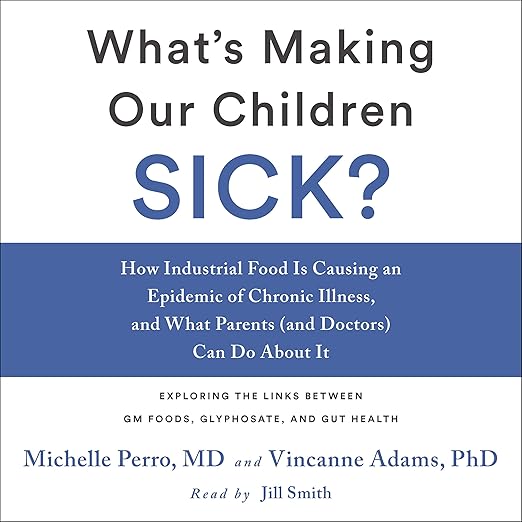
Quick Take
- Narration: Jill Smith reads with a clarity and composure suited to investigative health journalism, not alarmist in delivery, letting the data make the case.
- Themes: Agrochemicals and pediatric health, gut microbiome and chronic disease, food system politics
- Mood: Urgent and investigative, with the slow-building weight of a well-documented case
- Verdict: A serious, research-grounded investigation into industrial food production and pediatric chronic illness, rigorous enough to take seriously, though some conclusions remain actively debated.
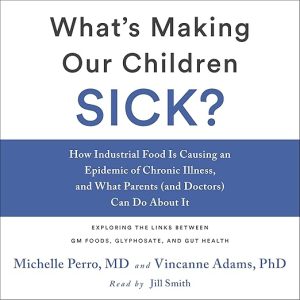
I finished What’s Making Our Children Sick? on a Saturday morning, the kind of morning where you have the house to yourself and the coffee is good and there’s enough quiet to actually think about what you’re hearing. That’s the right listening environment for this book, it makes claims that deserve careful consideration rather than distracted absorption, and it deserves the attention of a reader willing to follow an argument through its complexity rather than reaching for a verdict before the evidence is presented.
Dr. Michelle Perro is a pediatrician with decades of clinical experience in integrative medicine. Her co-author, Dr. Vincanne Adams, is a medical anthropologist at UCSF. Together they have written a book that connects the rise of chronic illness in American children, rates that the text accurately describes as epidemic, to the industrial transformation of the food supply, specifically to agrochemical use and genetically modified crops. This is not fringe territory. The questions being asked here are serious ones being asked in peer-reviewed literature as well as in this accessible trade book, and Perro’s clinical vantage point gives the argument a specificity that purely academic treatments sometimes lack.
The Gut Microbiome as Central Evidence
The section of this book that I expect will be most immediately useful to skeptical readers is the extended treatment of gut health and the microbiome. Perro and Adams argue that the connection between agrochemical exposure and pediatric chronic illness runs substantially through disruption of the gut microbiome, the complex ecosystem of bacteria, fungi, and other microorganisms that play a central role in immune function, neurological development, and metabolic regulation. This is an area where the science has advanced significantly in the past two decades, and the book’s treatment is current enough and careful enough to be taken seriously as a synthesis of existing evidence rather than as speculation.
The invocation of Rachel Carson’s Silent Spring as a predecessor is earned rather than rhetorical. Carson identified one chemical catastrophe; Perro and Adams are arguing that the agricultural response to that catastrophe has generated another. Pesticide use at an all-time high, despite the original promise of biotechnology to reduce pesticide need, this is the central irony they are working with, and they document it carefully through both clinical cases and structural analysis of the food system.
Jill Smith and the Documentary Register
Jill Smith’s narration is a good fit for material of this kind. She reads with the composure of a documentary narrator, steady and clear, allowing the information to make its own impact without adding urgency through performance. In a book making significant claims about public health, a narrator who lets the argument breathe is more credible than one who inflects toward alarm. Smith finds the appropriate register and holds it across the book’s considerable length.
The patient case examples that run through the book, clinical accounts of children with chronic digestive, neurological, and immune issues who improved on dietary changes that reduced agrochemical exposure, are read with the appropriate clinical specificity rather than sentimentalized. This matters for a book whose methodology explicitly draws on both the clinical and the political dimensions of this problem.
What to Know Before You Listen
What’s Making Our Children Sick? will be most useful to readers who come with genuine curiosity about the food-health connection and willingness to engage with contested terrain. The book presents a case, and it presents it rigorously. Some conclusions will remain disputed by other researchers and by agricultural industry representatives, and Perro and Adams are honest enough about the politics of food science to acknowledge this. This is not a simple anti-GMO polemic, it is a substantially more careful investigation than that framing would suggest.
Listeners looking for a quick guide to eliminating specific foods or supplements will be disappointed; that is not what this book is. What it offers is a framework for understanding why children are sicker than previous generations, drawn from both clinical practice and structural analysis of how the food supply has changed. For parents who have been told that their child’s chronic symptoms are manageable but mysterious, the framework this book offers, connecting food sourcing and gut health to a wide range of pediatric conditions, may be the beginning of a different kind of investigation. One reviewer, a teacher, describes “questioning both our medical resources and our food system” with increasing frequency. This book offers context and evidence for that questioning.
Frequently Asked Questions
Is this book anti-GMO, and should that affect whether I listen to it?
The book is more nuanced than a simple anti-GMO position. Perro and Adams’s central argument is about agrochemical use, specifically herbicides like glyphosate, and their effect on the gut microbiome, rather than GMO technology per se. They are critical of specific applications and the regulatory environment around them, but the argument is evidential rather than ideological. Readers across the GMO debate spectrum will find substantive material to engage with.
Does the book recommend a specific diet or supplement protocol?
Yes, and this is the clinical arm of the book. Perro draws on her integrative medicine practice to recommend a food-focused approach to treatment, including dietary changes that reduce agrochemical exposure and support gut health. The book does not read as a supplement sales vehicle, the recommendations are framed within the clinical context and draw on the preceding research. Listeners should bring their own physicians into any significant dietary changes, particularly for children with complex health conditions.
How current is the research cited in this book?
The book was published in 2017, which means some of the microbiome research it cites has been expanded or nuanced since publication. The core claims about glyphosate and agrochemical exposure remain areas of active scientific debate, and some findings referenced have received further support while others remain contested. It is worth supplementing with more recent research on any specific topic that is clinically relevant to your situation.
Is Jill Smith’s narration suitable for listeners who will be taking notes or returning to specific sections?
Smith reads clearly and at a pace that allows note-taking, but this is a dense investigative book and some sections, particularly those on gut microbiome mechanisms and the politics of food science regulation, benefit from being revisited. The print or Kindle edition will be easier to navigate for specific reference, while the audio version works well for the initial read-through and for the patient case narratives.