Quick Take
- Narration: Courtney Pinkerton delivers a clean, professional read that suits the clinical-meets-accessible tone Dr. Gray is aiming for, measured pacing, no unnecessary drama.
- Themes: biohacking and longevity, peptide science and dosing protocols, anti-aging and cognitive performance
- Mood: Methodical and optimistic, like a well-organized consultation with a forward-thinking physician
- Verdict: A solid entry point for anyone new to peptides who wants practical protocols without wading through academic papers, the PDF companion is a necessary addition to the listening experience.
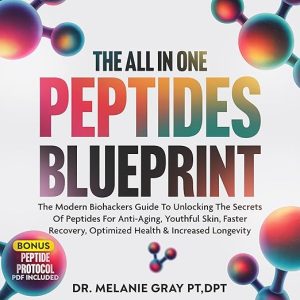
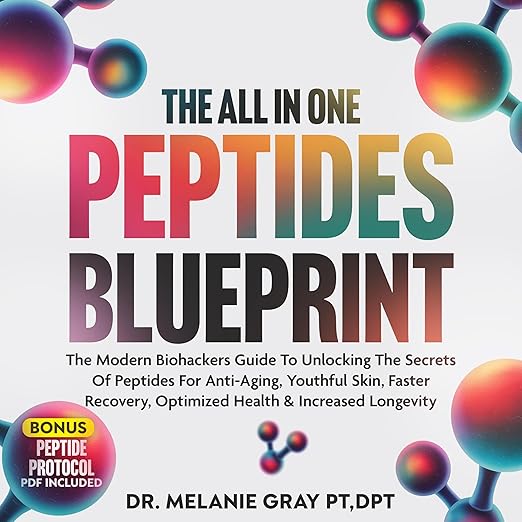
I started this one on a Tuesday morning with coffee, half-expecting the kind of breathless biohacking enthusiasm that promises you will feel twenty-five again by chapter three. What I got instead was considerably more restrained, and more useful for it. Dr. Melanie Gray writes about peptides the way a careful clinician explains a new treatment option: here is the mechanism, here are the realistic applications, here is what you need to monitor. Courtney Pinkerton reads it with the same composure.
Peptides sit in an interesting space in the wellness literature right now. They are genuinely backed by a growing body of research, widely available through compounding pharmacies and online suppliers, and almost entirely absent from mainstream health publishing. Most of what circulates online is either gym-focused optimization content or academic papers written for researchers. Gray’s book is attempting something in between, and largely succeeds.
What the Science Actually Supports
The most valuable section for anyone new to the subject is Gray’s explanation of how peptides function as signaling molecules, short chains of amino acids that instruct the body to do things it does naturally but with declining efficiency as we age. She distinguishes between peptides targeting different systems: BPC-157 for tissue repair and gut health, Ipamorelin for growth hormone secretion, Semax and Selank for cognitive function, variants targeting skin pigmentation and immune function. The distinctions matter, and Gray makes them clearly without collapsing into jargon.
Reviewer Trevor B. noted that the book is “refreshingly free of hype” and that description is accurate. Gray acknowledges what is well-supported by clinical research, what is promising but early-stage, and what remains poorly understood. That epistemic honesty is rare in the biohacking genre, where the incentive to oversell is considerable. The dosing protocols she provides are conservative and accompanied by genuine safety guidance, she is not encouraging people to inject whatever arrives in the mail without medical supervision.
The Audio Format and Its Practical Limits
A note about listening conditions: this is the first book in Gray’s Biohacking Books series, and the publisher has included a PDF companion in the Audible library alongside the audio. For a book structured around specific peptides, dosing schedules, and monitoring protocols, that PDF is not optional. It is essential. The information is navigable in audio form for a first pass, but if you intend to actually reference specific protocols, which is presumably the point, you will need the written companion to function as a working document.
Pinkerton’s narration handles the technical terminology competently. She does not stumble over peptide names or pharmacological terms, which is a baseline competence that is not always guaranteed in this genre. The pacing is appropriately measured, though at six hours the book occasionally feels like it covers some chapters in slightly more detail than others. The cognitive peptides section, which reviewer Julie N. cited as a particular strength, benefits from extra length; the chapter on beauty and skin applications feels comparatively lean.
Situating This in the Biohacking Genre
For context, the biohacking audiobook landscape includes everything from Peter Attia’s exhaustive longevity frameworks to quick-hit guides that amount to glorified marketing for supplement brands. Gray sits closer to the Attia end in terms of rigor while operating at a considerably more accessible level. She is not trying to replicate a clinical review, she is trying to give a motivated non-expert enough foundation to have an informed conversation with a knowledgeable physician.
That positioning is reasonable, and it defines who this book is actually for. The reviewer who bought it after hearing about peptides and finding the topic less complicated than expected captures the book’s strength precisely: Gray makes a genuinely complex biochemical subject navigable without dumbing it down to uselessness. With 58 ratings averaging 4.7, early listener response is strongly positive, though the relatively small review pool means the data is still accumulating.
Who Should Listen and Who Should Skip
Listen if: you have heard about peptides through fitness or longevity communities and want a credible overview before going further; you are considering peptide protocols and want to understand what you are working with; you appreciate a clinician’s measured tone over biohacking enthusiasm. Skip if: you want clinical-grade depth equivalent to a pharmacology reference; you are already well-versed in peptide science and looking for advanced protocols; you need visual charts and dosing tables that only work in print format.
Frequently Asked Questions
Does the book recommend specific peptides for specific goals, or is it purely educational?
Both. Gray covers the science of how peptides work generally, then organizes specific peptides by their primary applications, fat loss, muscle recovery, cognition, skin health, immune function. She provides dosing protocols and safety considerations for the most commonly used options, making it a practical guide as well as an educational one.
Is the PDF companion that comes with the Audible version actually necessary?
For understanding the material on a first listen, no. For referencing specific protocols, dosing schedules, and monitoring guidance in practice, yes. The book covers enough specific technical detail that having a written companion makes the information usable rather than just memorable in outline.
Does Dr. Gray address legal and access questions around peptides, given that availability varies by country?
The book acknowledges that peptide availability and regulation vary and recommends medical supervision for protocols. It does not provide jurisdiction-specific legal guidance. Listeners outside the US should verify availability and regulatory status independently before pursuing any protocols.
How does this compare to other biohacking audiobooks like those from Peter Attia or Dave Asprey?
Gray operates at a more focused and accessible level than Attia, who covers longevity comprehensively across multiple body systems. She is more clinically grounded than Asprey, who tends toward evangelism. Think of it as a focused introduction to one specific intervention rather than a comprehensive longevity framework.