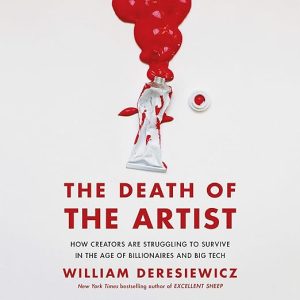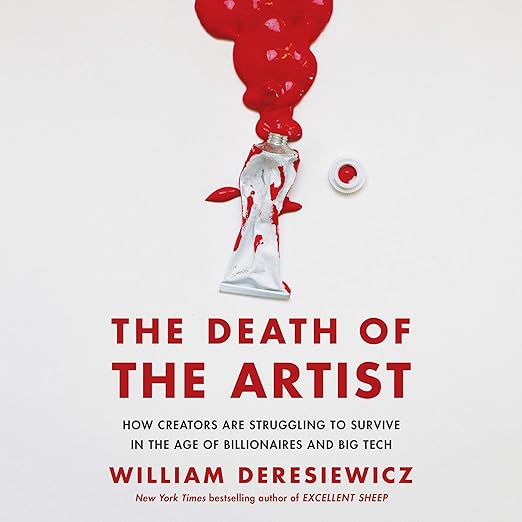
William Deresiewicz built The Death of the Artist from interviews with working artists across disciplines, including musicians, novelists, visual artists, and filmmakers, asking the question most cultural commentary skips: not whether art is flourishing in the digital age, but whether the people who make it can eat. The audiobook, narrated by Sean Patrick Hopkins across 13 hours and 55 minutes, arrives as a Macmillan Audio production and represents one of the more seriously researched entries in the crowded genre of books about creativity and the internet economy. Deresiewicz, whose earlier work Excellent Sheep drew wide attention, brings the same rigorous attention to institutional analysis here.
One of the book's more striking observations concerns the way the digital economy has effectively split artistic identity into two incompatible roles: the maker of the work and the marketer of the maker. Every serious artist Deresiewicz interviewed was spending substantial time on social presence, on building the audience that platforms require in order to surface the work at all, and the time spent performing artistic identity is time not spent developing it. Hopkins reads this argument with the cadence of someone who finds it genuinely troubling rather than merely analytically interesting, which is appropriate for material that has direct implications for anyone who has tried to maintain a sustained creative practice inside the attention economy. The recording's Macmillan Audio production quality supports the long-form argument throughout.
Hopkins Keeps Three Historical Phases Legible
Deresiewicz's central framework is historical rather than polemical, though the polemic is present. He traces the social role of the artist across three phases: the Renaissance artisan, whose work was commissioned and whose identity was craftsman; the nineteenth-century bohemian, whose artistic identity was constituted by rejection of commercial value; and the twentieth-century professional, whose university positions and foundation grants provided a buffer between artistic work and the market. The digital age, he argues, has dismantled the twentieth-century settlement without replacing it with anything coherent. Artists are now told to be entrepreneurs, to build brands, to develop audiences, to perform commercial functionality while somehow maintaining the aesthetic independence that artistic credibility requires. That double bind is the book's real subject.
Hopkins navigates the analytical sections with a clarity that keeps Deresiewicz's historical architecture legible across the full length. The shift from artisan to bohemian to professional to the emerging digital paradigm is a long argument, and Hopkins's pacing, never rushing the conceptual payoffs and never dawdling in the transitions, serves the structural ambition. The passages from artist interviews, which Deresiewicz weaves throughout, arrive in Hopkins's voice as clearly distinct from the analytical framing, which matters for a book this heavily dependent on the tension between theory and lived experience.
Musicians Who Made Streaming Work, and Those Who Didn't
The book's value is in the specificity of its research. Deresiewicz is not working from anecdote or think-piece; he interviewed artists systematically, across disciplines and income levels, and the range of responses to the digital economy's disruptions is considerably more varied than the prevailing narrative admits. Musicians who have made streaming work alongside musicians who have not and can explain precisely why. Visual artists who have leveraged social media alongside those who find the self-promotional imperative antithetical to the kind of sustained, private attention their work requires. That granularity separates the book from the hundreds of essays that cover this territory with less rigor.
For listeners who earn income from creative work, the book is both validating and practically useful: Deresiewicz does not offer a prescriptive solution, but the documentation of how other artists are navigating these conditions is more useful than most prescriptions. For listeners who consume art without making it, the book provides a vocabulary for understanding why the cultural landscape looks the way it does and what structural forces are shaping what gets made and what does not. Sean Patrick Hopkins renders the argument with consistent intellectual seriousness, which the material demands across nearly 14 hours.
Provincial Toward the Creator Economy
The book's publication date means some of its specific claims about platform economics and streaming royalties reflect conditions at a particular moment rather than the current situation. The audiobook listener who already follows music industry reporting will encounter claims about platform payout rates that may have shifted since publication. The structural argument holds regardless of specific figures, but it is worth keeping the publication context in mind when evaluating particular data points.
Deresiewicz also writes from a perspective more sympathetic to the traditional art-world model than to the creator-economy alternatives. His skepticism about the gig-economy framing of artistic work is substantiated by evidence, but listeners who have built sustainable creative businesses outside the legacy infrastructure may find his orientation occasionally provincial. The interviewees provide some counterbalance, but the selection and framing reflect an author fundamentally concerned with the conditions that sustained mid-century artistic production rather than the conditions of whoever is thriving today outside those structures.
More Content, a Decreasing Number Who Can Support It
Essential for working artists of any discipline who want a rigorous analysis of the structural conditions they are navigating rather than another book about hustle and platform strategy. Strong for readers interested in cultural economics who want evidence-based analysis rather than trend-piece commentary. Useful for anyone who has noticed that the digital age seems to produce an increasing volume of content alongside a decreasing number of people who can support themselves making it, and wants to understand why that contradiction exists and whether it is resolvable. Less rewarding as a first introduction for listeners who want accessible personal memoir-style engagement with the artist's life; this is research and argument rendered as such by Hopkins throughout the full runtime.
Key Details
- Performance: Sean Patrick Hopkins matches Deresiewicz's analytical precision without flattening the emotional urgency of the argument, keeping 13 hours of cultural economics from becoming a lecture.
- What it covers: The digital economy's effect on artistic livelihoods, the transformation of artistic identity from bohemian to content creator, platform capitalism and cultural value
- Feel: Urgent and rigorous, with the controlled frustration of someone who has done the reporting and does not like what it shows
- Our call: Deresiewicz's research-backed argument about art's viability in the digital age is one of the more serious audiobooks on this subject and earns its 13-hour length.
Is this audiobook more pessimistic or more practical about artists' prospects in the digital economy?
More analytical than either, though the research tends toward structural pessimism about the mid-career artist who wants institutional support. Deresiewicz documents the range of strategies artists are using without declaring a winner, and acknowledges that outcomes are highly variable by discipline, market, and individual circumstance.
Is this audiobook current enough to address the creator economy and major streaming platforms, or is its frame primarily the early digital era?
The book addresses the structural conditions of the platform economy more than specific platforms, which gives it more durability than a platform-specific analysis would have. Some specific data points reflect the publishing moment, but the framework for understanding what the digital disruption actually did to artistic livelihoods applies beyond any single platform generation.