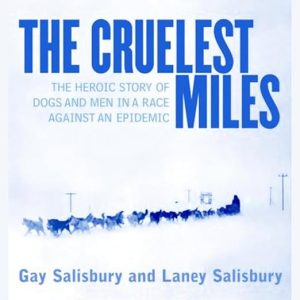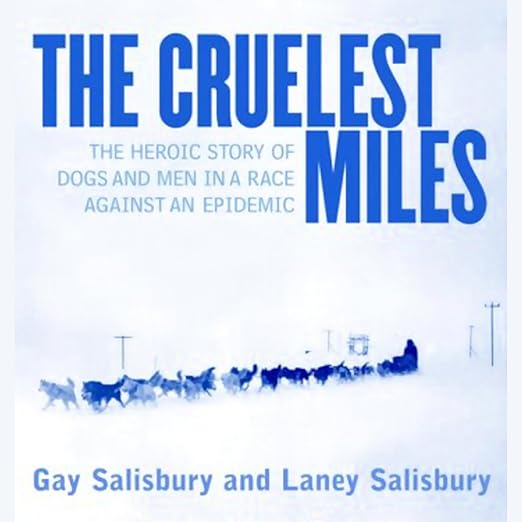
Nome sat seven hundred miles from the nearest railhead in January 1925, cut off by mountains, an icebound port, and a stretch of frozen sound no plane of that era could safely cross. Gay Salisbury opens The Cruelest Miles by boxing her subjects into that isolation before she even introduces the diphtheria outbreak threatening the town's children, a structural choice that does real work: readers feel the geography as a trap before they understand what is trapped inside it. Barrett Whitener narrates this nine-and-a-half-hour audiobook with the same measured, unhurried delivery the structure rewards, never rushing toward the relay before the stakes are fully set.
The craft decision that holds the whole book together is sequencing: rather than starting with Balto crossing the finish line into Nome, the moment most readers already associate with this story thanks to the Central Park statue, Salisbury builds outward from the town's isolation, then the outbreak, then the relay itself, leg by leg, musher by musher. That patience pays off in the middle third, where the book essentially becomes a relay in prose, cutting between drivers and dog teams the way a film editor would cut between simultaneous action. It is a smart structural echo of its own subject matter.
Worth noting for anyone who only knows the Balto version of this story: the real hero of the final, most dangerous leg was arguably Togo, the lead dog under musher Leonhard Seppala, who covered a far longer and more treacherous stretch of the run than Balto's shorter final leg into town. Salisbury gives this correction real space rather than treating it as a footnote, and it is one of the more satisfying threads in the book for listeners who grew up with the more famous, simplified version of events.
The synopsis's own blunt line, airplanes cannot fly, is not throwaway color. Aviation in 1925 was still primitive enough that open-cockpit biplanes could not reliably operate in extreme Arctic cold: engines seized, fuel lines froze, and pilots faced real risk of frostbite and disorientation at altitude. Salisbury uses that technological limit to explain why the relay had to fall to dog teams at all, turning what could read as a quaint historical detail into a genuine structural necessity within the story.
Why Listen to The Cruelest Miles
The reason to choose this one over a shorter retelling is texture. Salisbury does not just narrate the relay; she reconstructs 1925 Alaska in enough physical and political detail, the limits of aviation technology at the time, the isolation of frontier telegraph lines, the fragile relationship between Nome and the outside world, that the desperation of the serum crisis feels earned rather than assumed. Reviewer Wayne A. Smith puts it plainly: the book 'weaves a lot of background into a story,' which is accurate and, based on the strength of the finished result, a compliment rather than a complaint.
A second reason is the human-and-animal partnership at the center of the book, which reviewer Linda L. Oliphant highlights after visiting Alaska and finding herself, in her words, 'captivated with each dogsled ride.' The relay depended on the specific judgment of Alaska Native mushers and their teams reading terrain, ice, and whiteout conditions no outsider could navigate safely, and Salisbury credits that expertise directly rather than treating the dogs as the whole story and the drivers as incidental.
The modern legacy is worth knowing going in: the Iditarod Trail Sled Dog Race, still run every year across roughly similar Alaskan terrain, exists partly in commemoration of this 1925 relay. Listeners who only know the Iditarod as a contemporary endurance sport get real value from hearing the specific emergency that gave the route its symbolic weight, turning an abstract piece of sports trivia into a fully reconstructed historical event with real stakes and real losses.
What to Watch For in The Cruelest Miles
This listing tags the book under sports-outdoors and Winter Sports, which undersells what is really narrative history with a strong claim on modern mushing and the Iditarod's founding mythology. Listeners hoping for a straightforward sports book, stats, standings, competitive framing, will find something denser and more somber: a public health emergency with real fatalities on both ends, not a race run for glory.
Worth flagging too: this listing credits only Gay Salisbury, though the book's original edition was published under two names, Gay Salisbury and her co-author Laney Salisbury. Nothing about the text itself suggests an abridgment; at nine hours and thirty-five minutes it comfortably matches a full nonfiction narrative of this scope, but listeners cross-checking editions should know the byline here is incomplete.
One data quirk worth flagging: this listing shows a 4.7 rating attached to a single rating count, even though three full written reviews appear alongside it. That mismatch is likely a metadata quirk rather than a meaningful signal, but it means the numeric score should be weighted lightly; the substance of the three reviews, all detailed and specific, is a more reliable guide to quality than the star average alone.
Who Should Listen to The Cruelest Miles
This is a strong fit for readers of narrative survival history, adventure nonfiction in the vein of well-researched disaster-and-rescue journalism, and anyone who has ever traced the Iditarod route on a map without knowing the outbreak that inspired it. It also rewards listeners who came to the story through Balto's statue or the animated film and want the fuller, more accurate version of events.
Skip it if you want a tightly focused animal-adventure story without the surrounding history; the political and logistical context, while genuinely well handled, means the relay itself does not begin until well into the book. Listeners most interested in dog-sled racing specifically, rather than the public health emergency that prompted it, may find the first third slower going than the propulsive back half.
One small note on language: this listing's own synopsis uses period terminology, 'Eskimo drivers,' for the Alaska Native mushers at the center of the story, language that would likely be handled differently in a book written today. The book treats their expertise and heroism with real respect throughout, by every account in the attached reviews, but listeners sensitive to dated terminology in nonfiction published in the early 2000s should know it may surface in the text itself.
- Narrator: Barrett Whitener favors restraint over melodrama, letting frostbite, exhaustion, and a ticking clock supply tension on their own.
- Subjects: Survival, human-and-animal partnership, wilderness endurance
- Tone: Tense, cold, and propulsive once the relay begins
- Bottom line: The 1925 serum run holds up as tightly researched narrative history, best suited to listeners who want their adventure stories true.
Questions Listeners Ask
How long is The Cruelest Miles audiobook?
Nine hours and thirty-five minutes, covering the full political and historical context around the 1925 serum relay, not just the dogsled race itself.
Is The Cruelest Miles connected to the Balto statue in Central Park?
Yes, it tells the full story behind that statue, and specifically corrects the record on Togo, the lead dog whose leg of the relay was arguably more dangerous than Balto's.
Does this audiobook explain the medicine behind the diphtheria crisis, or just the dogsled relay?
Both; Salisbury spends real time on the outbreak itself and the serum shortage before the relay narrative takes over.