Quick Take
- Narration: Kitty Jay carries Eunhee Park’s memoir with restraint and precision, she does not perform suffering but conveys it, which is exactly right for material this serious.
- Themes: North Korean totalitarianism, survival and flight, the cost of choosing freedom
- Mood: Harrowing and ultimately hopeful, told without sentimentality
- Verdict: A concentrated, devastating memoir of escape from North Korea that earns its four and a half hours entirely, essential for anyone trying to understand what life inside the DPRK actually costs.
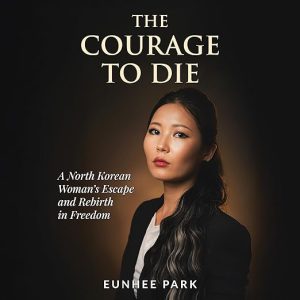
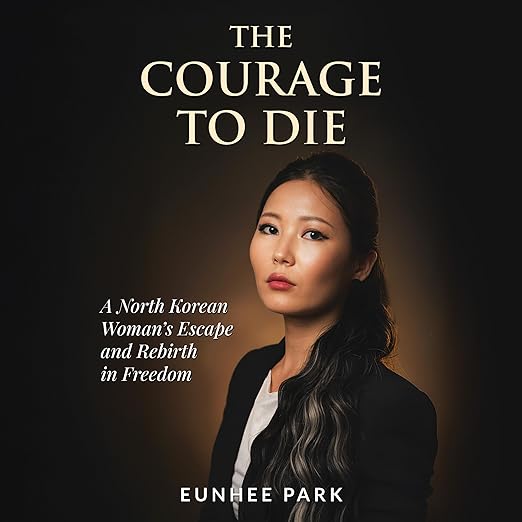
There is a particular kind of testimony that resists embellishment, not because the writer lacks craft, but because the facts themselves are so extreme that any ornamentation would feel dishonest. The Courage to Die belongs to that category. Eunhee Park’s account of growing up in a North Korean orphanage, crossing into China under conditions that exposed her to violence and exploitation, and eventually reaching freedom is not a story that needs dramatic heightening. It arrives with enough weight already.
I finished this one on a Sunday afternoon when I had intended to listen for maybe forty minutes. I listened through to the end. The four-hour-and-thirty-six-minute runtime is at once a mercy, because this material is genuinely hard to absorb, and a constraint. The story Park is telling could sustain something twice as long, and there are passages where I wanted more time with a particular person or moment before the narrative moved on. What is here, though, is complete and cohesive in the way that only a writer who has lived through something can make it.
What the Orphanage Years Taught
The first half of the book covers Eunhee’s childhood: divorced parents, a mother lost to mental illness, and eventual placement in a North Korean orphanage where survival required learning to perform loyalty to a system while preserving something private and true inside. This section does something that much North Korean escape memoir either skips or rushes. It takes the indoctrination seriously as an experience rather than merely as an obstacle to freedom. Park describes what it felt like to believe things she was taught, to be genuinely shaped by a worldview she would later reject, and the cognitive dissonance of beginning to doubt while having no framework for doubt. This is the kind of interior honesty that distinguishes testimony from polemic.
Her grandparents anchor the story. The disabled grandfather and the strong-willed grandmother are drawn with genuine specificity, not idealized, but real. Park credits them with the strength and curiosity that eventually made escape possible, and the book returns to them as an emotional touchstone even as the narrative moves into the dangerous journey through China. Their presence gives the memoir a human center that is not just Eunhee’s suffering but her formation. It also means the book carries loss on multiple registers simultaneously: the loss of a country, the loss of the people she left behind, and the loss of a version of herself that the regime had been constructing since childhood.
The China Crossing
The journey through China is where the book becomes most difficult and most important. Park does not spare the reader the specifics of what she endured: sexual abuse, hunger, the constant threat of capture and forced repatriation to North Korea. The brevity of the prose in these sections is its own kind of horror. Park describes events that would fill chapters in a less controlled memoir in a few concentrated sentences, and the restraint communicates the dissociation of survival. You write it quickly because dwelling on it is not how you survive it.
The treatment of the brokers, the safe houses, and the defectors’ network that Park relied on is handled carefully: specific enough to be credible, general enough to protect people still operating in dangerous circumstances. For listeners who want to understand the mechanics of North Korean escape, the route from the DPRK across the Tumen River and into northeastern China, and what happens to defectors who are caught and returned, this book provides a ground-level account that policy documents and journalistic overviews cannot match. Reviewers consistently use words like grit, tenacity, and determination: not the generic language of endorsement but genuine responses to someone whose decision to leave required abandoning everyone she had ever known, permanently.
Kitty Jay’s Restraint as a Virtue
Kitty Jay is a very good match for this material. The memoir requires a narrator who can convey suffering without performing it, and Jay’s approach is one of controlled clarity: steady pacing, tonal variation used to mark emotional shifts without dramatizing them, and the kind of attentiveness that makes individual sentences carry their full weight. She handles the Korean names with care, and the passages describing North Korean propaganda slogans are delivered with the flat, slightly hollow quality they deserve, as if Jay understands that these phrases are meant to sound hollow when heard clearly. The 4.8 rating across 111 reviews suggests that listeners consistently find this a successful listening experience, which tracks: Jay’s performance is most visible in what it does not do.
How to Approach This Book
This is not a book to start and put down. It is short enough that it asks to be heard in a sitting or two, and the emotional architecture depends on that continuity. Listeners who want a comprehensive history of North Korea’s political system should pair this with Michael Seth’s academic history. Listeners who want the experience of what survival inside and outside that system actually costs should come here first. The book does not argue a position about geopolitics or offer policy prescriptions. It presents a life, and lets the listener arrive at their own conclusions about a state that produces these stories with appalling regularity.
Frequently Asked Questions
Is this primarily a political analysis of North Korea or a personal memoir?
It is entirely a personal memoir. Eunhee Park does not take analytical detours into North Korean history or policy. The political context emerges organically through what she experienced and witnessed, which makes it more powerful as testimony than as political education.
How graphic is the account of abuse and violence during the China crossing?
Park describes sexual abuse and the constant threat of violence clearly but without gratuitous detail. The emotional weight is conveyed through controlled prose rather than explicit description. Most listeners will find it disturbing rather than exploitative, which reflects Park’s calibration of how much to show.
Does the memoir follow Park’s story beyond her escape, into her life after reaching safety?
The book focuses primarily on her childhood and the escape journey. The closing sections give some sense of what came after, but the emphasis is on the ordeal rather than the reconstruction, which makes the title’s reference to courage feel grounded in specific events rather than retrospective framing.
Does Kitty Jay’s narration work for a first-person memoir by a Korean author?
Yes. Jay handles the cultural specificity of the material with care, and the restraint in her performance is appropriate for a memoir that does not sentimentalize its own suffering. The match between narrator and material is one of the book’s quiet strengths.