Quick Take
- Narration: Imani Jade Powers delivers a controlled, measured performance suited to a book that is itself controlled and measured. She handles the analytical passages with clarity and the portrait sections with appropriate gravity, a strong professional match for the material.
- Themes: The structural failure of the Oslo peace process, the gap between diplomatic technique and political reality, the delusions of all parties to the conflict
- Mood: Candid and at times disheartening, the account of people who understood the obstacles and watched them prove insurmountable regardless
- Verdict: An insider post-mortem on the Israeli-Palestinian peace process that offers something genuinely difficult to find elsewhere: candid portraits of negotiating parties from people who were in the room. Essential for anyone trying to understand how three decades of effort produced October 7.
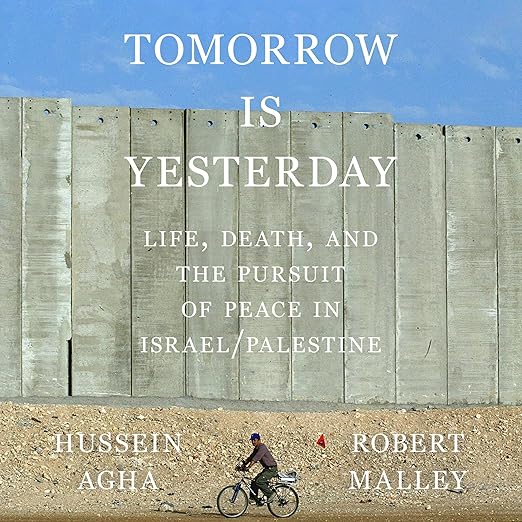
I came to Tomorrow Is Yesterday having read the standard accounts of the Oslo process, the optimistic histories from the 1990s, the post-mortems from Camp David 2000, the subsequent recriminations. What I was not prepared for was how differently the story looks when told by people who were advising Yasser Arafat and Mahmoud Abbas on one side and Bill Clinton, Barack Obama, and Joe Biden on the other, and who are willing to say that all three parties were operating under delusions that made failure structurally inevitable regardless of tactical decisions. That willingness to assign failure across the board rather than to any single actor is what makes this book unusual and worth serious attention.
Hussein Agha and Robert Malley are not neutral observers. Agha has advised the Palestinian leadership for decades; Malley served as a senior official in three Democratic administrations, most recently as Biden’s Special Envoy before his departure from government in 2023. Their experience gives them access to private conversations and negotiating dynamics that no outside analyst can reconstruct. But it also means their account is not fully transparent about the limits of their own participation or the decisions they were party to. The book apparently acknowledges this in part, and the reviewer who notes that the authors deserve credit for holding all three parties accountable has identified the book’s most important quality.
Oslo’s Promise and Its Structural Failures
The book’s central argument, as described by both its synopsis and its most substantive reviewer, is that the two-state solution became a global consensus only after it was no longer viable. That is a painful claim because it suggests that the failure of the peace process was not primarily a matter of bad timing, missed opportunities, or the wrong leaders being in power, but rather that the structural conditions for a durable settlement had already eroded by the time the international community committed fully to the framework. The gaps separating Israelis and Palestinians, the authors argue, have less to do with territorial allocation than with history and emotions, which means that technical negotiating schemes were always addressing the wrong problem.
This is a sobering framework, and it is worth noting that it is contested. Critics of this position argue that the conflict was solvable at specific moments, particularly in 2000 and 2008, and that one or more parties walked away from viable deals for tactical reasons that could have been overcome. Agha and Malley apparently push back on that narrative from their own direct experience at those negotiations, and the insider credibility they bring to that pushback is real even if their conclusions remain debatable.
Portraits of the Principals
One of the book’s most distinctive features is the candid portraits of leading figures including Arafat, Abbas, Clinton, Obama, and Biden. Insider accounts of political negotiations tend to flatten individuals into their public roles, and a book that actually describes the decision-making psychology of these figures from close observation is genuinely scarce. What Agha and Malley apparently offer is not gossip but analytical portraiture: how these people understood their own positions, what they feared, where they were operating under delusions, and how those internal dynamics shaped the negotiating dynamics they participated in.
The one substantial critical review here, rated at three stars, acknowledges that the authors hold all parties accountable but suggests the honesty is only partial. That reviewer’s point, that the authors served as negotiators on opposite sides and may have limited transparency about their own role in the failures they describe, is a legitimate methodological concern. Memoir and analysis are always in tension when the analysts were also participants, and readers should hold that tension in mind throughout.
October 7 as Historical Reenactment
The book’s most striking analytical claim, that Hamas’s onslaught and Israel’s war of destruction were not historical exceptions but historical reenactments, is the kind of framing that provokes strong reaction regardless of where the reader’s sympathies lie. It implies that October 7 and what followed were predictable from the structure of the conflict, not aberrations but logical outcomes of how the situation had been allowed to develop. Whether that interpretation is defensible or whether it inadvertently flattens moral distinctions is something readers will evaluate on their own terms. It is, at minimum, a serious analytical claim that deserves serious engagement rather than dismissal.
Who Should Listen and Who Should Skip
Anyone trying to understand the history of the peace process from the inside should listen to this. It is a ten-and-a-half hour investment that provides something unavailable elsewhere: the perspective of people who were actually in the negotiations, willing to be honest about the failures of their own side as well as others. Listeners who want a single-perspective account that validates their existing view of who is responsible will find this more complicated than they may expect, and more useful for it.
Frequently Asked Questions
Is this book primarily a memoir, a policy analysis, or something between the two?
It is explicitly both. Agha and Malley are drawing on their direct experience in negotiations while using that experience to make analytical arguments about why the process failed. The memoir elements, candid portraits of Arafat, Abbas, Clinton, Obama, and Biden, serve the analytical argument rather than being ends in themselves.
Does the book take a political side in the conflict, or does it genuinely hold all parties accountable?
The most substantial reviewer notes that the authors hold all three parties, Israelis, Palestinians, and Americans, accountable for the failure, and describes this as the book’s distinctive quality. The three-star reviewer qualifies that praise by noting the authors’ own involvement in the process creates potential blind spots. The consensus seems to be that the accountability is real but not unlimited.
The book was published after October 7, 2023. Does it read as a retrospective explanation of how that happened?
Explicitly so. The book opens with October 7 and the question of how the hopes of Oslo became what the authors describe as the horrors of the present. The claim that Hamas’s attack was a historical reenactment rather than an exception is the book’s most controversial framing, but it places the event within a structural analysis of the conflict rather than treating it as inexplicable.
How does Imani Jade Powers’s narration handle the analytical and political complexity of the material?
Powers delivers a measured, controlled performance that matches the book’s register. This is not a book that calls for dramatic narration, and she handles the analytical passages with appropriate seriousness. Her pacing gives the material room to land without rushing through complex arguments. The match between narrator and material feels well-considered.