Quick Take
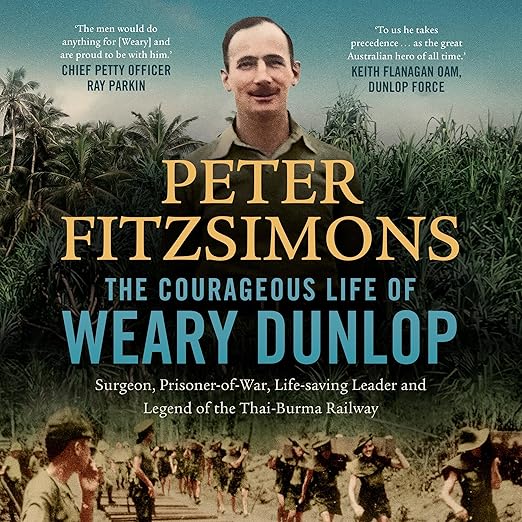
- Narration: Peter FitzSimons narrating his own biography of Dunlop is the obvious and correct choice, though his theatrical investment occasionally overreaches the subject it celebrates.
- Themes: Medical courage under occupation, POW survival on the Thai-Burma Railway, Australian resilience and leadership
- Mood: Cinematic and emotionally demanding, with FitzSimons writing at full scale across twenty-one hours
- Verdict: A thorough and deeply felt account of one of Australia’s most remarkable figures, best suited to listeners who want the full story rather than a compressed summary.
There are Australian figures who exist in the national consciousness as symbols before they exist as people, and Weary Dunlop is one of them. The surgeon who kept his men alive on the Thai-Burma Railway, who placed his body between Japanese bayonets and bedridden patients at Bandoeng, who performed operations with inadequate supplies under physical and psychological conditions that most people cannot begin to imagine: Dunlop has been mythologized in the way that Australians mythologize a specific kind of quiet heroism. Peter FitzSimons’s task in this biography is to give the myth back its human dimensions without diminishing what the myth is pointing at.
He largely succeeds, across twenty hours and fifty-two minutes that move from Dunlop’s rural Victorian childhood through his amateur boxing and rugby careers, his decision to pursue medicine rather than sport, his wartime service in the Middle East covering Palestine, Greece, Crete, Egypt, and Tobruk, and finally to the years on the Thai-Burma Railway that made him a national legend. The scope is ambitious, and FitzSimons is a writer who believes in comprehensive coverage. If you want the full arc of Dunlop’s life, not just the POW years but everything that prepared him for them, this is your audiobook.
The Railway Years and Why They Demand Detail
The sections covering Dunlop’s time as a prisoner of the Japanese are the emotional core of the book, and FitzSimons gives them proportional weight. The death toll from tropical disease, malnutrition, and overwork on the railway construction was staggering, and Dunlop operated in conditions that should have made surgical care impossible. He improvised, he argued with his captors, he took beatings to protect patients he couldn’t afford to lose, and he kept records: detailed medical records that constituted an act of resistance as much as a clinical practice. Those records eventually became evidence of war crimes. FitzSimons reconstructs this period with the granularity it deserves, and this is where the book’s twenty-hour investment most clearly pays off for the listener.
FitzSimons’s Characteristic Voice and Its Costs
The reviewer who called this a “cinematic masterpiece” is not wrong, though the word cinematic flags something worth naming. FitzSimons writes biography as if it were adapted for the screen, with dramatic scene-setting, heightened emotional beats, and a clear sense of the protagonist’s heroism at every stage. That approach produces deeply readable biography, but it can occasionally make the subject feel like a character performing for the audience rather than a person being documented. The reviewer who gently noted that “the author is not the main character” is responding to the same tendency: FitzSimons’s voice is present in ways that a more detached biographer’s would not be. His passion for Dunlop is genuine and infectious, but it requires twenty hours to sustain, and some listeners will find the pitch tiring before the final chapters.
Self-Narration at Scale
FitzSimons narrates his own work, which is the right choice for reasons beyond convenience. His enthusiasm for Dunlop is audible and real, and it carries the long stretches of operational military history that might otherwise flatten. The theatrical quality that one reviewer mildly criticized, noting you can hear him acting the words out, is the same quality that makes Dunlop’s defiance of the Japanese bayonets feel present rather than historical. Whether that trade-off works depends on your expectations. Listeners who prefer restrained narration may find him too much across twenty-one hours. Listeners who want to feel why this man became a legend will find FitzSimons is exactly the voice for it.
This is a book for listeners who want to understand not just what Dunlop did on the Railway but who he was before it and what he became after: a person whose courage was not situational but dispositional, built from a specific combination of physical toughness, intellectual rigor, and ethical commitment that his entire life before the war had been quietly constructing. FitzSimons understands that, and at his best moments in this biography, he makes you understand it too.
The book’s final sections, covering Dunlop’s post-war life, his advocacy for POW survivors, his medical career, and his role in Australia’s national memory of the Railway, are handled with the same thoroughness as the wartime chapters. FitzSimons doesn’t treat the war as the end of Dunlop’s significance. He shows how a man shaped by extreme circumstances chose to use his reputation not for personal advancement but for the welfare of the men who had survived alongside him. That continuity of character, before the war, during it, and after it, is what FitzSimons is really documenting, and it’s what makes this more than a war book. Those final chapters are less dramatic than the Railway sections, but they are essential for understanding why Dunlop became a symbol that stuck rather than a temporary wartime hero who faded when the conflict ended.
Frequently Asked Questions
Do I need to know anything about the Thai-Burma Railway before listening?
No prior knowledge is required. FitzSimons provides context for the Railway’s construction, the scale of the prisoner of war labor force, and the conditions imposed by the Japanese military command. The background is integrated into the narrative rather than presented as a separate section, which makes the story accessible to listeners without specialist WWII knowledge.
How does FitzSimons handle the Japanese military’s actions, and is it balanced?
FitzSimons is writing from the perspective of Allied prisoners and does not present the Japanese military’s actions sympathetically. The treatment is historically grounded in documented events, and the critique of conditions imposed on POWs is supported by the medical records Dunlop kept. Some readers seeking a more balanced account of the Pacific theater may find the frame limiting, but as biography of a prisoner of war, the alignment with the subject’s experience is appropriate.
Is there a shorter account of Weary Dunlop’s story available?
Dunlop’s own wartime diaries, published as The War Diaries of Weary Dunlop, give direct access to his voice and perspective without FitzSimons’s mediation. For listeners who want to understand the man alongside the narrative, reading the diaries after or alongside this biography is worth considering. FitzSimons’s work is the comprehensive modern biography; the diaries are the primary document.
How does this biography compare to Sue Ebury’s earlier Weary: The Life of Sir Edward Dunlop?
Ebury’s biography remains the standard scholarly account, based on extensive archival research and interviews. FitzSimons’s version is more accessible, more dramatically written, and has the advantage of being contemporary, but Ebury’s is the more rigorous biography. For listeners who want the definitive scholarly record, Ebury is the starting point. For listeners who want to be moved by the story at full cinematic scale, FitzSimons is the choice.