Quick Take
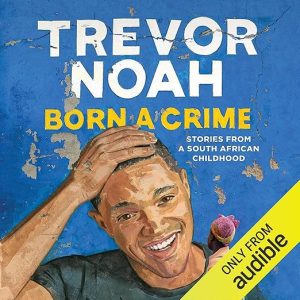
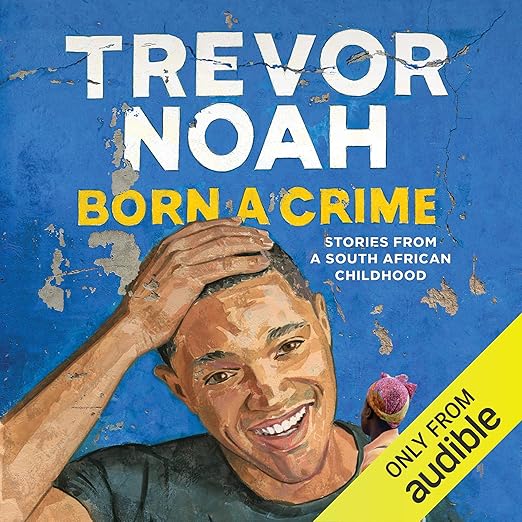
- Narration: Trevor Noah narrates his own memoir with extraordinary range, voicing characters in English, Xhosa, and Zulu and shifting between comedy and grief with total control, this is among the best self-narrated audiobooks in the memoir genre.
- Themes: Race and identity under apartheid, mother-son devotion, survival through humor
- Mood: Warm and urgent, funny and quietly devastating
- Verdict: Noah’s performance is the whole point, reading this one on the page would cost you the thing that makes it unforgettable.
I came to Born a Crime later than most. By the time I finally loaded it on a long train ride from Paris to Lyon, Trevor Noah had already been hosting The Daily Show for years, and the cultural moment around this book felt like it had passed. Within twenty minutes, I understood why it had never really passed at all. Noah’s voice filled the compartment through my headphones, switching from English to Xhosa mid-sentence, and I sat up straighter and forgot entirely where I was going.
This is a memoir about growing up mixed-race in South Africa during the final years of apartheid and its aftermath, a child whose very existence was a criminal act under the Immorality Act. But the book refuses to be defined by its historical context alone. It is, at its core, a portrait of one of the most vivid mother-son relationships I have encountered in contemporary nonfiction.
Our Take on Born a Crime
What distinguishes this memoir from hundreds of celebrity coming-of-age stories is the specificity and the honesty of the world Noah constructs. He does not soften the poverty, the violence of his Soweto neighborhood, or the psychic damage of being told by your society that you should not exist. The episode where his mother throws him from a moving van to save him from gangsters, which opens the synopsis, is not played for shock. It becomes a lens through which Noah shows us exactly who Patricia Nombuyiselo Noah is: a woman so fierce in her faith and love that she turns even danger into a demonstration of will.
The narration is the indispensable element. Noah received the Audie Award for Best Male Narrator in 2018, and listening, you understand immediately why. His command of accents and languages is not a party trick. When he performs his grandmother’s Zulu or slips into the cadences of township slang, you feel the texture of a community that most Western listeners will never encounter firsthand. Reviewer after reviewer notes that his mother steals the show through her son’s voice, which tells you everything about how fully Noah inhabits these people rather than merely describing them.
Why Listen to Born a Crime
There is a specific quality to autobiographical audio that printed text cannot replicate: the intimacy of hearing someone decide, in real time, how much weight to place on a word. Noah uses that intimacy brilliantly. A chapter about learning to hustle pirated CDs becomes a small master class in economics and survival. An account of his mother being shot by his stepfather arrives without warning and without melodrama, which makes it land far harder than if it had been staged. The comedy is real, the chapter involving a mishap at a Pentecostal church service had me laughing aloud in public, and the grief is real too, and neither cancels the other out.
Listeners who come hoping for the story of how Noah became the host of The Daily Show will find that story absent. As multiple reviewers note, the memoir ends before his comedy career begins. This is not a flaw. It is a choice that makes the book more, not less, coherent: Noah is writing about becoming himself, not about becoming famous.
What to Watch For in Born a Crime
Pay attention to the structural decision to move between historical context and personal narrative. Each chapter opens with a brief essay on some aspect of South African history or society, apartheid’s logic of racial classification, the role of language as a tool of division, and then drops into memoir. This rhythm is deliberate. Noah is showing you the scaffolding of the world before placing himself inside it, so that the personal stakes feel grounded in something real rather than abstracted into feel-good uplift.
The portrait of Patricia Noah is worth your full attention. She is stubborn, sometimes reckless, deeply faithful, occasionally infuriating, and rendered with a love so undefended it feels almost dangerous. Reviewer Susan Parker’s observation captures it well: this book is ultimately a tribute to his mother. That is accurate, but incomplete. It is also a reckoning with what it costs to be raised by someone that relentless about survival.
Who Should Listen to Born a Crime
This audiobook is for listeners who want memoir that earns its laughter and does not flinch from its darker material. It works equally well for those with no prior knowledge of South African history, Noah is a generous explainer without being condescending, and for those who already know the context and want to see it rendered through a personal lens. Fans of Tara Westover’s Educated or Jeannette Walls’s The Glass Castle will recognize the particular alchemy of a difficult childhood examined without self-pity.
Listeners who want a conventional celebrity memoir with showbiz anecdotes and name-dropping will be surprised. This is something more grounded and more durable than that.
Frequently Asked Questions
Does the audiobook include Trevor Noah performing in languages other than English?
Yes. Noah narrates in English throughout but voices characters in Xhosa, Zulu, and Afrikaans, switching accents and registers fluidly. This multilingual performance is central to the listening experience and is the primary reason the audio format is considered superior to the print edition.
Does the memoir cover Noah’s rise to hosting The Daily Show?
No. The book focuses on his childhood and adolescence in South Africa, ending before his comedy career takes off internationally. Multiple reviewers note this, and Noah addresses it directly, a follow-up memoir covering his later years is expected at some point.
Is this audiobook appropriate for younger listeners or classroom use?
It is rated for mature audiences due to violence, including a shooting, descriptions of abuse, and frank discussion of racial and sexual topics. Some younger reviewers report using it as an assigned school text and finding it educational, but parents should preview it before assigning to younger teens.
Why does the synopsis mention his mother throwing him from a moving van at the start?
That incident opens the book as a prologue and is one of several episodes used to establish his mother’s character. Noah uses it not as shock value but to immediately introduce Patricia Noah’s defining trait: a willingness to take any action, however extreme, to protect her son and her faith.