Quick Take
- Narration: Maggi-Meg Reed handles the dual register of scientific biography and military history with impressive range, keeping the technical oceanographic passages accessible without oversimplifying.
- Themes: Women in wartime science, Pacific theater WWII history, oceanography as military intelligence
- Mood: Propulsive and deeply researched, reading more like narrative nonfiction than academic history
- Verdict: An absorbing recovery of a genuinely forgotten figure whose work shaped the outcome of the Pacific War; Musemeche makes the science legible and the stakes visceral.
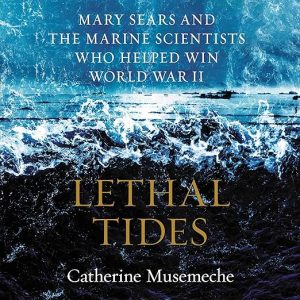
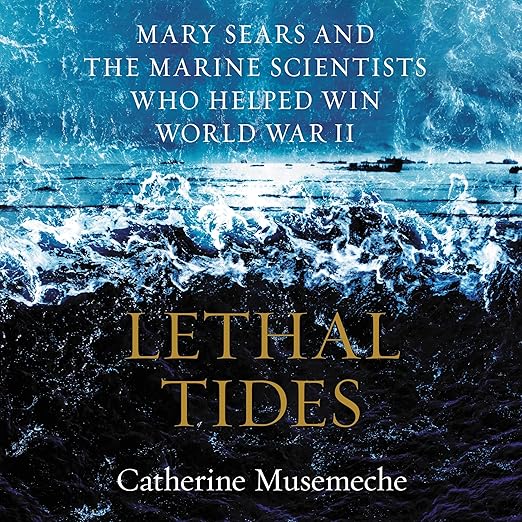
I started Lethal Tides on a Sunday afternoon planning to listen for an hour. I finished it late that evening, which is the kind of thing that tells you more about a book than most formal criticism can. Catherine Musemeche has done something that should be straightforward but is actually quite difficult: she’s taken a story that is simultaneously about marine biology, military logistics, amphibious warfare tactics, and one woman’s career, and made all four of those threads not just comprehensible but genuinely urgent.
Mary Sears, the book’s subject, was a marine biologist who became what Musemeche calls the first oceanographer of the Navy during World War II. Before the war, the U.S. Navy had almost no systematic knowledge of the Pacific Ocean’s tidal patterns, reef structures, surf conditions, or bioluminescent zones. That knowledge gap wasn’t an inconvenience. It was a potential catastrophe for every amphibious landing the island-hopping strategy required. Sears and her team of marine scientists built the intelligence infrastructure that made those landings survivable.
Our Take on Lethal Tides
What Musemeche gets right that distinguishes this from military history as a genre is her insistence on showing the science as science. Sears wasn’t just a woman who happened to be useful to the Navy. She was a serious marine biologist whose specific expertise, the behavior of ocean currents, tidal patterns, submarine hiding zones, directly shaped where and when amphibious forces could land with any chance of success. The Tarawa disaster, referenced in the synopsis, happened in part because the Navy didn’t have adequate intelligence about reef structures and tidal timing. Sears’s team existed specifically to prevent that kind of catastrophic failure from repeating. Musemeche connects those dots clearly.
The reviewer bonnie_blu noted how this book adds to the growing body of WWII history that recovers contributions from women, minorities, and overlooked perspectives. That’s accurate, and Lethal Tides is one of the better entries in that category because it doesn’t simply assert that Sears mattered. It demonstrates exactly how her specific outputs, the middle-of-the-night tidal calculations for last-minute landing decisions, the bioluminescence zone maps that helped submarines hide, shaped specific outcomes at specific moments in the war. That level of specificity is what separates biography from hagiography.
Why Listen to Lethal Tides
Maggi-Meg Reed is a strong choice as narrator for this material. She handles the scientific vocabulary, and there is substantial oceanographic vocabulary here, with the clarity that allows non-specialist listeners to follow without feeling left behind. She also navigates the shift between the documentary sections, Sears’s career arc and team dynamics, and the dramatic military action sequences without losing the thread of either. Admiral McRaven’s blurb calling this magnificently researched and noting it reads like an action novel is accurate. Musemeche paces the military history sections with genuine narrative urgency. The Okinawa buildup, the last major battle of the Pacific war, reads with real tension even though you know the outcome.
FloridaGal’s review captures something important: prior to Musemeche’s research, most of the information about what Sears’s unit actually did was classified or simply uncollected. The fact that this story hadn’t been told in book form before 2022 is genuinely surprising given the scale of the contribution. An interested reader’s review noted that Musemeche truly brought Sears and her colleagues to life, which is the hardest thing to do in biography: not just recover the facts of someone’s career but make them present as a person.
What to Watch For in Lethal Tides
The book weaves together Sears’s biography with the broader history of American oceanography and the specific military campaigns she supported. That structure occasionally requires the listener to hold several threads simultaneously, particularly in the middle section where the scientific team-building happens in parallel with major Pacific battles. The audio format handles this reasonably well because Reed’s narration maintains the tone distinctions between the science sections and the military action sections, but listeners who want a clean chronological narrative may occasionally feel the structure demanding.
The oceanographic detail is genuine and occasionally technical. Musemeche doesn’t simplify the science to the point of inaccuracy, which means some passages require close attention if you want to follow the specific mechanisms she’s describing. Most listeners will find this rewarding rather than frustrating, but it’s not a passive listen.
Who Should Listen to Lethal Tides
Readers interested in WWII history who want a perspective they almost certainly haven’t encountered before will find this essential. People interested in the history of women in science and the military will get a richly documented example of how that history gets lost and recovered. Listeners looking for narrative nonfiction that genuinely moves at pace will find Musemeche delivers. This is not a book for those who want only combat history or only biography: it’s strongest when both threads are active simultaneously, which is most of the runtime.
Frequently Asked Questions
How technical does the oceanographic science get in Lethal Tides?
There is genuine scientific content around tidal prediction, ocean current analysis, coral reef mapping, bioluminescence, and submarine depth zones. Musemeche explains these clearly for general readers, but the book doesn’t shy away from specifics. It’s accessible science writing rather than simplified summaries.
Is Mary Sears the only focus, or does the book cover the broader team of marine scientists?
Both. Sears is the central figure, but Musemeche gives substantial attention to the team of marine scientists Sears assembled, often described as quirky, and the institutional dynamics of the Navy’s Hydrographic Office where they worked. The team portrait is part of what makes the book rich.
Does this book require existing knowledge of Pacific War history?
No, but familiarity helps. Musemeche provides context for the key campaigns, Tarawa, Okinawa, and others, but she doesn’t provide a comprehensive WWII history. Listeners with some background in the Pacific theater will connect the military sections more readily, though the essential context is always present.
How does Maggi-Meg Reed handle the shift between scientific biography and military action narration?
Reed handles the tonal shift well, maintaining both the measured quality needed for scientific explanation and the urgency the combat sequences require. At eleven-plus hours, the pacing holds across the full runtime.