Before You Press Play
- At its heart: Parenting sensitive children, building genuine resilience, language and confidence
- Vibe: Practical and reassuring, without false optimism
- Short version: A focused, guilt-free guide for parents of cautious or anxious children who want tools they can apply today.
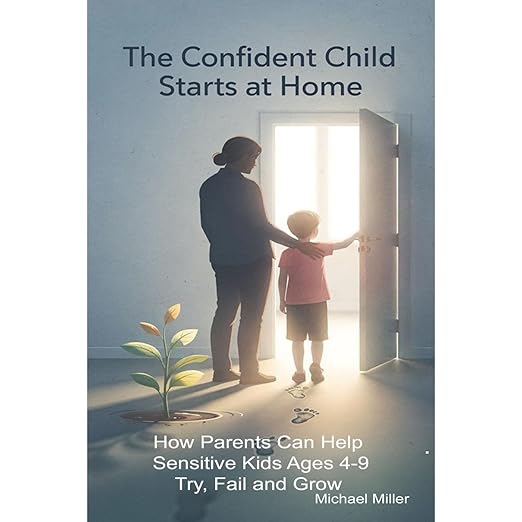
Parenting advice audiobooks tend to fall into two frustrating camps: the ones that catastrophize your child's anxiety until you feel like a crisis responder, and the ones that offer such breezy reassurance that nothing actually changes. The Confident Child Starts at Home by Michael Miller attempts something more disciplined than either - a short, practical guide aimed specifically at parents of sensitive children aged four to nine, focused not on fixing the child's personality but on building the kind of small-moment confidence that accumulates into something real. At two hours and twenty minutes, this audiobook is the length of a commute and a half, which is exactly its ambition: a guide you can absorb quickly and start applying the same week.
Miller's framing is the most important thing he gets right. Sensitive children, he argues, do not need to be toughened up or pushed toward a generic bravery that does not fit their temperament. They need a path to confidence that works with their sensitivity rather than against it. That reframe is not new - it echoes work by Elaine Aron on highly sensitive people and more recent parenting research on temperament-based approaches - but Miller applies it practically and specifically, without the academic scaffolding that can make those source texts feel inaccessible to an exhausted parent looking for something useful on a Tuesday evening.
What to Say Instead of Just Be Brave
The structure of this audiobook is what distinguishes it from comparable parenting titles. Miller organizes his guidance around specific situations - school, social settings, extracurricular activities, moments of mistake and failure - rather than around psychological theory. Each section offers concrete language: what to say when your child refuses to try something new, what to say instead of "just be brave," how to let a child struggle without either rescuing them or abandoning them to sink entirely. That specificity is valuable. A lot of parenting books tell you what the goal is without telling you what the words are.
The synopsis is transparent about the book's target audience: it is written for parents of cautious, anxious, or highly sensitive children aged four to nine. That specificity is both a strength and a limitation. The strategies here are calibrated for that developmental window, and parents of older children - or children whose challenges fall outside the anxiety and sensitivity spectrum - will find less direct application. Miller does not pretend to cover more ground than he does, which I respect. Too many parenting guides try to be universally applicable and end up uselessly vague as a result.
The narrator for this title is identified as Virtual Voice, which means the audio is AI-generated rather than performed by a human reader. At two hours and twenty minutes, the shorter runtime means any limitations in that delivery are less likely to fatigue the listener than they would be in a longer work. The content is structured enough - clear chapter divisions, specific numbered strategies - that the absence of a human narrator's emotional nuance is less costly than it might be in a memoir or narrative nonfiction title. That said, parents who find AI narration distracting should know this upfront, as the listening experience will differ from a recorded performance.
A Guilt-Free Case for Confidence Over Fearlessness
The audiobook format serves this material reasonably well. Parenting guides are often consumed in fragments - during commutes, while doing dishes, in the car - and this title's short runtime and chapter-based structure make it easy to pause and return without losing the thread. The practical language focus also benefits from audio delivery: you can hear the actual phrasing of what to say to a struggling child, which makes it easier to internalize than reading the same words silently on a page.
Miller explicitly frames this as a guilt-free resource, and that framing matters. The book repeatedly tells parents that they are not doing something wrong by having a sensitive child, and that the goal is not to produce a fearless child but a confident one - a child who can feel afraid and try anyway, who knows mistakes are survivable. That distinction between fearlessness and confidence is genuinely useful and underlies most of the book's practical strategies.
The age-specific guidance for children four to nine is one of the more thoughtful design choices. Developmental differences between a four-year-old and a nine-year-old are significant, and Miller distinguishes between age groups rather than treating the entire range as a monolith. Parents of younger children and parents of children approaching the upper end of the range will both find relevant material.
AI Narration Still Lacks a Parent's Warmth
This title has no published ratings or reviews at time of writing, which means listeners are working without the benefit of community feedback. That does not mean the content is poor, but it does mean less information is available about how the strategies land in practice, what the reading level feels like across the full runtime, or how the narration holds up across chapters. Approaching it with the understanding that it is a newer release with limited peer signal is wise.
The Virtual Voice narration is the most significant caveat for audio listeners. AI narration has improved considerably but still lacks the warmth and expressiveness of a skilled human narrator, particularly in parenting content where tone carries as much weight as information. Parents who are sensitive to that difference may prefer the print edition for full engagement with the material.
Miller's framework will resonate most with parents who already approach sensitivity as a temperament trait rather than a problem to eliminate. Parents looking for behavioral intervention techniques, clinical frameworks for anxiety disorders, or approaches calibrated to children with diagnosed conditions may find the scope of this book too general for their specific situation.
For Parents of Cautious Children Ages Four to Nine
This audiobook is well suited to parents of cautious, hesitant, or deeply feeling children in the four-to-nine age range who want practical, immediately applicable guidance rather than theory. It works well as a quick-listen resource for busy parents who cannot commit to a longer work. Those who need clinical specificity around anxiety diagnoses, or who prefer human narration, should supplement this with other resources or opt for the print edition.
Frequently Asked Questions
Is this audiobook appropriate for parents of children outside the four-to-nine age range?
Miller calibrates his strategies specifically for that developmental window, so parents of toddlers or preteens will find less direct application. The core philosophy around sensitive temperament and confidence-building is broadly relevant, but the specific language and situation-based guidance is designed for the four-to-nine range.
How does the Virtual Voice narration affect the listening experience of this audiobook?
AI narration handles structured, practical content like this more competently than it handles narrative or memoir, where emotional inflection matters more. The short runtime at two hours and twenty minutes also reduces fatigue from any stiffness in the delivery. That said, parents who find AI narration distracting or cold may prefer the print version for this kind of warm, relationship-focused content.
What specific situations does this audiobook cover for building child confidence?
Miller addresses school situations, social interactions, extracurricular activities, and the critical moments around mistakes and failure. He provides concrete language for each scenario, what to say, what not to say, and how to calibrate the balance between supporting a child and allowing productive struggle.