Quick Take
- Performance: Virtual Voice handles Carroll's declarative framework prose clearly, though the motivational closing passages lose the energy a human narrator would bring.
- What it covers: structured professional dialogue, persuasion under pressure, documentation discipline
- Feel: Methodical and directive
- Our call: A compact communication framework audiobook for professionals who want repeatable tools rather than another theory-heavy treatment.
Clarity Is Control, Structure Is Power
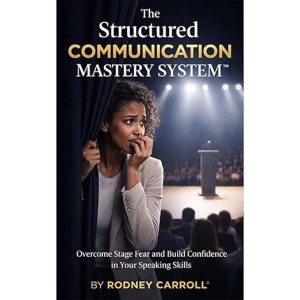
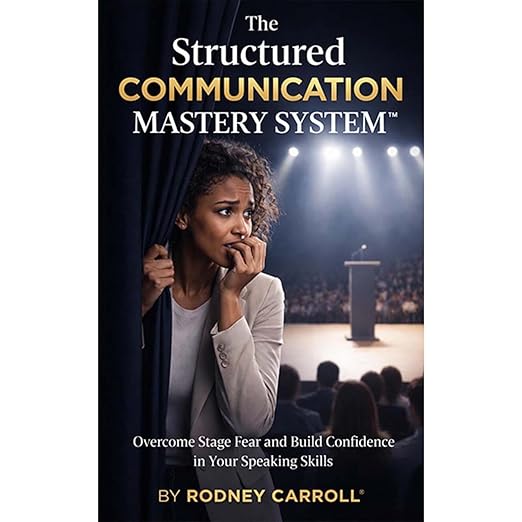
Rodney Carroll's premise is stated with unusual directness early in this audiobook: clarity is control, structure is power, communication is leverage. These three axioms are not offered as aspirations but as the load-bearing framework of everything that follows. The Structured Communication Mastery System is a fifty-five-minute precision framework designed to teach listeners how to organize thoughts before speaking, control conversations under pressure, present arguments clearly and with authority, and document their own positions in ways that carry formal weight in professional and administrative contexts. Carroll is clearly a practitioner, not an academic, and the book reflects that orientation at every level of its construction. He does not spend significant time building theoretical scaffolding before arriving at actionable content; each chapter introduces a model, explains its components, and demonstrates application in a real-world scenario. That compression is the book's defining feature and its primary value proposition.
The craft of the writing lies in its precision. Carroll's language is declarative and deliberate, which suits both the subject matter and the format. An audiobook about structured communication that itself models structured communication is doing something that many self-help productions fail to achieve: demonstrating its thesis through its own form. The decision to keep the runtime at fifty-five minutes rather than padding the material to meet some conventional length expectation reflects the same discipline Carroll is prescribing for his readers.
Why the Audiobook Beats Reading These Frameworks
The case for the audiobook over the print edition rests on the nature of the content. Communication models are meant to be internalized aurally, the way a speaker rehearses them, rather than studied from a printed page. Hearing the frameworks delivered in order, with their step-by-step breakdowns rendered as spoken instructions, allows the listener to absorb them as patterns of speech rather than as abstract structures on a page. For professionals who will use these frameworks in spoken contexts, listening is the more transferable preparation.
Carroll distinguishes his approach from what he calls theory-heavy communication books, and that distinction is meaningful. A great deal of communication literature spends considerable time on personality frameworks, psychological models of conflict, or the neuroscience of dialogue before arriving at tools. Books like Crucial Conversations, influential as they are, require a significant investment in theory before the practical applications emerge. Carroll shortcuts all of that. His focus on practical execution means that each chapter's content can be tested immediately after the listen, which is the appropriate use case for this kind of professional skill development. The Virtual Voice narration handles this declarative, framework-based content adequately. AI narration tends to perform better with structured instructional material than with narrative fiction, because the emotional range required is narrower, and Carroll's language is direct enough that the flatness AI voices sometimes introduce does not obscure the argument. The motivational closing passages are the weakest point, where a human narrator's energy would add more lift, but the instructional core is clear throughout.
Documentation as a Communication Discipline
The most distinctive element of Carroll's system is his emphasis on documentation as a communication discipline. Most frameworks focus exclusively on in-the-moment delivery: what you say, how you say it, how you manage the other party's responses. Carroll extends this to include how you record your own positions after the conversation, which is particularly relevant for professionals in legal, compliance, or administrative contexts where the documentation of what was communicated and when can have formal consequences. This thread runs through several chapters and represents the most practically differentiated part of the book relative to general business communication titles that focus purely on live delivery.
Carroll's treatment of persuasion without aggression is also worth close attention. He frames this as a skill distinct from negotiation or debate, centered on delivering your argument in a way that the other party can act on without feeling coerced or maneuvered. The specific language patterns he recommends in this section benefit from a second listen, because the phrasing he prescribes is precise enough to be worth memorizing rather than paraphrasing. Professionals in leadership roles where direct reports regularly push back, or in client-facing roles where the cost of perceived aggression is relationship damage, will find the most immediate application of this section. The systems approach Carroll takes, building each framework on the previous one rather than presenting them as independent tools, means the book rewards listening in sequence rather than jumping to the sections that seem most immediately relevant.
Built for High-Stakes Legal and Negotiation Settings
Working professionals who need a compact communication toolkit they can absorb and apply immediately are the ideal audience. The approach works particularly well for listeners who operate in high-stakes environments: legal proceedings, corporate negotiations, administrative hearings, or leadership positions where the quality and precision of communication has measurable consequences. Carroll explicitly designs for individuals who operate in complex environments, and that specificity of audience is accurate rather than aspirational. The documentation emphasis makes it especially useful for anyone whose professional communications may need to withstand later review.
Listeners expecting depth of research, extended case studies drawn from named organizations, or a narrative through-line will need to look elsewhere. At fifty-five minutes, the book cannot provide those things and does not attempt to. Its value is in compression: a working system for professional communication, delivered at pace, with enough framework clarity to allow immediate application. Those who learn by doing and want to test a new approach the next day will find Carroll's directness more useful than a longer, more theoretically elaborate treatment. It is not the only communication book worth reading, but it is the one most likely to change something about how you speak before the week is out.
At only 55 minutes, does this audiobook actually cover enough ground to be useful?
Carroll designed the book for compression, and the short runtime is a feature rather than a limitation. Each chapter delivers a usable framework rather than extended analysis, making it suitable for listeners who want immediate application.
How does the Virtual Voice narration affect the experience of this structured instructional audiobook?
AI narration handles this type of declarative, framework-based content more competently than narrative fiction. The argument is easy to follow throughout, and the flatness in the narration only becomes noticeable in the more motivational passages rather than in the instructional core.