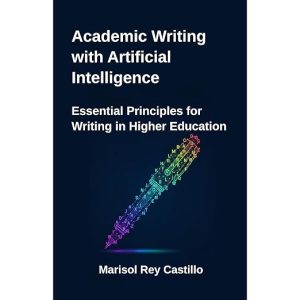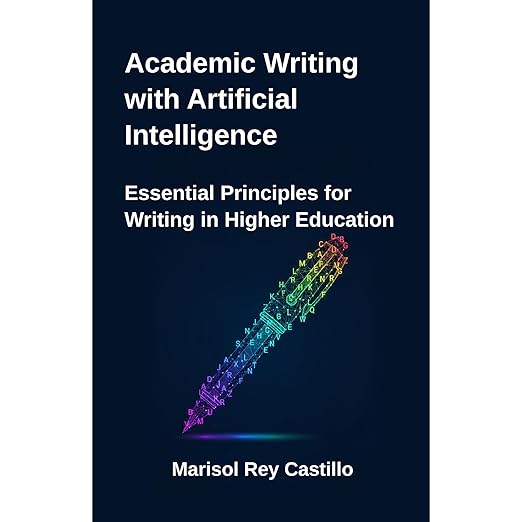
Marisol Rey Castillo's guide to writing with artificial intelligence in academic contexts arrives in this audiobook at a moment when most of the available literature on AI and writing falls into one of two unsatisfying categories: uncritical celebration of tools that generate text for you, or blanket prohibition from institutions still working out what academic integrity means in an AI-saturated environment. Academic Writing with Artificial Intelligence takes a third position that is both more demanding and more useful than either of those defaults.
The core argument is that integrating AI into academic writing is legitimate and even valuable, provided the student maintains something Castillo calls academic judgment. That phrase is the book's load-bearing concept. Castillo is not arguing for a set of rules about when AI use is acceptable. She is arguing for the development of an internal capacity to make informed decisions about when and how to use AI without surrendering authorship or analytical responsibility. That distinction, between following rules and developing judgment, is the most interesting thing about the book and the thing that separates it from more procedural guides on the same topic.
The audiobook is structured around the writing process itself: planning, organizing ideas, constructing arguments, drafting, and revising. Each stage receives its own treatment, and within each, Castillo identifies specific ways AI can function as what she calls cognitive support without replacing the writer's own thinking. She is careful to distinguish between using AI to expand your thinking, scaffold your structure, or check your reasoning and using AI to generate the thinking itself. The distinction might seem obvious stated plainly, but Castillo demonstrates through practical guidance how easily the line blurs in practice and how you can stay on the right side of it.
The narrator here is a Virtual Voice, which is the one significant caveat to recommend alongside the audiobook. Castillo's prose is clear and direct, but it has a philosophical register in its more reflective passages, particularly when she writes about intellectual identity formation and what it means to develop a voice through the act of writing. A Virtual Voice narration captures the semantic content of those passages but not their texture. Listeners who find the narration flat in these sections would not be wrong to supplement with a physical read of the more conceptual chapters.
Grounded in Research From International Universities
The book is grounded in recent research and draws on frameworks developed by international universities working through the same AI-in-education questions that Castillo addresses. That research grounding gives the guidance more authority than the personal-opinion approach that dominates much of the public conversation about AI and writing. Castillo is not telling you what she thinks. She is synthesizing what the evidence suggests about how academic writing competence develops and what role AI can play in that development without undermining it.
The book is explicitly designed for students in higher education, and that specificity is a strength. Castillo does not try to address every context where AI writing assistance is used. She focuses on the university setting, on the specific intellectual work that higher education is meant to develop, and on the particular risks and opportunities that AI introduces into that context. The focus makes the guidance more actionable than broader treatments of the topic would be.
Academic Writing as a Conversation With a Field
The section on intellectual authorship is the most philosophically ambitious passage in the audiobook and worth close attention. Castillo argues that learning to write academically is not primarily about producing correct texts. It is about forming an intellectual identity, learning to take positions, build arguments, and engage with ideas in a way that positions you as a thinker among other thinkers. That framing changes how AI assistance looks. If the point of academic writing is identity formation, then delegating the thinking to AI is not just a rule violation. It is a self-defeating move that undermines the development AI was supposed to support.
The revision chapters are also practically strong. Castillo's suggestions for using AI in the revision process, checking argument structure, identifying logical gaps, testing counter-arguments, are among the most immediately usable guidance in the book. These sections have the closest relationship to actual student writing practice and the clearest implementation advice.
The book also addresses the relational dimension of academic writing with more honesty than most AI guides manage. Castillo argues that academic writing is always a conversation with a field, with prior scholarship, and with a community of inquiry. AI assistance that replaces that conversation rather than supporting it does not just risk academic dishonesty. It deprives the student of the actual intellectual experience that higher education is designed to provide. That framing gives the book's guidance a pedagogical depth that distinguishes it from the compliance-focused discussions that dominate most institutional conversations about AI and academic integrity.
Eight Hours for Students Navigating AI Ethically
University students wrestling with how to use AI tools ethically and effectively in their coursework will find this audiobook directly useful. Instructors and course designers thinking through how to frame AI use in their assignments and syllabi will also benefit from Castillo's framework, which is more sophisticated than the blanket permission or prohibition policies most institutions are currently offering. If you are looking for a step-by-step guide to specific AI tools or a review of available software, this is not the book. Castillo stays at the level of principle and process. But for anyone who wants a serious intellectual framework for navigating AI assistance in academic writing without losing their own voice, this is a substantive and well-grounded guide.
Key Details
- Narration: Virtual Voice narration handles the instructional prose adequately but lacks the nuance to convey the more philosophical passages on intellectual authorship.
- Themes: AI as cognitive support, academic judgment, intellectual identity formation
- Mood: Clear and methodical, with an undercurrent of genuine pedagogical urgency
- Verdict: A serious and original contribution to the AI-in-education conversation, most valuable for students navigating AI use in higher education without wanting to lose their own voice.