Quick Take
- Narration: Rory Young brings a brisk, authoritative delivery that keeps the insurance terminology from becoming soporific, which is no small achievement across 12-plus hours of coverage.
- Themes: Life and health insurance, property and casualty licensing, test-taking strategy
- Mood: Purposeful and efficient, structured for retention under time pressure
- Verdict: A well-structured dual-exam audio companion that delivers on its core promise of covering both Life and Health and Property and Casualty content in a single, field-accessible format.
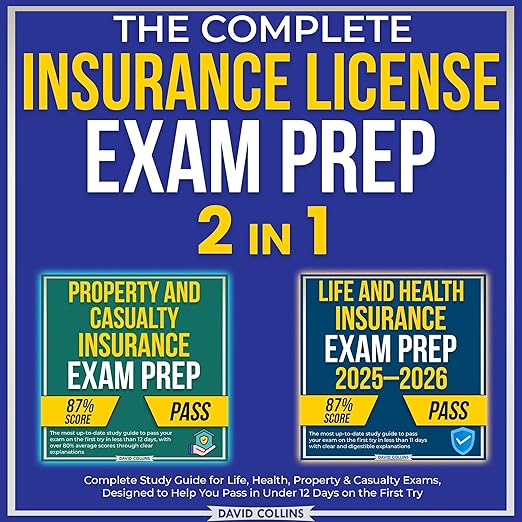
I have a soft spot for exam prep audiobooks that are honest about what they are. Not every study resource needs to be a profound listening experience. Sometimes the goal is to help you pass a licensing exam so you can start your career, and the clearest path to that goal is structured, repeated, well-paced audio you can absorb during a commute or between appointments. David Collins’ two-in-one insurance license prep guide is exactly that kind of product, and within its category it does what it promises.
The insurance licensing landscape is specific and consequential. Life and Health and Property and Casualty are typically separate licensing tracks in most states, requiring separate exams. Passing both opens significantly more career options than holding a single license, and the time investment is roughly doubled. A study resource that covers both tracks in a single twelve-hour package makes a genuine scheduling argument for busy candidates who are trying to complete their preparation quickly.
The Dual-Track Structure and How It Holds Up
The guide covers the two major exam tracks sequentially, spending roughly equal attention on each. The Life and Health section addresses life policies, annuities, health plans, Medicare coverage, disability income, underwriting principles, and the regulatory and ethical framework that governs insurance practice. The Property and Casualty section covers homeowners, auto, commercial lines, liability, risk management, and workers’ compensation.
Rory Young’s narration is a significant asset here. Insurance content is technically dense, and the terminology, particularly in the health insurance and commercial liability sections, can create comprehension friction even for listeners with some background in the field. Young delivers the material with enough pace variation to signal which content requires close attention and which is contextual background. That kind of human tonal intelligence is what separates professional narration from synthetic alternatives, and it matters over a twelve-hour listening run.
What the Twelve-Day Promise Actually Means
The synopsis promises that candidates can pass both exams in twelve days or less. That is a marketing claim, and like most marketing claims it deserves some scrutiny. Twelve hours of audio divided across twelve days is an hour of listening per day, which is a realistic daily commitment. Whether that results in exam-ready knowledge depends substantially on the candidate’s prior exposure to insurance concepts, their state’s specific exam content, and how actively they engage with the material rather than listening passively.
What the structure actually delivers is a pace framework that prevents the procrastination and cramming cycle that derails many licensing candidates. The built-in chapter recaps, which the synopsis specifically flags as confidence-building reviews, reinforce the audio content through repetition. For insurance exam content, which is heavily vocabulary-driven, that repetition mechanism is genuinely useful.
Who This Works For
The ten reviews averaging 5.0 suggest a satisfied user base, which for a licensing exam prep product carries real weight. People who leave reviews on study guides are overwhelmingly people who either passed or failed, and a 5.0 average indicates the former category is well represented here. For candidates entering insurance from another career, the scenario-based teaching approach described in the synopsis is a reasonable bridge between abstract policy definitions and the real-world situations those definitions govern.
Candidates who need state-specific regulatory detail beyond the federal framework should supplement this guide with their state’s exam content outline, as no single national audio guide can address the full range of state-level licensing variations.
Frequently Asked Questions
Does this guide provide separate preparation for the Life and Health exam versus Property and Casualty, or is the content too integrated to use for one exam at a time?
The guide is organized as a two-in-one resource, which implies distinct sequential sections for each licensing track. Candidates who are only pursuing one license initially can likely benefit from the relevant section without completing the entire audiobook, though the guide is structured to support both exams in a single preparation cycle.
How does Rory Young’s narration handle the mathematical components of insurance licensing, such as premium calculations and benefit ratios?
The synopsis does not describe interactive calculation exercises, and audio format is inherently limited for numerical problem-solving. Young can explain insurance math conceptually, but candidates who need practice with calculation-heavy questions will benefit from supplementing the audio with written practice problems.
Is this guide useful for a candidate who has already passed one of the two licensing exams and only needs preparation for the second?
Yes, the two-in-one structure means a candidate who holds a Life and Health license can focus on the Property and Casualty sections without starting from the beginning, and vice versa. The sequential format makes targeted listening practical.
Does this audiobook address the continuing education requirements that come after passing the licensing exams, or is it focused exclusively on initial exam preparation?
The guide is framed entirely around initial licensing exam preparation, covering the content areas tested in both Life and Health and Property and Casualty exams. Continuing education requirements, which vary by state and license type, are outside the scope of this product.