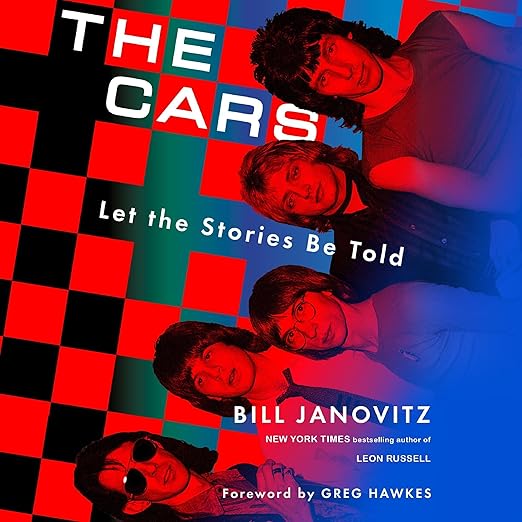
Boston's music scene gets more credit than usual in this audiobook, and that turns out to be one of its real strengths. I put this on during a long stretch of yard work, expecting a standard formation-to-breakup arc, and instead got something closer to a study of how five well-traveled musicians from four different states, Maryland, Ohio, New York, and New England, found each other, found a sound, and then found a city willing to build a scene around them. Bill Janovitz, who fronts Buffalo Tom and has already written biographies of the Rolling Stones' Exile on Main St. era and of Leon Russell, approaches The Cars as a working musician first and a critic second, and that shows in how carefully he handles the mechanics of building a song like Just What I Needed.
Boston and the Band Grew Up Together
The book's real subject is how a band this commercially smooth carried this much internal friction the entire time. Janovitz doesn't flatten the tension between Ric Ocasek's tight control of the band's direction and the rest of the group's frustration with it; he traces it album by album, using new interviews with surviving members alongside decades of prior reporting. The synopsis promises each landmark album gets fully chronicled and dissected, and that promise holds. Anyone who only knows the singles gets a much clearer sense of how deliberate the band's minimalist, synthesizer-forward sound actually was, and how much of it came from arguments rather than accidents.
Boston gets treated as more than a backdrop. Janovitz, who has spent decades inside that same regional scene himself, makes a real case that The Cars' rise and the city's broader music scene grew up together, each lending the other credibility at a moment when Boston wasn't yet known as a rock town. That local-history angle is the kind of thing a band biography written by an outsider critic would likely skip, and it's one of the clearest benefits of having a musician-critic with actual Boston roots behind the project.
Janovitz doesn't stop at chronicling the hits. He gives real attention to the band's less commercially dominant later albums, tracing how the same synth-driven minimalism that made them stars in 1978 started to feel dated by the mid-1980s, and how the band's response to that shift, rather than any single scandal, did as much to end them as any interpersonal conflict. That willingness to treat commercial decline as its own kind of story, not just a footnote before the breakup chapter, is a more mature choice than most rock biographies make.
Carthew Never Imitates a Bandmate's Voice
Corey Carthew narrates just under twenty hours of material, and the length is doing real work here rather than padding a slim story. Carthew keeps a steady, unhurried pace through years of touring schedules, studio sessions, and label politics without letting the momentum sag, which matters over a book this long. He doesn't attempt to imitate any band member's speaking voice during quoted interview passages, a sensible choice that keeps the narration from tipping into impression territory and lets Janovitz's own reporting stay the focus.
Greg Hawkes contributes the foreword, which gives the book a credibility marker right out of the gate: this isn't an unauthorized outsider's account, but it also isn't a hagiography written with the band looking over Janovitz's shoulder. One longtime fan reviewer described loving every album and every video for years while still not really knowing much about the band's internal history, which is exactly the gap this audiobook is built to close, drawing on new reporting plus what the synopsis calls the enthusiastic participation of nearly everyone who surrounded the band over the decades.
The book also benefits from Janovitz's access to people who rarely get quoted in Cars coverage: engineers, road crew, and Boston scene contemporaries who watched the band's rise from the ground up rather than from a magazine profile's distance. That range of voices gives the audiobook a texture closer to oral history than to a single authorial narrative, even though Janovitz's own critical voice still shapes the throughline.
Chapters Built Album by Album to Navigate
Nineteen hours and fifty-six minutes is a serious commitment for a band with a relatively compact discography compared to acts with forty-year unbroken careers. Casual listeners who just want the highlight reel, the Rock and Roll Hall of Fame induction, the big singles, the surface-level version of the story, may find the album-by-album, session-by-session detail more granular than they bargained for. That granularity is a genuine feature for the audience most likely to pick up a book this specialized in the first place, though it does mean the casual-fan version of this story isn't really what's on offer here.
The book also assumes a baseline familiarity with New Wave as a genre and moment, referencing contemporaries and industry context without much hand-holding for listeners coming in cold. If you don't already know why a synthesizer-heavy Boston band mattered in the late 1970s, Janovitz's insider fluency can occasionally read as written for people who already care, rather than as an introduction for newcomers.
Readers of Janovitz's earlier Rolling Stones book, Exile on Main St., or his more recent Leon Russell biography will recognize his method here: deep archival digging paired with a working musician's ear for why a specific arrangement choice mattered. Newcomers to his writing should know this isn't quick pop-culture skimming; it's the same rigor he's applied to subjects with much longer critical paper trails already written about them.
The chapters follow a clear album-by-album structure, which makes the audiobook easy to navigate for listeners who want to revisit a specific era rather than committing to the full chronological sweep in one pass. That structural clarity is a small but real usability advantage for a book this long, and one reviewer's own verdict on the book states it about as tersely as possible: 'Lots of details.'
Patience Pays Off More Than Curiosity
This is a strong pick for Cars fans who, like the reviewer who bought every album and attended every concert in their city, always felt they didn't actually know the band behind the songs, and for readers of music biography generally who prefer reporting depth over tabloid drama. Fans already won over by his music writing more generally should feel right at home here, since the same reporting instincts are simply pointed at a new subject.
Listeners who enjoyed how Janovitz blends insider access with critical distance in his other music writing should find this an easy next pick, and anyone curious how a band this stylistically minimal became this influential will get a satisfying answer.
One caution for anyone hoping for a quick primer: at nearly twenty hours, this rewards patience more than casual curiosity, and readers looking only for a condensed highlight reel rather than the full internal history may be better served starting with a shorter documentary before committing to the whole audiobook.
The Short Version
- Narration: Corey Carthew sustains a steady, unhurried pace across nearly twenty hours without letting the momentum sag.
- Themes: Band formation and internal conflict, the Boston music scene's rise alongside the band, New Wave's commercial and artistic tensions.
- Mood: Detailed and immersive, closer to deep-dive music journalism than a quick fan tribute.
- Verdict: A rewarding, thorough listen for genuine Cars fans and music-history readers, less suited to anyone wanting just the highlight reel.
Good to Know
Is this audiobook narrated by a member of The Cars or by author Bill Janovitz himself?
No. Corey Carthew narrates; Janovitz wrote the book, and keyboardist Greg Hawkes contributes only the foreword, not any narration.
Does this audiobook cover The Cars' entire career, including what happened after the band split?
Janovitz traces the band from their late-1970s Boston formation through their Rock and Roll Hall of Fame induction and the internal conflicts that led to their breakup, drawing on new interviews with surviving members.
Is nineteen hours and fifty-six minutes an unusually long runtime for a band biography audiobook?
It's on the longer end, reflecting an album-by-album, session-by-session level of detail rather than a condensed overview.
Do I need to already know The Cars' discography well to follow this audiobook?
Some baseline familiarity helps. Janovitz writes with insider fluency about New Wave and the band's specific albums without much hand-holding for complete newcomers.