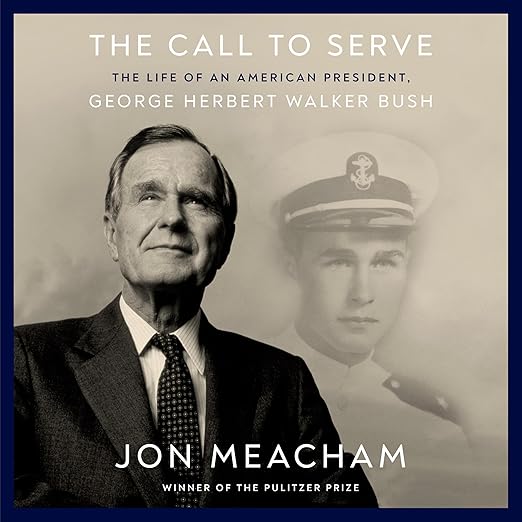
Jon Meacham reading his own words about George H.W. Bush is an audiobook experience that carries a particular quality of conviction. Meacham spent years immersed in Bush's life for his biography Destiny and Power, and The Call to Serve, a centennial tribute timed to Bush's hundredth birthday, draws directly on that archive. The narration here is sourced from Meacham's biography, which means this is a man reading the sentences he composed with full documentary knowledge of their subjects, and the difference in authority that creates is palpable from the opening passages.
Shot Down at Nineteen, the Book's Real Origin
This is not a conventional biography. The Call to Serve is framed as a tribute volume, lavishly illustrated in its print form with more than 450 photographs, many drawn from the scrapbooks kept by Barbara Pierce Bush across a lifetime together. In audio form, those photographs are absent. This is the most important caveat for prospective listeners: the book was designed as a visual object, and the audiobook includes a downloadable PDF of photographs to partially compensate for that absence. Listeners who do not download the PDF will miss a significant dimension of the work as conceived. Those who do will find the audio and visual elements work together, with Meacham's narration providing the interpretive framework for what the images show.
The scope is comprehensive. Bush's World War II combat service in the Pacific, where he was shot down at nineteen years old, is presented not as biography's first chapter but as the foundational event of his entire understanding of service. From there Meacham traces the career in sequence: Texas politics, the United Nations ambassadorship, the envoy posting to China, the directorship of the CIA, the Reagan vice presidency, and then the presidency itself. The portrait that emerges is of a man whose ambition was genuine but whose sense of service was not instrumental; he did not seek power in order to impose a vision but in order to fulfill obligations he took seriously as personal moral commitments.
The book draws directly from the scrapbooks Barbara Pierce Bush kept across a lifetime, which gives it a texture that commissioned biographies assembled from official records cannot replicate. The scrapbooks reflect Bush as he was seen from within his own household, in the images and captions that the family chose to preserve, which is a different angle from the public record and a valuable one. Meacham's commentary situates that private evidence within the larger story of American public life in the twentieth century, and the combination is more affecting than either dimension would be alone.
Meacham Reads Obama's Words Like Evidence
Meacham's narration sustains the intimacy appropriate to a tribute volume. He does not adopt the neutral register of a documentary narrator; his investment in the subject is audible. When he describes Barack Obama's statement that Bush put the country first "both before he was president, while he was president, and ever since," Meacham reads it as evidence for a case he has spent years building rather than as a quotation he is simply delivering. That quality of commitment to the subject communicates clearly through audio in a way that can be missed in print.
One reviewer described the book as "almost a premium coffee table book" in its print form, and "a master story teller painting the story of Bush" in Meacham's hands. Another noted that "the text flows flawlessly and is captivating," though also acknowledged some overlap with the earlier Destiny and Power biography. For listeners who have already read the full biography, this audiobook functions as a distillation of its essential argument with the additional texture of the photographic archive. For those coming to Bush through Meacham for the first time, it serves as an accessible, emotionally coherent portrait of a particular kind of American public character.
A Tribute That Admits He Was 'Cutthroat'
The celebratory framing is consistent throughout. This is a tribute, written and narrated by someone who admires his subject, and it does not dwell extensively on Bush's failures or the more controversial aspects of his domestic record. He was, as Meacham notes, capable of being "cutthroat on the campaign trail," and that dimension of his character is acknowledged, but the book's purpose is commemoration rather than full biographical accounting. Listeners looking for a critical assessment of the Bush presidency will need to consult other sources alongside this one.
The two-hour-and-thirty-nine-minute runtime is notably compact for a figure with the biographical breadth Bush represents. This is a consequence of the format: a tribute volume with narration drawn from a larger biography is necessarily condensed, and some episodes that receive fuller treatment in Destiny and Power are compressed here. For listeners who want depth on the CIA directorship or the internal foreign policy debates of the Bush administration, the longer biography remains essential.
A Companion Piece for Destiny and Power Readers
This audiobook serves readers interested in twentieth-century American political leadership, presidential biography, and the question of what public service has meant at its most serious. Those who have already read or listened to Destiny and Power will find this a companion piece rather than a repetition. Listeners new to Meacham's Bush will get a coherent, emotionally resonant introduction. Those wanting critical distance from the subject's legacy should supplement with other sources. Anyone listening without downloading the PDF companion should know they are receiving only part of what the work offers.
Key Details
- Narrator: Jon Meacham self-narrates with the measured authority of a biographer who has spent years in these documents, and his delivery adds interpretive depth that a hired narrator could not provide.
- Subjects: Public service as personal identity, the cost of political grace, leadership modeled through integrity across five decades
- Tone: Reverential but honest, intimate in scale
- Bottom line: A reflective audiobook companion to Meacham's larger Bush biography, essential for those who have read Destiny and Power and valuable on its own terms for listeners interested in presidential character.
Common Questions
Is this audiobook a condensed version of Destiny and Power, or does it cover different material?
The narration is drawn from Destiny and Power, which means there is substantive overlap. The Call to Serve is structured as a tribute volume with commentary from Meacham throughout, framing the material around the theme of service. Listeners who have read the full biography will find familiar passages in a new editorial context rather than entirely new content.
Does the audiobook edition include the photographs, or is a separate PDF required?
The audiobook edition includes a downloadable PDF of photographs from the book. The photographs are not embedded in the audio itself. Given that the original print book features more than 450 images as a core part of the experience, downloading the PDF is strongly recommended for listeners who want the full intended presentation.
Is this audiobook suitable for listeners with no prior knowledge of George H.W. Bush?
Yes. Meacham provides enough context to make the life legible for newcomers, covering Bush's career from World War II through the presidency in a coherent sequence. Those who want deeper detail after listening will find Destiny and Power an appropriate next step.
How balanced is this audiobook in its treatment of Bush's legacy and the controversies of his presidency?
The book is primarily a tribute, written for the centennial of Bush's birth by a biographer who admires the subject. It is honest about Bush's flaws, including his capacity for ruthlessness in political campaigning, but it does not pursue critical examination of his policy record in depth. Listeners seeking that perspective should read supplementary sources alongside it.