A Label Medieval Europeans Never Used
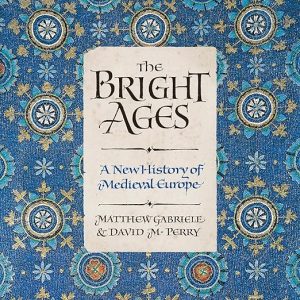
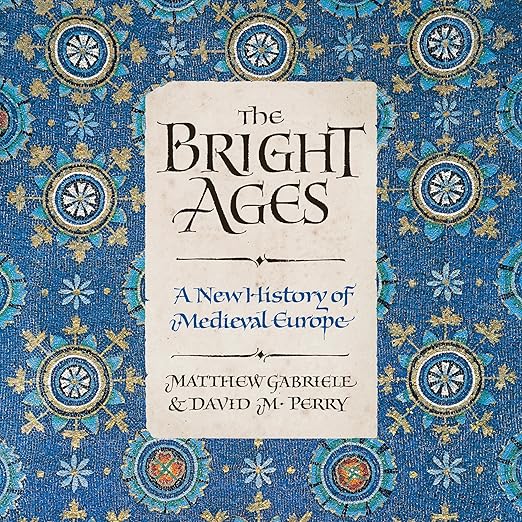
What actually happened between Rome's fall and the Renaissance, a thousand years popular imagination has flattened into ignorance, superstition, and poor hygiene? This audiobook of The Bright Ages spends nine and a half hours arguing that the entire premise of that question is wrong, built on a label, the Dark Ages, that medieval Europeans themselves never used and would not have recognized.
One correction worth making up front: the credited author field for this listing names only Matthew Gabriele, a professor of medieval studies at Virginia Tech, but The Bright Ages is co-written with David M. Perry, a journalist and medieval historian, and both names appear together on the book's actual cover and audiobook credits. Their two-person perspective, one academic historian, one historian-turned-journalist, shapes the book's readable-but-rigorous tone throughout, closer to narrative popular history than to a single scholar's monograph.
A recurring thread ties the whole book together: how permeable political and cultural borders in medieval Europe actually were, compared to how solid and fixed modern maps make them look in retrospect. Trade routes, religious conversion, and intermarriage moved people and ideas across what later became national boundaries constantly, and the book uses that permeability as its real argument against both the Dark Ages myth and a more romanticized medieval nostalgia: neither version accounts for how much genuine exchange and complexity was actually happening on the ground.
Holding Both the Brutality and the Beauty
The book's real achievement is refusing to pick a side between the two extreme popular versions of medieval Europe, either superstitious backwater or misty age of chivalry, and instead holding both the brutality and the beauty in view at once. Gabriele and Perry move across ten centuries and multiple continents in a single narrative arc, from Rome's fall through Charlemagne, the Vikings, the Crusades, and the Black Death, but also into territory popular medieval history usually skips: the religiously mixed societies of Iberia, the sophistication of Byzantium, and the intellectual authority of women like Hildegard of Bingen and a series of genuinely powerful medieval queens.
The 'Dark Ages' framing itself has a specific history worth knowing, one the book gestures at directly: the label traces back centuries, to Renaissance writers eager to cast their own era as an enlightened rebirth by contrast with everything that came before it. Gabriele and Perry are not the first historians to push back against that inherited framing, but they are unusually effective at making the pushback readable rather than purely academic, translating decades of specialist revisionist scholarship about the medieval period into a narrative built for a general audience rather than a classroom.
Hildegard's Music Still Gets Performed Today
Mike Duncan, host of the Revolutions and History of Rome podcasts and author of Hero of Two Worlds, blurbs this book directly, calling it thoroughly enjoyable and accessible, and that endorsement matters because Duncan built his own audience specifically on making dense historical periods approachable without dumbing them down. The book's opening and closing image, a blanket of golden stars built by an empress with Germanic, Roman, Spanish, and Byzantine ancestry, echoed nearly a thousand years later by Dante writing his own vision of heaven, is the kind of structural bookend that only works if the intervening history earns it.
Hildegard of Bingen, one of the medieval women the book restores to proper attention, was a composer, natural historian, and mystic whose surviving musical compositions are still performed today, nearly nine hundred years after she wrote them. Citing her alongside emperors and popes rather than as a footnote to 'women in the Middle Ages' is exactly the kind of correction The Bright Ages specializes in: not adding a token chapter about overlooked figures, but weaving them into the main narrative at the same scale as the political and military history that usually crowds them out.
Readers of Dan Jones's popular medieval histories will find a kindred spirit here, though Gabriele and Perry lean more consistently into thematic argument than Jones's more chronicle-driven narrative style, spending real time explaining why the Dark Ages framing took hold in the first place rather than just narrating around it. That argumentative backbone is what separates The Bright Ages from a simple greatest-hits tour of medieval events: every chapter is doing rhetorical work against a specific misconception, not just recounting what happened next.
Meskimen Signals Which Names Matter Most
Jim Meskimen has no directly comparable narrative-history credit in this specific catalog to measure against, so his performance here is worth judging on what the material demands: sustaining narrative momentum across ten centuries and dozens of named figures, from an obscure Iberian caliph to a Viking raiding party to a German mystic nun, without letting any single figure blur into the general historical wash. Popular history at this scope lives or dies on a narrator's ability to signal, through pacing and emphasis alone, which names matter enough to remember and which are passing color.
The genre tag on this listing files The Bright Ages under Architecture, which is not entirely arbitrary, the book does discuss cathedral rose windows and illuminated manuscripts as evidence of medieval artistic achievement, but it undersells what this actually is: a work of narrative history spanning politics, religion, and culture across an entire continent, not a study of medieval buildings specifically. A companion PDF does accompany the audiobook, useful for the maps and images that a narrative history covering this much geography benefits from having on hand.
One Reviewer Calls the Central Thesis Shaky
Not every reviewer buys the full argument. One four-star review calls the overarching thesis shaky while still praising the book as readable history, pointing out specifically that Rome's administrative structure simply relocated east to Constantinople rather than genuinely collapsing, a nuance some readers may feel the bright-versus-dark framing oversimplifies in the marketing even if the actual chapters handle it carefully. That is a fair tension to flag: the title's rhetorical framing is punchier than the more careful argument inside actually needs to be.
The companion PDF is worth actually using rather than skipping, particularly for the sections on Iberian multi-religious coexistence and Byzantine political structure, where geography and lineage get complicated enough that a visual reference genuinely helps a listener keep track of who ruled what and when.
Skip It If You Want One Narrow History
This suits listeners who enjoyed Duncan's own podcast-to-book work, anyone whose only exposure to medieval Europe came from fantasy fiction borrowing its aesthetic without its actual complexity, and readers specifically interested in the underexamined corners of the period: Iberian religious coexistence, Byzantine political sophistication, and the real authority medieval women like Hildegard held.
Skip it if you want a narrow, single-country or single-event medieval history rather than a continent-spanning synthesis, or if you are committed to the traditional Dark Ages framing and unlikely to be moved by a counter-argument built from a thousand years of specific counter-examples.
Does this audiobook argue the Middle Ages were not actually dark, or just less dark than assumed?
It argues the entire dark-versus-bright framing oversimplifies a thousand years of real complexity, showing genuine brutality and genuine beauty coexisting throughout, rather than simply flipping the traditional narrative to an unqualified positive one.
Does this audiobook focus only on Western Europe or does it cover a wider geography?
It ranges considerably wider, covering Byzantium, multi-religious Iberia, and connections into Asia and Africa, alongside the more familiar Western European material like Charlemagne and the Vikings.