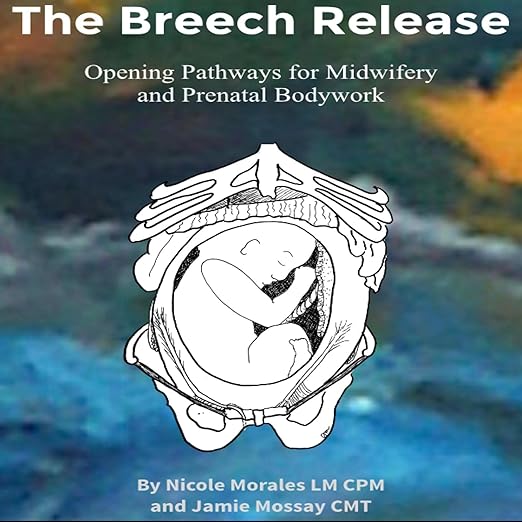
Quick Take
- Narration: Nicole Morales reads her own professional text with the measured authority of a practicing midwife, precise and humane, though the companion PDF is genuinely essential for the bodywork content.
- Themes: breech positioning as information rather than pathology, nervous system and bodywork integration, reclaiming midwifery touch
- Mood: Philosophical and technical in equal measure, dense for the general listener but deeply useful for practitioners
- Verdict: A specialized professional text for midwives and prenatal bodyworkers that rethinks breech pregnancy from the ground up, the companion PDF transforms the audio from partial into complete.
I will say upfront that this is a specialist text, and that clarity is important before a general listener commits to nearly sixteen hours of audio. The Breech Release is addressed primarily to midwives, prenatal bodyworkers, doulas, and the broader community of people who work with pregnant bodies. It is also, in a secondary sense, addressed to pregnant people who want to understand breech positioning in a register that goes considerably deeper than the standard reassurance that a cesarean will solve the problem. It is not a consumer pregnancy guide, and it should not be evaluated as one.
Nicole Morales is a licensed midwife and certified professional midwife, and she narrates the text herself. Self-narration for a professional clinical text can go several ways, and here it works. Morales reads with the steady authority of someone who has attended hundreds of births and thought carefully about what she knows and what remains genuinely uncertain. There is no performance of expertise, just expertise itself. The moments where the book’s philosophy gets most ambitious, arguing that breech babies may be mentors for the birthworker community, are read with the same measured conviction as the anatomical sections, which is the only way to make them land.
What the Breech Actually Teaches
The book’s organizing argument is that breech-positioned babies are not a problem to be corrected so much as a source of information about the pregnant body, the nervous system, and available space in the womb. Morales draws on anatomy, bodywork traditions, nervous system science, and midwifery experience to argue that understanding why a baby positions breech opens windows into understanding how all babies move and position, and what that means for birth outcomes generally.
This is a genuinely original framework that sits outside the standard obstetric approach to breech presentation, which tends to run: identify, attempt external version, proceed to cesarean if unsuccessful. Morales is not arguing against medical management per se; she is arguing that the conversation around breech has been prematurely narrowed and that bodywork, positioning, and nervous system support offer pathways that deserve serious attention in the birthworker community.
The Four Pathways and Why They Converge
The text organizes around four converging pathways: nervous system care, bodywork, positioning, and the application of gravity and movement. Each gets substantial treatment, and the way Morales builds the relationships between them is the book’s intellectual core. The nervous system chapter is particularly strong, making a case that tension held in the psoas and related structures can communicate information to the baby about available space, and that releasing that tension is a legitimate clinical pathway rather than an alternative medicine adjunct.
A reviewer describes the book as unique in the world and situates it within a tradition of female knowledge about birth that predates medicalized obstetrics. That framing is perhaps elevated beyond what a clinical text can carry, but it points at something real: Morales writes from within a specific tradition of midwifery practice that values the continuity of embodied knowledge, and the book reflects that orientation throughout.
The Companion PDF and Format Considerations
The illustrations and photographs are described by reviewers as lovely and helpful, and the companion PDF that comes with the Audible purchase contains them. This is load-bearing for the bodywork and anatomy content. The audio alone communicates the conceptual framework effectively, but the positional and anatomical guidance benefits substantially from visual reference. Practitioners who plan to use this in clinical work should pull up the PDF regularly as they listen rather than treating it as optional. At fifteen and a half hours, this is a serious professional text that rewards slow engagement over commute-time consumption. The philosophy and clinical detail both deserve full attention.
Frequently Asked Questions
Is The Breech Release accessible to pregnant people who are not healthcare professionals?
It is written with birthworkers as the primary audience, but motivated pregnant people considering birth options outside standard obstetric management will find the framework genuinely illuminating. The anatomical and bodywork sections are technical, but Morales writes with clarity rather than unnecessary jargon. Someone wanting to understand why their baby is breech and what options exist beyond external version and cesarean will get real depth here. It is challenging rather than inaccessible for a non-professional reader.
The reviews mention illustrations, how much of the content depends on visual material that audio cannot convey?
The companion PDF that comes with your Audible purchase contains the illustrations and photographs. For the bodywork techniques and anatomical positioning content, the visual material is genuinely important and the audio alone provides incomplete instruction. Morales describes techniques in enough detail that a trained practitioner can follow the audio, but the photos add precision that matters for clinical application. Download and use the PDF alongside the audio rather than treating it as optional.
How does this book relate to other breech-specific resources like Spinning Babies?
Spinning Babies focuses primarily on optimal fetal positioning through specific maternal movements and positions, primarily for use by pregnant people themselves. The Breech Release is more philosophically ambitious and more technically oriented toward practitioners, covering nervous system work, bodywork protocols, and the theoretical framework of why babies position the way they do. They address overlapping territory from different angles: Spinning Babies is more consumer-accessible, The Breech Release is more clinically deep.
Is the philosophical framework that breech babies can mentor birthworkers clinically supported or more speculative?
It occupies a space between clinical observation and interpretive framework. The specific claim that breech positioning carries information about available space and nervous system tension is grounded in the anatomy and bodywork research Morales cites. The broader argument that engaging seriously with breech presentation teaches birthworkers things about fetal positioning generally reflects accumulated clinical experience rather than controlled study. Morales is transparent about this; she is building a framework for understanding rather than presenting randomized trial data, and the book should be engaged with in that spirit.