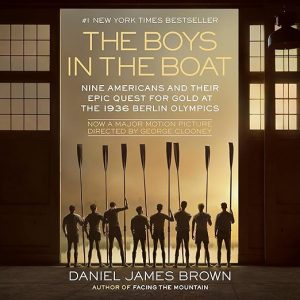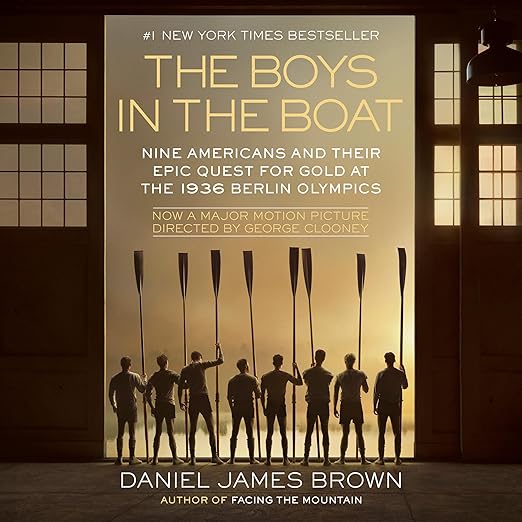
Daniel James Brown's The Boys in the Boat is the kind of audiobook that reminds you why narrative nonfiction at its best reads like a novel without abandoning its fidelity to what actually happened. Joe Rantz - a teenager without family or prospects who rows for the University of Washington's eight-oar crew in the depths of the Depression - is one of the most fully realized nonfiction subjects I have encountered in years of reviewing books. Brown built this account from the boys' own journals and the vivid memories of surviving participants, and what he creates is not just sports history but a portrait of Depression-era America rendered through nine specific young men and their coach. The audiobook, narrated by the late Edward Herrmann, is the definitive version of this text.
Joe Rantz Is the Real Center of the Boat
The book is nominally the story of nine University of Washington oarsmen who defeated the German team rowing for Adolf Hitler at the 1936 Berlin Olympics, but reviewers are correct to note that Joe Rantz is its emotional core. Brown follows Rantz from an abandoned childhood, through his improbable path to the University of Washington, through his development as an oarsman under coach Al Ulbrickson. The book uses this intimacy to make the climactic Berlin race something more than a sports upset: it becomes a reckoning between two visions of what young men can be forced or inspired to do. The nine working-class sons of loggers, shipyard workers, and farmers defeating the elite crews of the East Coast, Britain, and finally Germany is a story Brown tells without false triumphalism, because he is also honest about what the boys were up against, both economically and physically, in getting there.
Edward Herrmann's Baritone Sounds Like Memory
Edward Herrmann was one of the great American audiobook narrators of his generation, and The Boys in the Boat is among his finest performances. His baritone carries exactly the kind of authority that Depression-era American history requires - it sounds like memory rather than recitation, like the voice of someone who was there. The historical scope of the book shifts between intimate character scenes and wide-angle descriptions of the political context of Nazi Germany's 1936 Olympics, and Herrmann navigates these registers without the shifts feeling jarring. At 14 hours and 24 minutes, this is a long audiobook, and a long audiobook lives or dies on its narrator. Herrmann makes the runtime feel earned. The final race sequences, which one reviewer called worth the price of admission on their own, land harder in audio than they might on the page because the cumulative investment Herrmann has built over the preceding hours makes the outcome feel personally urgent.
George Pocock's Boats Get Equal Billing
The book's scope means it covers a lot of ground outside the boat itself. Brown interweaves chapters on the design and construction of the racing shell, the political machinations of the 1936 Olympics, the Depression-era conditions in the Pacific Northwest, and the coaching philosophies of Ulbrickson and his predecessors. This breadth is one of the book's genuine achievements, but listeners who came primarily for sports narrative should know the book regularly steps away from the action on the water. One reviewer found this approach slightly diffuse - noting the book sometimes loses momentum when it shifts into historical or biographical context. That is a minority view among the book's substantial readership, but worth flagging for listeners whose main interest is the rowing rather than the surrounding history. The New York Times bestseller designation and the PBS documentary adaptation are accurate signals of the book's mainstream reach and quality.
Brown's research methodology is worth acknowledging because it shapes the entire texture of the book. He did not write about the 1936 Washington crew from a distance - he spent years interviewing surviving family members, reading the boys' own journals, and reconstructing the Depression-era Pacific Northwest that produced them. Joe Rantz's granddaughter Judy Willman was Brown's primary source for the intimate details of Rantz's inner life, and the trust she placed in him is visible in the specificity of what the book contains. The sections on the design and construction of the racing shell by master boatbuilder George Pocock are as lovingly detailed as the sections on the races themselves, because Brown understood that what Pocock built for these boys - a vessel that could carry their collective effort across the Berlin course - was as much a part of the story as anything that happened on the water. The book's commitment to giving the reader the full material world of the 1930s rowing scene, from the boathouse culture to the qualifying races to the economics of Depression-era college athletics, is what makes the payoff at the Berlin Olympics feel genuinely earned rather than simply dramatic.
Unbroken Fans Will Recognize This Register
Listeners who love narrative nonfiction with deep biographical focus and genuine historical sweep will find this audiobook among the best of its kind. The comparison the publisher draws to Unbroken is apt in register and ambition if not in subject: both are stories of young men pushed to their limits by history and circumstance, and both reward patient listening rather than passive consumption. Sports fans who want more than statistics and scores will find the rowing sequences genuinely thrilling once Brown has given you the context to understand what they require of the athletes. Listeners whose primary interest is the political history of the 1936 Berlin Olympics may find the book's focus on Joe Rantz's personal arc feels slightly disproportionate, but most readers find that focus is precisely what makes the larger history land.
At a Glance
- Narrator: Edward Herrmann's baritone gives the Depression-era narrative exactly the gravitas it deserves - his voice matches the book's register of earned triumph so well that it is difficult to imagine a better fit.
- Subjects: Class and American ambition, the psychology of athletic teamwork, the 1936 Berlin Olympics as political theater
- Tone: Sweeping and emotional, historically grounded and quietly triumphant
- Bottom line: One of the genuinely great narrative nonfiction audiobooks of the past two decades - Daniel James Brown's account of the 1936 University of Washington crew team is both intimate biography and wide-angle history, and Edward Herrmann's narration elevates it further.