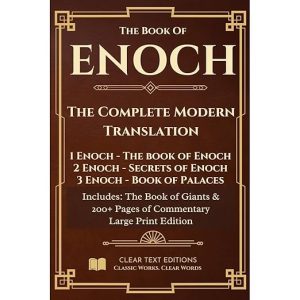
Ancient apocalyptic writing attracts packaging, and this audiobook carries a great deal of it. Four texts sit at the center: 1 Enoch from the Ethiopic, 2 Enoch from the Slavonic, 3 Enoch in Hebrew, and the fragmentary Book of Giants recovered from the Dead Sea Scrolls. Around them Robert Treynol has assembled historical commentary on the formation of the biblical canon, summaries for each section, and, by the publisher's own count, more than two hundred pages of original essays inside a volume running past six hundred. Thirteen hours later, roughly a third of what you have heard is apparatus rather than ancient text.
Four Enochs and a Fragment, in Sequence
Four texts in one place is the actual product here, and it is a sensible thing to want. The three Enochs come from separate languages and separate traditions, Ethiopic, Slavonic, and Hebrew, and hearing them in sequence shows how differently each one handles the same figure: the man who walked with God, the visionary taken up through the heavens, the transformed being of the later mystical writing. The Book of Giants then arrives in fragments, and the change in texture is instructive on its own. Nobody assembles these four by accident, and the sequence is the reason to choose this over a single-volume edition.
Scripture and Commentary Share the Same Unvarying Voice
Ms MM, at five stars, identified the audience with precision, praising summaries and conclusions written with the layperson in mind and describing the effect as strengthening the faith of believers while educating newer Christians. That is the register throughout. This edition is built for devotional and study use rather than for the seminar room, and the editorial voice guides rather than argues.
Reading credit on this edition goes to a machine voice, not to a human performer, which creates a specific problem for material of this kind. Scripture and commentary arrive in the same unvarying delivery, so the boundary between a second-century apocalypse and a modern editor's explanation of it has to be inferred from wording alone. Treynol signposts the transitions clearly enough, but a human reader would ordinarily mark that shift with a change of pace, and here nothing does.
Modern English Makes This Thirteen-Hour Listen Work
Edwin Hathaway captured the appeal in a five-star sentence about learning things you did not know you needed, and recommended it to any adult curious about what sits behind the scenes. That curiosity is what the description targets directly: the Watchers, the Nephilim, the connection to Genesis 6, and the line from Enoch quoted at Jude 1:14. These texts explain references that many lifelong Bible readers have simply stepped over. The essays supply context that would otherwise have to be assembled from a dozen scattered sources.
Completeness is the practical argument. Most encounters with Enoch stop at the first book, and the other material stays scattered across editions of varying quality, so having the whole corpus assembled with the Dead Sea fragments included saves a lot of hunting. The historical commentary on canon formation adds the piece people usually want next, which is not what the texts say but why they ended up outside the Bible.
Modern English is the other genuine selling point, and it matters far more in audio than in print. Public domain translations of Enoch carry Victorian syntax that becomes punishing when spoken aloud, with inverted clauses and archaic pronouns that a listener has to unpack in real time. Treynol's stated aim is a fresh translation preserving the meaning while reading naturally for a contemporary audience, and for a thirteen-hour listen that choice is the difference between finishing and abandoning.
Retail Keywords Pasted Onto an Audio Product
tim birchfield, whose response also carries five stars, notes plainly that this is not regarded as a book of the Bible, then reaches for the familiar summary of Enoch as the man spared death alongside Elijah. That is roughly the level of prior knowledge most listeners will arrive with, and the marketing does little to sharpen it, leaning instead on the language of lost and banned books. Know before you start that you are listening to pseudepigrapha, not to disputed canon.
Print language saturates this listing in a way that should be flagged. The description sells page counts, references, and a comprehensive study apparatus, and it closes with an extended section that is not a description at all but a list of search phrases: modern English Book of Enoch, banned books of the Bible, books for end times researchers, apocryphal gospels. Retail keyword copy has been pasted onto an audio product without an editing pass.
Credits are the last thing to examine. Robert Treynol is listed as the author of writings composed thousands of years ago, with no separate translator credit anywhere on the entry, which leaves the actual editorial role invisible. The page also carries two series identities at once, Lost Books of the Bible and Clear Text Editions, neither of them numbered, so ordering within either sequence is anyone's guess.
Curious Readers Welcome, but Scholars Should Look Elsewhere
Freddie Jones made the broadest recommendation on the page, five stars and no qualifications, calling it worthwhile for everyone regardless of belief, and that is fair. Bible study groups, prophecy readers, anyone who has met the Nephilim in a documentary and wanted the source, and listeners drawn to Jewish mysticism and angelology will all find what they came for. Curiosity is enough of a qualification, and the summaries carry anyone who arrives without one.
Scholars should look elsewhere, since a critical edition with citations, variant readings, and a defended translation philosophy is not what this is. Anyone needing to compare renderings line by line will also struggle, because audio gives you no way to hold two versions side by side. And listeners who want the ancient material undiluted should know that editorial commentary is threaded throughout rather than parked at the end.
Enoch has been circulating outside the canon for a very long time, and interest in it keeps returning for reasons that have little to do with scholarship. This edition serves that interest honestly: clear language, generous context, everything in one sequence. Ignore the packaging, which still believes it is selling a large print paperback, and take the texts, which have survived worse marketing than this.
Before You Press Play
- What it covers: Watchers and Nephilim, heavenly journeys, canon formation, Jewish mysticism
- Feel: Strange and repetitive by design, ancient apocalyptic delivered in plain modern English
- Our call: The most complete Enoch collection available in audio, wrapped in a listing still written for print.
Common Questions
What happens to the large print edition features in the audiobook?
They evaporate, as they must. Large print, page counts, cross-references, and the study layout all belong to a physical object, and the entry never adjusts its language for the format it is actually selling. Reference material either arrives as spoken text or does not arrive at all.
Does the audiobook suit a Bible study group?
With planning, yes. The summaries are pitched at laypeople, the modern English reads aloud comfortably, and Cjmaine's five-star response points to the sheer quantity of information as the draw. Thirteen hours across four texts needs dividing into sessions, though, and citing chapter and verse by ear is awkward.