Quick Take
- Narration: Rob Shapiro delivers Gordis’s analytical but emotionally invested prose with appropriate gravity, sustaining the dual register of historical survey and personal reckoning across twelve hours.
- Themes: Zionist idealism versus Israeli reality, democratic backsliding and judicial crisis, Israel’s reckoning after October 7
- Mood: Honest and sober, written by someone who loves Israel and refuses to look away from its contradictions
- Verdict: The most balanced and analytically rigorous assessment of Israel’s seventy-fifth year available in audio, updated through the October 7 aftermath and written with rare willingness to name both achievements and failures.
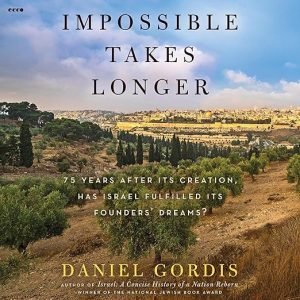
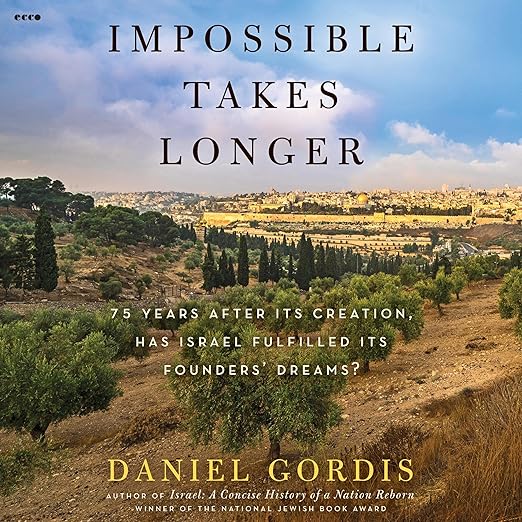
There are not many books about Israel that reviewers consistently describe as balanced. The subject tends to produce either apologetics or prosecution, and the middle ground is a lonely place to occupy. Daniel Gordis’s Impossible Takes Longer occupies that ground with unusual steadiness. It won the Rabbi Sacks Book Prize, which is a meaningful signal about its reception within the Jewish intellectual community. But what strikes me more is the structural device Gordis chose: using Israel’s Declaration of Independence as the measuring instrument for the book’s entire argument.
I listened to this in pieces over several evenings, usually late, with the kind of attention the material demands. Gordis is a two-time National Jewish Book Award winner, a scholar and writer who immigrated to Israel from the United States and has spent decades as one of the more intellectually honest voices on Zionism’s achievements and its contradictions. This revised and updated paperback edition includes material through the October 7 war and its aftermath, which transforms the book from a seventy-fifth anniversary retrospective into something more urgent.
The Declaration as a Measuring Stick
The organizing device is more than structural cleverness. Israel’s Declaration of Independence in 1948 made specific promises: equal rights for all citizens regardless of religion or ethnicity, democratic governance, social development, and a state that would be a home not just for Jews already there but for Jews everywhere. Gordis takes each of these commitments seriously as a standard and asks which have been honored, which have been partially fulfilled, and which have been systematically betrayed.
The answers are genuinely mixed, and Gordis does not shade them. He presents the resurrection of Hebrew as a living language as one of the most remarkable cultural achievements in modern history. He cites Israel’s scientific and technological development as extraordinary by any comparative measure. He is equally frank about the treatment of Arab citizens, the failures of absorption for certain immigrant communities, and the long damage done by settlements in the West Bank. A reviewer described the experience as Talmudic: one the one hand, on the second hand, and also on the third hand. That is accurate, and it is not a criticism. The subject requires that form.
The Judicial Crisis and What It Revealed
Gordis spent significant time analyzing the judicial reform crisis that dominated Israeli political life in the months before October 7, 2023, and his framing of it is one of the more incisive treatments available. He describes it as the most dangerous internal rupture in Israel’s history, more destabilizing in some ways than external threats, because it exposed a fundamental disagreement about what kind of state Israel is and should be. The tension between majoritarian democracy and the protection of minority rights, between the authority of an elected coalition and the independence of the judiciary, is not a problem unique to Israel, but it took a particularly acute form there.
The revision to include October 7 and its immediate aftermath gives the book a quality that no version written before that date could have. The question of whether Israel has fulfilled its founders’ dreams, already complicated by the judicial crisis, becomes genuinely existential in the context of what Gordis describes as the worst attack on Jewish lives since the Holocaust. He does not offer reassurance. He offers something more honest: a careful reckoning with what October 7 revealed about both Israel’s vulnerabilities and the sources of its resilience.
Rob Shapiro and the Demands of This Register
Rob Shapiro’s narration is a strong match for Gordis’s register. This is analytical writing with a personal stake, and Shapiro conveys both qualities. He does not perform anguish or triumph; he reads with the gravity of someone who understands that the material is serious and trusts the listener to respond accordingly. The twelve-hour runtime does not flag. Hebrew and Arabic names are handled with care, which matters considerably in a book that moves between Israel’s Jewish and Arab populations with equal attention.
A reviewer noted that the chapters flow and that using the Declaration of Independence as an outline works very well. That structural clarity is part of what makes this work as an audiobook rather than just as a print text. Each chapter has a defined scope, a defined standard, and a defined verdict. The cumulative argument builds clearly even for listeners who come with limited prior knowledge of Israeli history, though Gordis clearly expects more background than a complete beginner will have.
What This Book Is Not Trying to Do
Gordis is sympathetic to the Zionist project. He believes the Jewish state is a success, more extraordinary than its founders imagined. He also believes it has failed, repeatedly and seriously, in specific ways he names. This is not a neutral position. It is a position held by someone who cares about the outcome and refuses to let that care distort the analysis. Listeners who want either a full-throated defense of Israeli policy or a systematic critique of the state’s founding will find this book frustrating in productive ways. Listeners who want the most honest reckoning currently available in audio form will find it here.
Frequently Asked Questions
Does the audiobook cover the October 7, 2023 Hamas attack?
Yes. This is the revised and updated paperback edition, which Gordis specifically updated to address the October 7 war and its immediate aftermath. It substantially shapes the final section of the book’s argument.
Does Gordis take a political side in the Israeli-Palestinian conflict?
Gordis is sympathetic to the Zionist project and believes Israel is a success, but he is explicitly critical of specific Israeli policies, particularly regarding Arab citizens and West Bank settlements. Multiple reviewers describe the book as balanced while acknowledging his overall sympathy for the state’s existence.
Is this accessible to listeners without deep knowledge of Israeli history?
Gordis provides enough context that interested general readers can follow the argument, but the book assumes some familiarity with key events from 1948 onward. His earlier book Israel would serve as useful preparation for listeners coming with minimal background.
What does the Rabbi Sacks Book Prize indicate about how the book was received?
Named for the late British Chief Rabbi Jonathan Sacks, the prize recognizes books that engage seriously and thoughtfully with Jewish life, tradition, and values. The award suggests the book was well received within the mainstream Jewish intellectual community as a serious and fair-minded treatment of the subject.