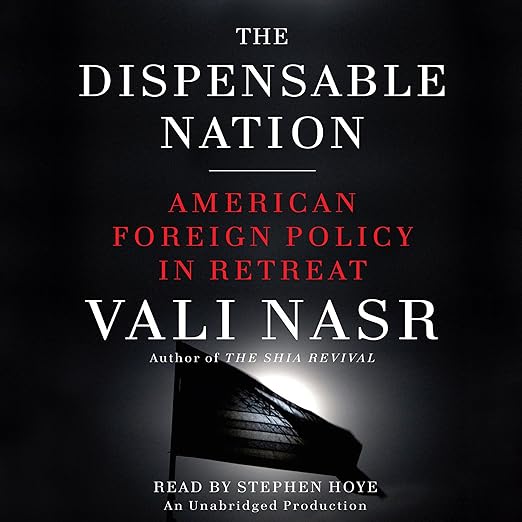
Quick Take
- Narration: Stephen Hoye brings professional steadiness to a book-length policy argument; his clean, neutral delivery suits the bureaucratic insider register of the material without adding texture it does not need.
- Themes: US foreign policy retreat, Obama administration decision-making, South Asian and Middle Eastern diplomacy
- Mood: Measured frustration; the tone of a competent official who watched a better plan lose to institutional caution
- Verdict: An essential insider account of where Obama’s foreign policy went wrong in the Muslim world, written by someone with direct access to the strategic debates and enough distance to make sense of them.
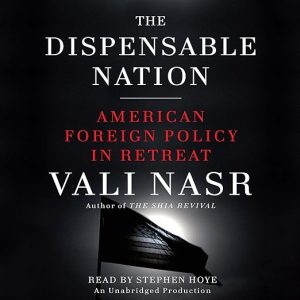
I finished this one on a Saturday morning when I had given myself the rare luxury of a long, uninterrupted listening session, and the experience reminded me why I keep returning to this particular category of book: the diplomat-turned-author memoir, written close enough to events to carry real information but far enough to allow some analytical honesty. Vali Nasr is one of the sharper practitioners of this form working today, and The Dispensable Nation is his most sustained argument.
Nasr served as Senior Adviser to Richard Holbrooke at the State Department from 2009 to 2011, during the period when the Obama administration was attempting to reshape American engagement in Afghanistan, Pakistan, and the broader Muslim world. The book he has written is partly a chronicle of that effort and partly a broader argument about what the administration did wrong and why those failures matter beyond any specific policy outcome.
Holbrooke, Clinton, and the Policy That Wasn’t
The most valuable section of this book, and the one that distinguishes it from think-tank analysis, is Nasr’s account of the working relationship between Hillary Clinton and Richard Holbrooke, and of how their efforts to pursue an ambitious South Asian policy were systematically undercut by the White House. Nasr was in the room for enough of this to speak with specificity, and he does. The picture that emerges of Obama’s inner circle is of a team that was consistently more risk-averse than the officials it had deployed to the field, and that substituted rhetorical ambition for strategic patience when the going got complicated.
Holbrooke in particular is rendered with real texture here. Nasr is clearly loyal to his former mentor, which means the portrait is not entirely dispassionate, but the loyalty is bounded enough that the contradictions in Holbrooke’s character come through. He was brilliant, difficult, politically vulnerable within the administration, and working on problems that had no good solutions. The combination produced a kind of sustained frustration that Nasr conveys without melodrama.
The Obama Administration’s Muslim World Calculus
Nasr’s central argument is that the Obama administration had a rare opportunity to fundamentally change the terms of American engagement with the Muslim world after the Bush years, and that it squandered that opportunity through a combination of political timidity and institutional inertia. The fear of another Iraq, of another open-ended commitment, of another set of images that would generate domestic political backlash, drove decision-making in ways that produced outcomes as damaging as the policies they were meant to avoid.
The parallel argument, which Nasr develops more briefly but with considerable force, is that while the US was disengaging from complexity in the Muslim world, China and Russia were quietly expanding their influence in precisely the spaces America was vacating. This argument has aged well. Nasr was writing before the full scope of that expansion became conventional wisdom, and the sections where he traces the specific mechanisms of Chinese and Russian positioning in South and Central Asia read now with an almost uncomfortable prescience.
Stephen Hoye’s narration is a good match for this material. The book is written in the flat, analytical prose of someone trained to produce policy memoranda, and Hoye’s clean delivery does not attempt to add color that is not there. Some listeners will find this combination dry. I found it clarifying. The ideas do the work, and a narrator who got out of the way was the right choice.
Where the Insider Account Has Limits
The book’s limitations are largely the limitations of the insider perspective itself. Nasr is extremely good at explaining what the people in the room were thinking and why they made the choices they made. He is less equipped to evaluate those choices against alternatives that were never seriously considered, because those alternatives were never in the room. The book’s prescription, roughly that the US should re-engage more boldly with Muslim-majority states and reclaim its role as an indispensable broker, is argued with more confidence than the evidence strictly supports. Reviewers who found the book impartial were responding to Nasr’s tone, which is measured, but his substantive position is not neutral: he believes American power, engaged strategically, produces better outcomes than American retrenchment.
Whether that premise is correct is a larger argument than this book can settle. What the book can do, and does well, is show how the mechanisms of American policy formation produce specific kinds of failure even when the people involved are skilled and well-intentioned.
The Audience This Book Was Built For
Listen to this if you follow US foreign policy and want a credible insider account of the Obama administration’s strategic failures in South Asia and the Middle East; if you are interested in how bureaucratic dynamics shape foreign policy outcomes; or if you want a well-argued case for American strategic engagement as an alternative to retrenchment. Consider skipping if you are looking for a comprehensive history of the region rather than a focused policy argument; if you want equal treatment of Afghan, Pakistani, and Arab perspectives rather than the view from the State Department; or if you have already read Holbrooke’s posthumous memoir and are looking for significantly new factual ground.
Frequently Asked Questions
Does Nasr’s close relationship with Richard Holbrooke undermine the credibility of his account of that period?
The loyalty is real and Nasr does not pretend otherwise. Where it introduces bias most clearly is in the portrait of Holbrooke relative to the White House, which is drawn more charitably than the Obama inner circle. That said, Nasr is specific enough about events and conversations that readers can often evaluate the evidence independently of the interpretive framing he applies.
How does the book hold up given that it was published in 2013 and covers events that are now over a decade old?
The core argument about American strategic retreat and the expansion of Chinese and Russian influence into the resulting vacuum has aged better than most policy books of its vintage. Some specific prescriptions about re-engagement have been overtaken by events, but the diagnostic analysis of what went wrong in the Obama years remains largely intact.
Is Stephen Hoye’s narration appropriate for a policy-heavy 11-hour listen?
His delivery is clean and professional throughout. The book does not attempt narrative flourishes and neither does Hoye. For listeners who find policy prose easier to absorb in audio than in print, the narration represents no obstacle; it is neither energizing nor distracting, which is probably ideal for this material.
Does Nasr address the Arab Spring and how it changed the administration’s calculations?
Yes, the Arab Spring features in the book’s treatment of how the administration struggled to respond to events it had not anticipated. Nasr argues that the administration’s instinct for caution, already visible in its South Asia policy, was reinforced rather than challenged by the upheavals of 2011, producing a reactive rather than strategic response to a moment that called for the opposite.