Quick Take
- Narration: Rich Miller handles the memoir’s shifting registers – from combat operations to political philosophy – with care, though the material’s emotional weight would arguably have been stronger in Ayalon’s own voice.
- Themes: Security ideology versus peace imperatives, moral reckoning inside the Israeli security establishment, the cost of political silence
- Mood: Searching and disquieting – the memoir of a warrior who concluded that the war he fought was making things worse
- Verdict: A National Jewish Book Award finalist that earns its accolades: few books on the Israeli-Palestinian conflict carry the authority of a former Shin Bet chief who changed his mind about what security actually requires.
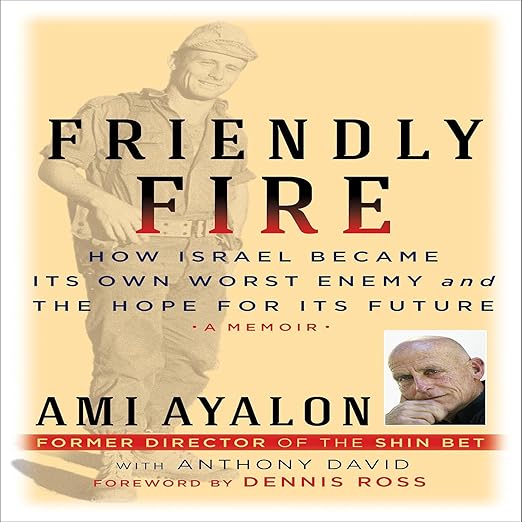
There is a particular kind of book that only certain people can write: the memoir of someone who was instrumental in a policy they later came to believe was wrong. Ami Ayalon’s Friendly Fire is that kind of book. He spent decades at the highest levels of Israeli security – Naval commando, commander of the Israeli Navy, head of the Shin Bet, member of Knesset – and his credentials as a patriot are not in doubt. What he eventually concluded, after decades of serving that patriotism with distinction, is that the policies he helped implement were self-defeating at a structural level. That conclusion, coming from this source, is extraordinary.
The title is not accidental. Friendly fire, in military terminology, refers to casualties inflicted by one’s own side through error or miscalculation. Ayalon uses it as a metaphor for what he came to see as Israel’s relationship with its own civil society and its own long-term security: the measures taken to protect Israel from its enemies were, he argues, simultaneously inflicting damage on Israel itself – on its democratic institutions, its moral coherence, and its capacity for genuine security.
What Running the Shin Bet Taught Him
The most arresting section of the memoir is Ayalon’s account of what he learned as head of the Shin Bet, Israel’s internal security service. He expected to find that security operations – targeted killings, arrests, surveillance – reduced Palestinian violence by eliminating its capacity. What he found instead was a more complex dynamic: when operations were conducted in a political context of hopelessness, when Palestinians had no viable path toward statehood or dignity, the effect of security operations was not to reduce support for violence but to increase it. People with nothing to lose, he concluded, will support violence because the alternative is simply continued humiliation with no endpoint.
This is not a pacifist conclusion – Ayalon does not argue that security operations should cease. He argues that security operations divorced from a political horizon are strategically counterproductive. The distinction matters, and it is one that many critics of Israeli policy, who reach similar conclusions by a shorter route, tend not to make with this specificity. Ayalon’s credibility on this point comes precisely from the fact that he implemented the operations he is now critiquing. He knows what they can and cannot accomplish from the inside.
The Courage the Book Required
Ayalon is frank that many who consider themselves Zionists will regard his conclusions as radical. He argues that Israel’s continued occupation is undermining Israeli civil society, that the settlements are not security assets but strategic liabilities, and that the secular majority has enabled the trajectory toward what he calls an Orwellian dystopia not through ideology but through silence and fear. These are not comfortable arguments for much of his natural audience, and the book’s publication required a willingness to be denounced by former colleagues and allies. The National Jewish Book Award nomination reflects how seriously it was taken outside those circles.
One reviewer called this memoir sadly prescient, which seems right given the events that have unfolded since its publication. Ayalon was describing structural dynamics – what happens when a society normalizes occupation indefinitely – that have become dramatically visible in recent years. Reading it now is a different experience than reading it on release.
Rich Miller and the Memoir’s Register
Rich Miller reads this carefully and without obvious stumbles. The memoir has a thoughtful, meditative quality – this is not a thriller or an action narrative, despite the biographical material that could support one – and Miller matches that register well. The moments where Ayalon’s writing becomes most personal, most uncertain, would arguably have more force in the author’s own voice, but that’s a structural limitation of the narrated memoir format rather than a failing of this specific recording. At just over ten hours, the listen is substantial but never padded.
Who Should Sit With This Book
Readers who want to understand the Israeli-Palestinian conflict through the eyes of someone who was at its operational center – not a journalist or academic but a practitioner – will find this essential. It is not a politically neutral book, and it will frustrate readers looking for pure equivalence. But its perspective is genuinely rare: the senior security official who concluded that security alone cannot produce security. That argument, made with this much authority, deserves a serious hearing.
Frequently Asked Questions
Is Friendly Fire sympathetic to Palestinians?
More accurately, it is honest about Palestinian perspectives in a way that Ayalon’s earlier career was not. He explicitly describes how his views evolved through direct engagement with Palestinian interlocutors. The book is not a Palestinian advocacy text; it is an Israeli security professional’s account of why ignoring Palestinian political reality has been strategically disastrous for Israel.
Does the book describe specific Shin Bet operations?
Some, though Ayalon is careful about classified material. The operational material is present enough to ground his arguments in concrete experience, but the book is primarily a memoir of political and moral evolution rather than an operational history of the Shin Bet.
How does Friendly Fire compare to The Gatekeepers documentary?
The 2012 documentary film interviewed six former Shin Bet chiefs, all of whom expressed similar disillusionment with Israeli occupation policy. Ayalon was one of the six. Friendly Fire goes deeper into his personal journey and is more explicitly prescriptive about what Israel should do. The two work well together for listeners interested in this perspective.
Is the Eyewitness Memoirs series designation significant for reading order?
The Eyewitness Memoirs designation appears to be a publisher’s series label rather than a narrative sequence requiring a specific reading order. Friendly Fire stands entirely on its own.