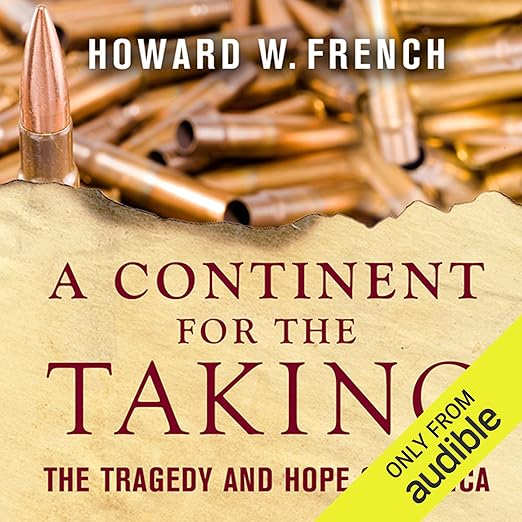
Howard W. French spent years as a New York Times correspondent in West and Central Africa during some of the most catastrophic periods of that region's recent history: the collapse of Mobutu Sese Seko's Zaire, Charles Taylor's arrival in Monrovia, the Rwandan genocide, and the Congo wars that followed and left millions dead. A Continent for the Taking is the audiobook form of what grew from that experience across twenty-five years of passionate engagement with the continent, and Mirron E. Willis's narration carries the dual register of the book, journalistic precision and ethical rage, with real skill across nearly eleven hours. One listener who heard a Fresh Air interview with French purchased the audiobook immediately and found it far exceeded what they had anticipated in both depth and emotional impact.
French is not writing a detached historical survey. He was present for many of the events he describes, and the personal dimension of the book is both its greatest strength and the source of its most interesting tensions. His frustration with Western hypocrisy, and with African political leadership that perpetuated the exploitation of its own populations, is not buried in diplomatic hedging. One reviewer called the book brilliant but a bit bitter, which seems about right as a description of its emotional register, though bitter may be too small a word for what French is actually expressing about decades of preventable catastrophe.
Willis Blends Reportage and History Seamlessly
The book blends two modes of writing that do not always coexist comfortably: eyewitness reportage and historical analysis. French moves between them without always signalling the transition clearly, and Willis navigates this by maintaining a consistent authorial tone that keeps both registers grounded in the same moral seriousness. The section on Mobutu's fall is the most cited highlight in the listener reviews, and it earns that attention. French had extraordinary access during that period, and his reconstruction of events is both detailed and morally specific in a way that distinguishes it from most journalism of the era.
The book's central argument is that Africa has been repeatedly failed by a combination of colonial legacy, Western political cynicism, and African leaders who perpetuated the extractive logic of colonialism under different flags. French is not gentle about this accounting. He is equally critical of American foreign policy in the region, French neocolonial influence, and leaders like Mobutu and Taylor whose depredations were tolerated or enabled by Western powers for strategic convenience. The audiobook form gives this argument an immediacy that cold historical prose can struggle to achieve, and Willis sustains that immediacy without melodrama.
Eleven Hours Beyond Crisis Journalism Cliches
Willis's narration is a significant asset. His voice carries weight without performative solemnity, and he handles the shifts between personal memoir, historical analysis, and political argument without letting any one mode overwhelm the others. For listeners whose understanding of Africa is formed primarily by crisis journalism, which tends to decontextualise events and present them as natural disasters rather than political failures with specific architects, this audiobook provides essential historical grounding. French names the architects, traces their relationships to Western governments, and refuses the comfortable narrative that portrays African suffering as simply the product of internal dysfunction.
The ten-hour-and-fifty-eight-minute runtime is substantial but feels appropriate to the scale of what French is covering. He is not writing about a single event or a single country: he is writing about a quarter century of political catastrophe across a continent, and the audiobook needs that time to let the individual stories, Mobutu's Zaire, Taylor's Liberia, the Rwanda genocide and its Congo aftermath, accumulate into a coherent argument about what went wrong and why. Listeners who commit to the full runtime will find that the later sections gain power from the accumulated evidence of the earlier ones.
The book also offers something that many Africa histories do not: a sense of the continent's genuine vitality and possibility alongside its political disasters. French saw extraordinary cultural richness and human resilience alongside the catastrophes he chronicled, and he is honest about both in a way that neither sentimentalises the one nor minimises the other.
Published in 2004, Politics Have Moved On
French's perspective is that of a journalist with deep personal investment in the region and genuine anger at how it has been treated by both foreign powers and its own political class. The book is not a neutral survey, and listeners who want a balanced account of all political actors will find French's moral clarity occasionally partisan. One reviewer noted the book is heavy on the tragedy and light on hope, which is accurate about the emotional texture, though French does include a final chapter articulating the genuine possibilities he sees in Africa's cultural and demographic strengths.
The book was first published in 2004, which means some of the political situations it describes have continued to evolve since French wrote about them. The historical analysis holds up, but listeners should be aware that events are presented as they stood at the time of writing rather than with subsequent developments incorporated. The Congo and West Africa situations in particular have continued to change significantly in the decades since.
French's Visceral Investment Rewards Committed Listeners
Listeners with an interest in African history, West African politics, the legacy of colonialism, or the role of foreign correspondents in shaping historical understanding will find this audiobook essential. It is also an excellent choice for anyone interested in how eyewitness journalism functions as a form of historical record that professional historians cannot easily replicate. Listeners who prefer surveys that maintain emotional distance from their subject should know that French's investment in his material is visceral and present throughout. This is not a comfortable listen, and it is not designed to be one.
At a Glance
- Narrator: Mirron E. Willis brings a grounded authority to French's firsthand account, balancing journalistic urgency with the historical gravity the subject demands across nearly eleven hours.
- Subjects: Western complicity in African political failure, the lasting weight of colonialism, eyewitness journalism as historical record
- Tone: Urgent and morally serious, with flashes of hard-won hope
- Bottom line: French's twenty-five years of West African reporting produces a book that demands more from its reader than most Africa journalism dares to, and this audiobook delivers that demand with full force.
Does this audiobook cover the Rwanda genocide in depth, or is the focus primarily on West Africa?
French covers both Rwanda and the Congo conflicts that followed the genocide alongside his West African reporting from Liberia and Zaire. The book traces French's experience across the region during the 1990s, with the Congo and Rwanda sections functioning as a culminating chapter in his argument about African political failure and Western complicity.
Is Mirron E. Willis's narration well-suited to the blend of personal memoir and political history in this audiobook?
Willis maintains a consistent authorial voice that handles the tonal shifts between journalism, memoir, and historical analysis without jarring transitions. His delivery suits French's measured but morally engaged prose, and he sustains the weight of the material across nearly eleven hours without letting the emotional intensity drop or become performative.
Does the audiobook offer any perspective on African political strengths, or is it primarily a chronicle of failure and catastrophe?
French explicitly addresses Africa's complexity, diversity, and cultural strengths in the book's later sections, and describes the work as ultimately hopeful despite its unflinching account of political disaster. The tone is earnest about possibility rather than performatively optimistic, and the final chapter articulates genuine grounds for what French sees as Africa's longer-term potential.
How does this audiobook compare to other journalism-based accounts of African politics from the 1990s?
French distinguishes himself by combining firsthand access with sustained historical analysis over twenty-five years, and by naming political actors, Western governments, and African leaders specifically and holding them to explicit accountability. This gives the audiobook a moral specificity that more academic or diplomatically cautious treatments tend to avoid.