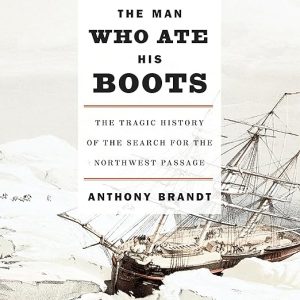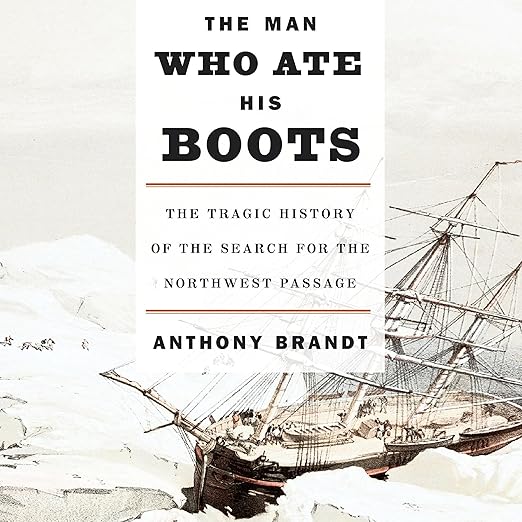
Quick Take
- Narration: Simon Vance brings his characteristic precision and stamina to a 15-hour narrative history, giving Brandt’s ensemble of explorers distinctive weight without resorting to melodrama. His pacing through long documentary stretches is excellent.
- Themes: British imperial obsession, survival at the margins of human endurance, the tragedy of Franklin’s lost expedition
- Mood: Propulsive and elegiac in equal measure, with a mounting dread that the historical record makes inevitable
- Verdict: One of the finest narrative histories of Arctic exploration available in audio, and Simon Vance is exactly the right narrator for it.
I started The Man Who Ate His Boots on a long overnight train journey, somewhere between cities, the window showing nothing but dark fields. There was something appropriate about that. Anthony Brandt’s account of the British obsession with finding the Northwest Passage is precisely about the compulsion to move toward an unreachable horizon regardless of what waits there. By the time I arrived at my destination the next morning, I had been with these men in the ice for seven hours and was not ready to leave them.
The book covers more than three decades of British Arctic exploration, from the resumption of the search after the Napoleonic Wars through the catastrophic loss of Sir John Franklin and his 128 men in 1845. Brandt is not writing a single biography or a tight incident account. He is doing something more ambitious: tracing a national pathology, the way an imperial power, flush with post-war confidence and genuine scientific curiosity, turned an open question on a map into a matter of prestige, then obsession, then grief. The scope is larger than any single expedition, and that breadth is what gives the book its authority.
The Architecture of Obsession
What Brandt does exceptionally well is give each expedition its own character without losing the thread of the larger story. John Ross, William Parry, George Back, John Franklin on his first overland journey, the one that produced the book’s title, the march so desperate that the men ate their own boots to survive: each of these figures is rendered as a specific human being operating within the specific pressures of their moment. The British Admiralty’s institutional culture of promotion through exploration, the class dynamics of officers and sailors, the debates about what equipment and methods to use. Brandt makes all of this feel immediate rather than archival. He is particularly good at showing how individual decisions that look like failures or miscalculations in hindsight were rational choices within the institutional logic of the era.
The Franklin material, which dominates the second half, is where the book reaches its full power. Lady Jane Franklin, who drove the search for her husband with extraordinary political skill for over a decade, is one of the more compelling figures in the book. Brandt handles her without condescension or hagiography. She was not simply a grieving wife. She was a strategist who understood Victorian public sentiment and used it, and she kept her husband’s legacy alive long enough to ensure that when evidence of what had actually happened finally emerged, he was remembered as a martyr rather than a failure.
The Franklin Fate, Told Unflinchingly
The final descent of Franklin’s expedition into scurvy, starvation, lead poisoning from canned food, and eventual cannibalism is handled with appropriate gravity. Brandt does not dwell on the horror gratuitously, but he does not look away from it either. This is responsible narrative history: the evidence is presented, the probable sequence of events reconstructed from material evidence and Inuit testimony, and the reader is left with a clear understanding of what happened without false certainty where the record remains incomplete.
One reviewer noted that the personal detail can feel excessive at times, that the backstories sometimes slow the main line of the narrative. This is a fair observation. Brandt’s thoroughness, which is one of his great strengths, occasionally tips into digression. But the shape of the whole justifies the proportions. No expedition in this saga exists in isolation from the others, and understanding why each subsequent Admiralty attempt made the choices it did requires understanding the men who made those choices. A book that treated these expeditions as mere plot incidents rather than human enterprises would be considerably less honest.
Simon Vance Through 15 Hours of Ice
Simon Vance is one of the most capable narrators working in historical nonfiction, and this is among his better performances. He manages the documentary passages, the long stretches of logistical detail and political maneuvering, without losing the listener’s attention. His voice for the expedition accounts, colder and more stripped-down, shifts effectively from the drawing-room scenes in London. At 15 hours, the audiobook is substantial but never punishing. The structure gives natural pause points at each expedition’s conclusion, making it entirely manageable to listen across multiple sessions over several days.
Arctic Reading Order: Where This Fits
Essential listening for anyone interested in Arctic exploration, naval history, or the Victorian relationship with geographic ambition and national identity. Readers who enjoyed Hampton Sides’ In the Kingdom of Ice, which covers a parallel American Arctic disaster, will find Brandt’s book a natural companion and the more analytically rich of the two. Skip if you need a tightly focused narrative rather than a comprehensive account, or if 15 hours of predominantly male ensemble cast in a single frozen theater sounds like too much. But if the subject draws you at all, this is the book to listen to first.
Frequently Asked Questions
Does the book cover the more recent forensic findings about lead poisoning and the canned food theory?
Brandt engages with the forensic and archaeological evidence available at the time of writing, including discussions of lead contamination and Inuit oral accounts. More recent excavations of the Erebus and Terror, both ships found after the book’s publication, are not covered, so listeners wanting the most current Franklin scholarship may want to supplement with more recent material.
Is this a good starting point for someone who knows nothing about the Northwest Passage search?
It is an excellent starting point. Brandt builds the context carefully from the beginning, explaining the geographic, political, and scientific stakes before the expeditions begin. The reviewer who described being surprised by how much more there was to the story is a representative response from readers coming in without prior knowledge.
How does The Man Who Ate His Boots compare to Michael Palin’s Erebus?
Palin’s Erebus is a narrower, more atmospheric account focused specifically on the final Franklin expedition and the ship herself. Brandt’s book is broader in scope, covering the full three-decade arc of the search. They complement each other well, with Palin offering depth on the final voyage and Brandt providing the essential context for why that voyage mattered so much to the people who sent it.
Is the title explained early in the book?
Yes, the title refers to Franklin’s first overland expedition through northern Canada in 1819-1822, during which the party was reduced to eating lichen, leather, and eventually their own boots to survive. Brandt covers this early in the narrative as the incident that paradoxically made Franklin a hero in Britain, since the sheer extremity of what he endured was read as proof of exceptional courage rather than catastrophic planning.