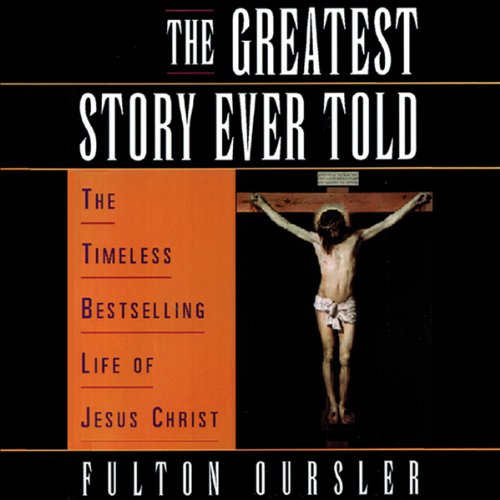
Fulton Oursler's novel about the life of Jesus Christ was published in 1949 and remained continuously in print for decades afterward. It was adapted into a major film in 1965. It received an introduction by Billy Graham. And yet it had never been produced as an audiobook until this recording, narrated by Edward Herrmann, made it available to listeners in that form. That combination, a 75-year-old work of religious fiction arriving in audio with a preface by an evangelist and a narrator whose voice is among the most recognizable in American audiobook production, requires some contextual orientation before the review can be useful to a prospective listener. The audiobook that is The Greatest Story Ever Told is a specific kind of experience, shaped by when it was written, by who wrote it, and by what form it takes, and knowing that context in advance helps a listener decide whether to invest six hours in it.
Oursler's approach was to take the Gospels of the New Testament as structural source material and surround those documented events with imagined dialogue and historical texture, while maintaining, as the synopsis describes it, Biblical integrity. He was not writing theology; he was writing narrative fiction grounded in scripture. The distinction is significant for understanding what kind of audiobook this is. Listeners who arrive with purely scholarly expectations about the historical Jesus will find the fictionalized dialogues disorienting. Those who arrive expecting a straight devotional reading of the New Testament will find the novelistic approach to Biblical characters unexpectedly dramatic. The book was most embraced historically by readers who wanted the Gospel story told with narrative momentum and imaginative historical texture, and that is precisely what Oursler delivers.
The scope of the narrative is comprehensive. From the nativity through the Holy Family's flight into Egypt, Christ's public ministry in Galilee and Judea, the events of Holy Week from the triumphal entry through the Last Supper, the passion, death, and resurrection, Oursler covers the full arc of the Gospel accounts while filling in the historical background of first-century Roman Palestine with care. Reviewers who describe being transported to the historical scene are responding to that immersive detail. One reviewer specifically notes the texture extending from the introduction of Barabbas through Pilate's court as particularly vivid. The historical imagination here is what distinguishes Oursler's book from a plain prose retelling and what justifies a novelistic approach to material whose basic outline is already known to most readers.
Herrmann's Classical Weight Matches Oursler's Formal Prose
Edward Herrmann is exceptionally well-suited to this material, and the casting of this audiobook represents a genuine alignment between narrator and text. His voice carries a classical weight and measured authority that aligns with the formal prose style Oursler employed. Oursler was not writing in a contemporary vernacular; he was writing in a register pitched to the seriousness and significance of his subject, and Herrmann meets that register without over-performing it or allowing the formality to become stiffness. The invented dialogues are particularly challenging to narrate convincingly because they need to sound plausible within the world of first-century Judea while also carrying the narrative function Oursler assigned them. Herrmann handles that challenge with the controlled authority his voice naturally projects.
At six hours and ten minutes, the audiobook is long enough to feel like a complete and immersive experience without becoming arduous. The runtime also reflects the comprehensiveness of Oursler's coverage. He is not abridging the Gospel narrative but expanding it with historical texture, and six hours allows that expansion the room it requires. The Billy Graham introduction that precedes the main text establishes the book's evangelical reception history clearly. For listeners coming from within that tradition, Graham's presence will feel like appropriate framing. For listeners from other faith traditions or secular orientations, the introduction provides useful context about how this text has been positioned and received across the decades since publication.
Dialogue Designed to Feel Plausible, Never to Challenge
Listeners should approach this audiobook with a clear understanding of the tradition Oursler is working within. He is writing pious historical fiction in a form with specific conventions: the dialogue he invents for Biblical characters is dignified, theologically consonant, and designed to feel plausible within the Gospel accounts rather than to surprise or challenge them. Those who want revisionist or skeptical treatments of the historical Jesus will not find them here. Oursler's project was to make the Gospel narrative vivid and emotionally accessible to a mid-century American reader, and he succeeds on those terms. The project is not about historical reconstruction in the academic sense but about imaginative access to a narrative that many readers knew only in the formal register of scripture.
The political texture of the audiobook is also worth noting. Oursler gives considerable attention to the Roman political context of Judea, to Pilate's position as a Roman administrator navigating competing pressures from Jewish religious authorities and his own imperial obligations, and to the social world within which the Pharisees, tax collectors, fishermen, and disciples all occupied specific positions. Those sections, which one reviewer describes as bringing every character fully to life, reflect Oursler's investment in historical plausibility as the foundation for imaginative engagement.
A Bridge From Gospel Story Into Literature
This audiobook is for listeners who approach it with either Christian faith or genuine curiosity about how the Christian narrative has been told and received across the twentieth century. Devotional listeners who have found direct Biblical reading abstract will find Oursler's novelistic approach reinvigorating. Those interested in mid-century American religious culture will find the 1949 publication date and Graham's introduction as historically interesting as the text itself. Listeners who want to understand the Gospels as literature before engaging with them as scripture may find this audiobook a useful bridge. Those seeking critical or academic analysis of the historical Jesus should look to different resources; Oursler's text is imaginative reconstruction in service of faith rather than historical scholarship in service of accuracy.
At a Glance
- Read by: Edward Herrmann brings classical authority to Fulton Oursler's 1949 novelization, lending the invented dialogue and historical passages the gravitas the source material requires.
- At its heart: Life of Christ, fictionalized New Testament, 1st-century Judea, faith and imagination
- Vibe: Reverent and cinematic
- Short version: Oursler's celebrated novelization of the Gospels arrives in audio for the first time, matched with a narrator whose voice is precisely suited to the material's formal register.