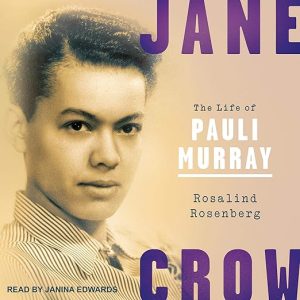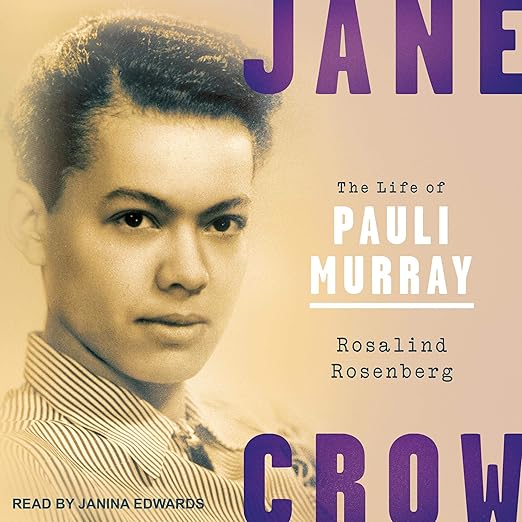
Pauli Murray's name appears in law school casebooks, in footnotes of Supreme Court decisions, and in the acknowledgments of movements she helped spark but rarely led from the front. This audiobook, Rosalind Rosenberg's Jane Crow, narrated by Janina Edwards over 18 hours and 30 minutes, is the definitive attempt to pull Murray from those margins and place her at the center of the story where she belongs. Murray attended Hunter College, graduated first in her class at Howard Law School, earned the first JSD awarded to an African American at Yale, co-founded what became NOW, and was ordained as one of the first women Episcopal priests. She accomplished all of this while being rejected twice from graduate programs at the University of North Carolina and Harvard, the first time for race and the second time for sex. Rosenberg's audiobook is the story of a life shaped entirely by double exclusion and of the singular intellect and determination that refused to accept that exclusion as a ceiling.
Credit That Went to Marshall Instead of Murray
The biography's central argument is that Murray's concept of "Jane Crow" was not a rhetorical flourish but a legal strategy. When she advanced the idea before the President's Commission on the Status of Women in 1962, she was applying the same constitutional logic she had helped develop for racial equality to gender discrimination. The connection was not metaphorical. It was jurisprudential. Rosenberg documents carefully how Murray's Howard Law School scholarship formed part of the conceptual backbone for the NAACP's approach to challenging segregation, including arguments that informed the landmark Brown v. Board of Education case. The fact that Thurgood Marshall received the recognition and Murray did not is a recurring motif in this biography, handled without bitterness but with clear-eyed honesty about how gender and race combined to limit whose contributions got credited and whose got absorbed anonymously into the record.
Murray's personal life receives equally serious treatment, and it is one of the audiobook's most significant contributions to the historical record. Her gender identity, which contemporary readers might describe as nonbinary or transgender, is addressed with genuine care by Rosenberg, who draws extensively from Murray's own surviving papers. Murray did not have the vocabulary of today's discourse available to her, but she understood herself as different in ways she spent decades trying to reconcile, writing privately and at length about her sense of being neither the person she appeared to be nor the person others expected her to become. Rosenberg neither retrofits modern categories onto Murray's self-understanding nor dismisses what Murray herself wrote about her identity. The result is a portrait of someone navigating profound self-knowledge without a map, while simultaneously conducting legal and activist battles on behalf of others who were also navigating exclusion.
Edwards Keeps the Listener Oriented Through Complexity
Janina Edwards's narration is well-suited to a biography of this seriousness. Her pacing gives weight to the dense legal passages without allowing them to become lectures, and she shifts registers convincingly between Murray's private correspondence and the institutional history that surrounds it. The archival depth Rosenberg brings means some passages are packed with names, dates, and organizational histories that reward full attention rather than background listening. Edwards keeps the listener oriented through that complexity without simplifying it.
What makes the listening experience particularly worthwhile is how Rosenberg builds the accumulative force of Murray's career. Each rejection, each strategic pivot, each alliance formed with figures like Eleanor Roosevelt, who appointed Murray to the President's Commission on the Status of Women, and Betty Friedan, whom Murray persuaded to establish what became the National Organization for Women, adds to a portrait of someone operating with extraordinary precision under extraordinary constraints. Rosenberg contextualizes each milestone within the institutional barriers Murray was simultaneously dismantling, which gives even the relatively quieter chapters of Murray's life a sense of forward motion.
A Priesthood Continuous With Her Legal Work
Listeners should be prepared for a biography that is comprehensive rather than propulsive. Rosenberg is a historian first, and the book carries that sensibility throughout. The early chapters on Murray's North Carolina childhood, her mixed-race family background, and her years as a labor activist in New York in the 1930s establish context that pays dividends later, but those sections require patience from listeners expecting the more dramatically charged legal material to arrive quickly. That said, the biographical approach Rosenberg adopts never becomes dry. Murray's own voice comes through vividly in letters and diary entries that Rosenberg quotes at length, and those passages are among the audiobook's most affecting.
The chapters dealing with Murray's religious life deserve particular attention. In 1977, Murray became one of the first women ordained as an Episcopal priest, and this dimension of her story is treated with the same seriousness as her legal and activist career. Her faith was not a late-life departure from her earlier work; it was continuous with it in ways that Rosenberg articulates carefully. That insight, developed over several chapters near the biography's close, reframes everything that came before it and makes the final sections of this very long audiobook feel essential rather than supplementary.
Influence That Far Exceeds Current Recognition
This audiobook is for listeners who want the unabbreviated version of a life that changed American law in ways that have been systematically under-credited. Readers familiar with Brown v. Board of Education or the founding of NOW will find this biography reorients their understanding of both those events by making visible a contributor who shaped them from behind the formal record. Students of American legal and political history, listeners drawn to LGBTQ+ biographical narratives that engage with historical complexity rather than flattening it, and anyone who has wondered why certain names appear everywhere in footnotes but never in headlines will find this audiobook one of the more rewarding investments in the biography section of any listening library. It is not a short or easy listen, and it demands sustained attention. What it offers in return is a complete and rigorously sourced picture of someone whose influence on American life far exceeds her current recognition.
A Few Questions About Jane Crow
Is the Jane Crow audiobook accessible to listeners without a legal or academic background?
Yes, though some familiarity with the civil rights movement helps. Rosenberg explains the jurisprudential concepts Murray developed clearly, and Edwards's narration keeps the academic material from feeling dense. Listeners without legal training will follow the arguments; those with it will appreciate the precision of Rosenberg's scholarship.
Does this audiobook address Pauli Murray's gender identity directly and with historical care?
It does, and with considerable nuance. Rosenberg works from Murray's own personal papers and applies historical sensitivity rather than anachronistic labeling. The sections on Murray's self-understanding are among the most carefully researched passages in the biography and are handled with genuine respect.
Do I need prior knowledge of the civil rights movement to get full value from this audiobook?
A general familiarity with Thurgood Marshall, Eleanor Roosevelt, and Betty Friedan helps, but Rosenberg provides enough context that the audiobook stands independently. Murray's relationships with all of those figures are explained fully as they arise in the narrative.
How does this audiobook compare to other civil rights-era biographies in terms of scope and depth?
It sits firmly in the scholarly biography tradition, comparable in rigor to Taylor Branch's multi-volume King series. Rosenberg had access to Murray's extensive personal archive, which gives the biography a primary-source depth that distinguishes it from more survey-oriented treatments of the period.