Quick Take
- Narration: Suzanne Toren delivers Roosevelt’s voice with calm authority and warmth, making the Depression-era prose feel surprisingly immediate.
- Themes: women’s civic responsibility, domestic economy during crisis, gender and public life
- Mood: Thoughtful and historically rich, with moments that feel startlingly current
- Verdict: Essential for anyone drawn to first-wave feminist history or the political biography of Eleanor Roosevelt.
I came to this one expecting a period piece and found something more unsettling: a text that kept sounding like it was written last week. I was folding laundry on a Sunday afternoon when Suzanne Toren, reading Eleanor Roosevelt’s words from the height of the Great Depression, started talking about women taking personal responsibility for keeping the economy afloat, and I had to stop the playback just to sit with that for a moment.
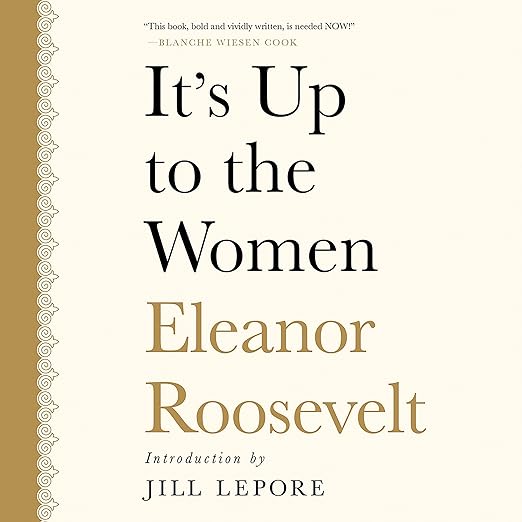
Published in 1933, It’s Up to the Women is part advice manual, part civic call-to-arms, and part economic primer from a woman who had just watched her husband walk into the White House while she quietly dismantled every expectation of what a First Lady was supposed to be. Jill Lepore’s introduction, included in this audio edition, sets the stakes well: Roosevelt went on a national tour, wrote a newspaper column, championed civil rights, and then sat down to write this book. That context matters.
Our Take on It’s Up to the Women
What strikes you immediately is how Roosevelt refuses sentimentality. This is not a book about sisterhood in the abstract. It is relentlessly practical: how to cut household costs, how to cook nutritious meals cheaply, how to organize community support networks, how to vote, how to demand policy changes. The recipes feel dated. The civic urgency does not. Reviewer Karen Heenan, who purchased the book while researching 1930s women for a novel she was writing, noted that it was extremely helpful not only in reproducing Roosevelt’s voice but in understanding the concerns of the time applied to women of all social classes. That dual quality, historically grounded yet personally applicable, is exactly right.
There is a passage where Roosevelt argues that working women need time for themselves in order to fully enjoy time with their families. In 1933. The line sits there perfectly plainly, without fanfare, as though it were obvious. In many ways, that is the book’s most consistent rhetorical move: stating as simple fact things that were actually radical.
Why Listen to It’s Up to the Women
Suzanne Toren is an excellent casting choice here. Her voice carries weight without theatrics, which suits Roosevelt’s no-nonsense prose. This is not a text that benefits from heavy performance; it benefits from clarity, and Toren provides that in full. At just over five hours, the listening experience is tight, with no padding. If anything, the book’s brevity is part of its character: Roosevelt was not interested in philosophical excess.
The audio format also helps with the passages that are most obviously dated. When Roosevelt writes about women’s domestic obligations in language that would make a contemporary reader wince, hearing it in Toren’s measured delivery creates a useful critical distance. You are listening across nearly a century. That gap is part of the point.
What to Watch For in It’s Up to the Women
One reviewer on Audible described the book as very dated and passe, which is fair and also slightly beside the point. Of course it is dated. Women had held the vote for only fourteen years when Roosevelt was writing it. The legal and social landscape she describes is barely recognizable. But the datedness is itself the material. Listening to what a politically astute woman in 1933 thought women were capable of, and what she believed they owed each other and their country, is a lesson in how far social change travels and how slowly it sometimes moves. If you approach this as a historical document rather than a self-help title, it rewards serious attention.
There is also a thread running through the book about women’s presence in the new social order, a phrase Roosevelt uses without irony, that reads now as both triumphant and incomplete. She could see further than most of her contemporaries. She could not see everything. Sitting with that tension is genuinely interesting work for a listener willing to do it.
Who Should Listen to It’s Up to the Women
Listeners who enjoy reading primary sources in women’s history, who are working through the political biography of Eleanor Roosevelt, or who want to understand what Depression-era feminism actually sounded like will find this essential. Writers researching the 1930s, as Karen Heenan noted, will find Roosevelt’s voice and preoccupations unusually well-preserved here. Listeners who want a straightforward self-help listen or who are not prepared to engage critically with dated assumptions about domesticity should look elsewhere.
Frequently Asked Questions
Is this book only relevant to women readers?
Not really. Roosevelt’s argument is fundamentally about civic participation and economic responsibility, subjects that extend well beyond gender. That said, the book is explicitly addressed to women, and its historical significance is inseparable from that framing.
How does Jill Lepore’s introduction add to the audiobook experience?
Lepore’s introduction provides essential context about Roosevelt’s political evolution after entering the White House, including her national tours and civil rights advocacy. It reframes what follows as a political act, not just a self-help manual.
Is the content too dated to be useful today?
Some sections, particularly the domestic economy advice and certain assumptions about women’s roles, are unmistakably of their era. But the civic arguments and Roosevelt’s insistence on women’s active public role remain surprisingly resonant. Treat it as a historical document, not a how-to guide.
Does Suzanne Toren’s narration suit Roosevelt’s writing style?
Very well. Toren’s clear, authoritative delivery mirrors Roosevelt’s own no-nonsense prose. She does not dramatize the text, which is exactly the right choice for material that carries its own weight.