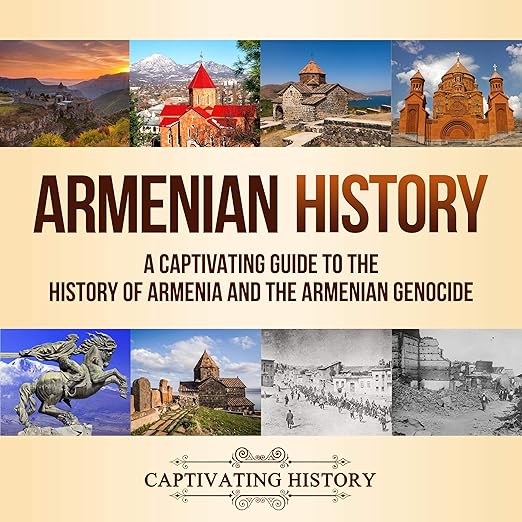
In Brief
- Performance: Jason Zenobia delivers the two-manuscript format with consistent energy across 7 hours, well-suited to a survey covering thousands of years in relatively compact form.
- What it covers: Armenian civilizational continuity, the Ottoman Armenian Genocide, resistance and survival across centuries
- Feel: Earnest and narrative-driven, with a gravity appropriate to the subject matter
- Our call: A solid introductory double feature for listeners who want both the broad sweep of Armenian civilization and the specific history of the 1915 Genocide without committing to specialist scholarship.
Armenian history is one of the more consequential bodies of historical material that general audiences encounter in fragments: a mention of Mount Ararat, a reference to the Genocide, perhaps an awareness of the Armenian diaspora's influence on art and culture. The Armenian History audiobook from Captivating History addresses that gap directly, packaging two separate manuscripts into a single 7-hour production narrated by Jason Zenobia. The structure is characteristic of the Captivating History series: broad survey paired with a more specific thematic study, delivered in accessible narrative style rather than academic register.
Two Manuscripts, One Steady Narrator
The first manuscript, History of Armenia, covers the full sweep of Armenian civilization from ancient Urartu through the Soviet period and the 1991 declaration of sovereignty. The scope is genuinely ambitious, moving through Urartu's rise and fall, the Armenian Apostolic Church's foundational role in national identity, the medieval Crusader period, successive conquests by Persians, Arabs, Mongols, Ottomans, and Russians, and the modern period of genocide and diaspora. For a single manuscript of this breadth, the narrative necessarily moves quickly through individual periods, but the connective tissue between episodes is handled well enough that the listener emerges with a sense of Armenia's civilizational continuity rather than a disconnected list of events.
The second manuscript, The Armenian Genocide, focuses on the systematic massacre of Armenians by the Ottoman Empire between 1915 and 1923. The chapter titles in the synopsis are direct and unflinching: Red Sunday, Death March, One Thousand Orphans, The Black Sea Runs Red, Operation Nemesis. Captivating History's approach to this material is appropriately serious. The Genocide is the defining trauma of modern Armenian identity and the subject of ongoing political denial by Turkey, so the editorial choice to cover it with a dedicated manuscript rather than a chapter in the broader survey is the right call. The two-part structure prevents the atrocity from being absorbed into the larger historical sweep as just another chapter in a long story of conquest.
Zenobia's narration is consistent across both manuscripts, which aids the sense of continuity between them. His delivery is measured and clear, not sensationalized, and the measured tone is appropriate for material that requires neither dramatic inflation nor clinical distance to convey its weight.
Long Historical Sweep, Two Listening Units
The audiobook format suits this material particularly well because it allows listeners to absorb a long historical sweep without the eye fatigue that dense historical prose can produce on the page. The two-manuscript structure also allows listeners to engage with the survey and the Genocide history as separate units. Someone who already has background in general Armenian history can move directly to the second manuscript without feeling obligated to revisit material they already know. Chapter navigation on most platforms makes that flexible engagement practically straightforward.
At 7 hours total for two manuscripts covering thousands of years and one of the twentieth century's major atrocities, the depth is introductory rather than scholarly. The Captivating History series is designed for general audiences approaching a topic for the first time, and that target shapes both the vocabulary and the scope of the treatment. One reviewer notes they could not put it down and would recommend it to anyone interested in the history of major kingdoms and empires. That is an accurate summary of the series' positioning and its honest limitations for more specialist readers.
Operation Nemesis Amid a Compressed Survey
Listeners with Armenian heritage may find certain editorial choices in the historical survey less satisfying than a more specialized treatment would be. The rapid pace through long periods means the nuanced political and cultural history of specific eras, including the Cilician Armenian kingdom, the dynamics of Ottoman millet governance, and the Soviet Armenian period, is necessarily compressed. The Genocide manuscript is more focused and sustains its argument with more detail than the survey allows for individual periods, creating some imbalance in depth between the two components.
The Captivating History series approaches its subjects from a narrative perspective rather than a historiographic one. Primary source debates, scholarly disagreements about periodization, and the historiography of the Genocide's place in international law are not the focus. Listeners seeking to understand where historians disagree about specific questions will need to follow up with more specialized scholarship. What this audiobook does well is provide the chronological and contextual foundation that makes specialist reading comprehensible when you are ready to pursue it.
The Operation Nemesis chapter in the second manuscript deserves specific mention for listeners who are unfamiliar with that chapter of Armenian history. Operation Nemesis was a secret Armenian Revolutionary Federation campaign in the early 1920s that targeted perpetrators of the Genocide who had escaped justice after the war. The story of the operation, including the assassination of former Ottoman officials in Berlin and other European cities, reads like thriller narrative but is entirely documented history. Captivating History covers it with appropriate seriousness, and for many listeners it will be the most surprising and morally complex section of the entire production.
Reliable Introduction to Armenian History and Genocide
Listeners with no prior knowledge of Armenian history who want a reliable, accessible introduction to both the full civilizational sweep and the specific history of the 1915 Genocide will find this audiobook a useful starting point. The double-manuscript format provides more content per listening hour than most single-topic introductions in this series. History enthusiasts who have covered the major Western and East Asian narratives and are expanding their coverage into the Middle East and Caucasus region will find Armenia a compelling subject and this production a reasonable entry point. Specialist readers or listeners with existing knowledge of Armenian history will find the treatment too introductory for their level of engagement with the material.
A Few Questions About Armenian History
Do I need to listen to both manuscripts in this audiobook, or can I jump straight to the Armenian Genocide section?
The two manuscripts are designed to work together but function independently. Listeners with some background in Armenian history can move directly to the Genocide manuscript, which covers the 1915-1923 period in dedicated detail. First-time learners will benefit from the survey manuscript first since it establishes the centuries of context that give the Genocide its specific historical weight.
How does Jason Zenobia handle the emotional weight of the Genocide content in his narration?
Zenobia maintains a consistent, measured delivery throughout both manuscripts. He does not sensationalize the material in the Genocide sections but reads the content with appropriate gravity. The Captivating History house style tends toward clear narrative prose rather than emotionally charged language, and Zenobia reflects that in his delivery throughout.
Is this audiobook accurate about the Armenian Genocide given that Turkey still officially denies it?
Captivating History treats the Armenian Genocide as the established historical consensus event that it is, recognized by most historians, genocide scholars, and many national governments. The audiobook presents it as deliberate systematic mass murder rather than wartime casualties, which aligns with the scholarly record. Turkey's official denial position is not reflected in the content.
At 7 hours covering thousands of years of history, how deep does this audiobook actually go?
The depth is introductory. The Captivating History format prioritizes narrative accessibility and broad coverage over scholarly depth. The survey manuscript moves quickly through major periods to give listeners a chronological framework. The Genocide manuscript is somewhat more detailed since it covers a concentrated period. Both manuscripts are designed to orient a new listener rather than to satisfy a specialist.