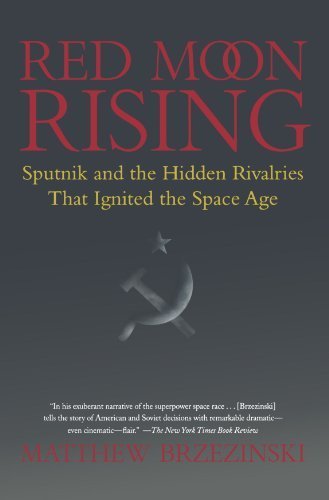
Matthew Brzezinski opens Red Moon Rising not in orbit but on the ground, with a V-2 launch against London, which is exactly the right choice. The audiobook makes this clear from the opening minutes: the space race did not begin in the inspiration of scientific wonder. It began in the terror of ballistic missiles, in the realization by everyone involved that the technology that could put a satellite into orbit could also deliver a nuclear warhead to any city on earth. Brzezinski understood that the emotional core of the Sputnik story is not ambition but fear, and Charles Stransky's narration, measured and authoritative, delivers that understanding clearly across eleven-and-a-half hours.
Brzezinski takes us inside multiple closed rooms simultaneously: the Kremlin, the White House, secret military facilities, Congressional hearing rooms, and the deep-cover spaces where rival intelligence services tried to understand what the other side was building. The dramatis personae is extraordinary. Survivors of the Soviet gulag who ended up building the rockets, rehabilitated Nazi scientists working for both sides, corporate chieftains navigating Pentagon procurement, a general who won the day specifically by refusing to follow orders. Brzezinski moves between them with confidence, and Stransky's narration keeps the characters distinct across a large and varied ensemble.
The structural insight that makes the book work is Brzezinski's insistence that the battles on earth were as dramatic as anything that happened in orbit. Sputnik itself, the event of October 4, 1957, takes less than a chapter to describe. The real story is everything that made it possible and everything it set in motion. The domestic politics of American scientific ambition, the specific ways in which interservice rivalry between the Army, Navy, and Air Force allowed the Soviets to reach orbit first: this is where Brzezinski does his best work, and it is where the book most clearly distinguishes itself from other accounts of the same period.
The New York Times Book Review observed that Brzezinski tells the story with remarkable dramatic flair, almost cinematic in its construction, and in audio that observation becomes even more applicable. The book was praised by one reviewer as their single favorite, one they keep and return to. Another called it absorbing from start to finish, noting the atmospheric quality of the opening V-2 description and praising the way it illuminates the internal politics that lay behind the early space programs. In audio, the Cold War atmosphere comes through with particular vividness under Stransky's control.
What Stands Out
The documentary sourcing is one of the book's real strengths. Brzezinski drew on original interviews and newly available documentary sources from both sides of the Cold War, giving the narrative access to decisions and conversations that had not previously been on the public record. The account of how Nikita Khrushchev used Sputnik's launch politically, how it was calibrated to frighten the American public and intimidate allies, is one of the most specific and revealing passages in a book full of specific reveals. The passage about the dog Laika, sent aloft in Sputnik 2 and reported to have died within hours when the heat insulation failed, is handled without sentimentality but without dismissiveness either.
The audiobook excels because the material is genuinely cinematic and Stransky's narration serves that quality consistently. His energy does not flag across the eleven-and-a-half hours, and the Cold War paranoia never drains out of the performance. Brzezinski's account of American institutional failure in the years before Sputnik is particularly compelling in audio, where the accumulation of missed opportunities and bureaucratic self-interest builds to a conclusion that feels genuinely consequential.
What to Watch For in Red Moon Rising
The book covers the period leading up to and immediately following Sputnik's launch, which means it does not extend to the later years of the space race or the Apollo program. Listeners wanting a comprehensive history of American space exploration will find this an excellent foundation but will need to look elsewhere for what came after. Brzezinski is telling a specific story about a specific technological and political moment, and he tells it completely within that scope.
Some readers have noted that the book functions better as a dramatic narrative than as a technical history of rocketry. Brzezinski explains the technology clearly enough to follow the competitive dynamics, but specialists looking for engineering depth will not find it here. The human and political story is primary; the technical story is context. The balance serves the general listener well but may frustrate those with deep technical interest in propulsion or orbital mechanics who come expecting something closer to a scientific account.
Is This One for You?
This audiobook rewards listeners drawn to Cold War history, political thriller dynamics, and the intersection of science and geopolitics. It pairs naturally with books like David Hoffman's The Dead Hand and Richard Rhodes's nuclear history series. Those who want to understand how Sputnik changed American science education, defense policy, and public psychology will find Brzezinski's account the most readable available treatment. Listeners primarily interested in the technical history of space exploration will want supplementary reading alongside this one, but as a political and institutional narrative of how the space age actually began, Red Moon Rising remains the standard against which other accounts of the same period are measured. Brzezinski's combination of original sourcing, dramatic construction, and historical range produces a book that rewards both first-time listeners and those who return to it knowing how it ends.
Frequently Asked Questions
Does the Red Moon Rising audiobook cover the full history of the space race, or just Sputnik?
Just Sputnik and its immediate aftermath. Brzezinski is telling the story of how the space age began, not the full arc from 1957 to the moon landing. The scope is the late 1950s, with context reaching back to V-2 development and forward to the initial American response to the Soviet lead. It is a complete story within that frame.
How does Charles Stransky's narration handle the large cast of characters in Red Moon Rising?
Well. Brzezinski's ensemble includes Soviet scientists, American generals, politicians, and spies, and Stransky keeps them distinct without resorting to caricature. The Cold War atmosphere comes through clearly in the narration, which maintains tension across nearly twelve hours without flagging.
Is Red Moon Rising audiobook accessible to listeners without a physics or engineering background?
Yes. Brzezinski's primary focus is political and human, not technical. He explains the competitive dynamics, the institutional failures, and the geopolitical stakes clearly without requiring scientific background. The technical material is present but serves the story rather than driving it.
How does this audiobook compare to other Cold War history titles in terms of primary source depth?
Favorably. Brzezinski drew on original interviews and documentary sources not previously available to historians, including material from the Soviet side. The book is not archival scholarship in the academic sense, but it has more primary sourcing than most popular histories of the period, and the narrative reflects that depth.