Quick Take
- Narration: Carrie Goetz narrates her own book, and her industry insider voice gives the career guidance an authenticity that a professional narrator couldn’t replicate.
- Themes: Data center career paths, infrastructure fundamentals, workforce access
- Mood: Encouraging and practical, like a mentorship session with someone who has been in the industry for decades
- Verdict: A genuinely useful career primer for the data center industry, most valuable for career-switchers and tradespeople who want to understand what opportunities actually exist and how to access them.
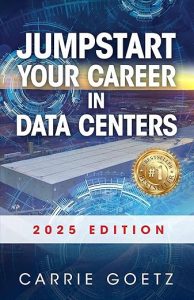
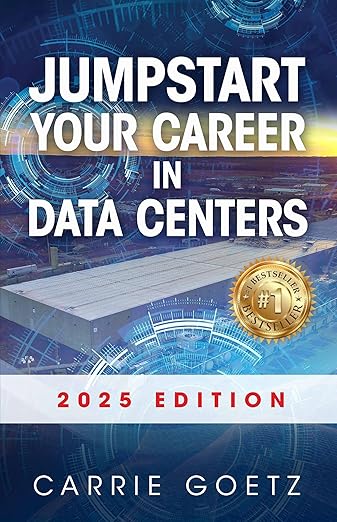
On a Wednesday evening not long ago, I was talking with someone just out of a community college trades program who had no idea that data centers employed people with exactly her skill set. She knew about IT jobs in the abstract, but the physical infrastructure side of the industry, the power systems, the cooling, the construction and facilities management, had never been presented to her as a career path. Carrie Goetz wrote this book specifically for people in that position, and it’s worth taking seriously as a resource because it’s filling a gap that genuinely exists.
Goetz has decades of industry experience, and the self-narration here is not a cost-cutting measure but a feature. Her voice carries the kind of relaxed authority that comes from having actually done the work and having thought carefully about how to explain it to people who haven’t. One reviewer described the book as simplifying complex concepts in a fun-to-follow format and noted that it made them unable to put it down, which surprised them given their expectation that a book about data center infrastructure would be dry. The updated 2025 edition adds material on AI’s role both as an operator and end-user of data center resources, which is a meaningful revision given how dramatically AI workloads have shifted infrastructure demand in recent years.
The Breadth of the Opportunity Map
The book’s most practically useful section is its survey of more than 200 job roles within the data center ecosystem. Goetz organizes these across the full spectrum: tradespersons including electricians, plumbers, and HVAC technicians; degreed professionals in networking, cybersecurity, and systems administration; and non-technical roles in project management, real estate, procurement, and operations. The stated entry point for many of these positions, starting salaries over $100,000 with college debt relief programs in some cases, is accurate enough to the current market that it doesn’t read as exaggeration. The industry is genuinely experiencing a significant talent shortage, and Goetz documents that shortage with specific numbers rather than vague claims.
Infrastructure Fundamentals Without the Jargon Wall
The technical content covers power systems, cooling, physical security, networking, server infrastructure, whitespace management, and sustainability. Goetz’s goal is not to make you an expert in any of these areas but to give you enough conceptual fluency to understand where your existing skills fit and to have informed conversations during job interviews and onboarding. Reviewers with backgrounds in data center development praised its ability to introduce fundamentals without condescension, which is harder to achieve than it sounds. The new sections on liquid cooling and AI infrastructure requirements reflect actual shifts in how hyperscale and colocation data centers are being built right now.
Resources, Pathways, and Who This Is For
The book includes specific resources: scholarships, certifications, veteran support programs, women’s industry initiatives, and trade organization contacts. This practical appendix content works well in audio because Goetz reads it with the same conversational warmth as the rest of the book, rather than slipping into a list-recitation mode. A minor note for listeners: this is the kind of resource book you’ll want to return to in sections. Goetz structures it around the who-what-where-when-why-how framework, which makes it relatively easy to navigate back to specific chapters once you’ve done an initial listen-through. The five-star ratings, drawn from a small but consistent reviewer base, align closely with the accounts of actual data center professionals who describe it as the first book to offer career guidance specific to the industry rather than general IT career advice.
For listeners who have been considering a career move into infrastructure or who know someone in the trades looking for a higher-growth path, this is a rare resource: genuinely specific, genuinely useful, and narrated by someone who knows the industry rather than summarizing it from the outside.
Frequently Asked Questions
Does this book work for people with no IT background at all?
Yes. Goetz explicitly addresses tradespersons, recent graduates, career-switchers, and pre-apprentices without assuming any prior IT knowledge. She explains the ecosystem from the ground up and helps readers identify which of their existing skills, whether in electrical work, plumbing, construction management, or facilities, map to specific data center roles.
Is the 2025 update substantially different from earlier editions?
The AI infrastructure sections are the most significant additions. Given how dramatically AI workloads have reshaped data center design requirements, particularly around power density and cooling systems, this material is genuinely new rather than cosmetically updated. If you have an earlier edition, the infrastructure fundamentals remain valid but the AI context is worth adding.
Does Carrie Goetz’s self-narration work for a listen-through, or is this better in print?
Her narration is one of the book’s strengths. The conversational warmth she brings makes the career guidance feel personal rather than generic. The resources sections, which include scholarship programs and certification pathways, are worth noting for follow-up; keep a notepad handy or be prepared to replay those sections.
What’s the difference between this book and general IT career guides?
Most IT career books focus on software development, cybersecurity, or systems administration as understood from the software side. Goetz’s book is specifically about the physical infrastructure layer: power, cooling, construction, facilities management, and operations. That niche focus is what makes it unusual and useful for the specific audience she’s addressing.