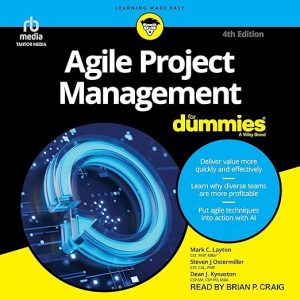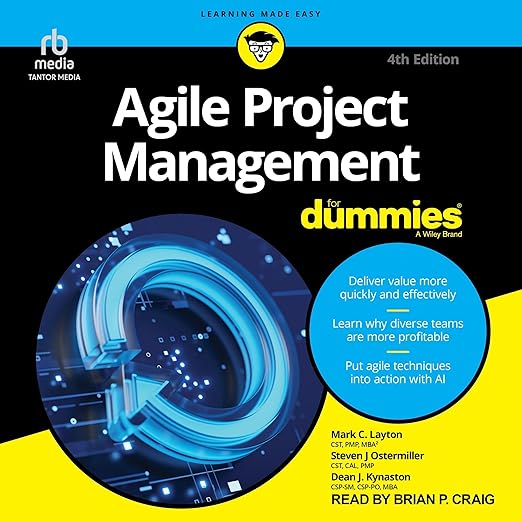
Agile Project Management for Dummies (4th Edition) is an audiobook designed for people who need to understand and apply agile principles in professional environments, and Dean J. Kynaston approaches the material with the clarity and systematic organization that distinguishes the Dummies brand at its best. Brian P. Craig narrates across eighteen hours and twenty minutes with the steady, professional delivery that suits a reference guide: clear pronunciation of technical terminology, consistent pacing through framework descriptions, and enough variation in emphasis to keep extended listening sessions from becoming monotonous. For project managers, product owners, and team leads who need to get up to speed on agile methodology rather than just gesture toward it in meetings, this edition delivers substantial practical grounding.
The fourth edition's timing matters. The additions that distinguish it from earlier versions include coverage of AI's role in the agile world and a dedicated treatment of how Inclusion makes organizations more agile, two topics that were either absent or peripheral in earlier editions and that reflect how both the workplace and technology have shifted. Kynaston's decision to address these additions explicitly rather than grafting them awkwardly onto existing framework chapters suggests genuine revision rather than nominal updating, though listeners familiar with earlier editions will need to assess for themselves how substantially the core content has been refreshed.
The book's most useful framing decision is its explicit move beyond software development as the primary audience for agile thinking. Kynaston argues throughout that agile principles apply to companies in any industry, and he uses examples and frameworks that translate the software origins of agile into territory that marketing departments, healthcare administrators, and construction project managers can apply. That broadening is essential for a 2024 edition, given how thoroughly agile terminology has entered general management culture over the past decade without always being accompanied by genuine understanding of what the principles require in practice.
The practical scope is comprehensive. Product roadmap creation, sprint planning, stakeholder communication, managing scope creep, handling team dynamics, and addressing quality and risk within an agile structure are all covered with enough detail to function as genuine reference material rather than an introduction-only overview. The Dummies guide format structures this into navigable sections rather than demanding sequential reading, which makes the audio version somewhat demanding: listeners who want to use this as reference material for specific topics will find it easier to engage with in print. As a through-listen, however, Craig's narration makes the eighteen hours more manageable than the page count might suggest.
Brian Craig's Narration Imposes a Reading Rhythm
For listeners who absorb procedural and technical information well through audio, this is a genuinely efficient use of commute time or desk-listening sessions. The framework-heavy content, which in print can feel like reading a series of connected lists, lands more naturally in audio because Craig's narration imposes a reading rhythm that helps concepts flow rather than accumulate. The treatment of agile-friendly culture and team dynamics is particularly well-suited to audio because those sections read more like narrative argument than procedural instruction.
The coverage of AI's relationship to agile methodology is the most forward-looking section of the fourth edition. Kynaston does not simply observe that AI tools exist but examines how machine-generated velocity data, automated backlog management, and AI-assisted sprint retrospectives change the agile practitioner's role and decision-making context. For professionals navigating teams that are adopting AI tools in their workflows, this section provides a framework that the third edition could not have anticipated.
Zero Reviews and an Eighteen-Hour Time Commitment
The zero-review count at time of writing means this assessment relies on the book's stated content, Kynaston's approach as described in the synopsis, and Craig's established track record as a narrator for technical nonfiction. Listeners who rely on community review volume to calibrate expectations for a purchase should note the book's recent release and limited feedback period.
At eighteen hours and twenty minutes, this is a substantial time commitment for a methodology guide. Listeners who need a quick introduction to agile vocabulary would be better served by a shorter overview, while the full edition is most valuable for professionals who want comprehensive, systematic treatment of agile project management rather than an introduction they can apply to a specific meeting next week. The Dummies format's characteristic accessibility does not make the material lightweight, and listeners should expect to engage actively with the concepts rather than passively absorbing them.
Professionals Outside Software Who Need Agile Vocabulary
Project managers and product owners who want to build a systematic agile vocabulary and practical methodology toolkit, professionals in non-software industries who need to adapt agile principles to their specific context, and team leads preparing to introduce agile practices to organizations without prior agile experience are the core audience. The fourth edition's treatment of AI and Inclusion also makes it relevant for practitioners who have worked with earlier editions and want to update their understanding of how the agile world has changed. Professionals in healthcare, manufacturing, marketing, or any field where agile terminology has entered management culture without a corresponding depth of understanding will find the practical grounding here directly translatable to their work.
Listeners who want a quick-reference card rather than a comprehensive guide, or who are already certified scrum masters seeking advanced practitioner content, will find the Dummies format and scope either too foundational or too broad for their specific needs. This is a serious, systematic foundation-builder rather than a specialized deep-dive, and that distinction is worth knowing before committing to eighteen hours.
Questions Listeners Ask
Does this audiobook require prior agile knowledge, or is it genuinely entry-level?
Kynaston explicitly addresses both newcomers and professionals updating their practice. The book covers all core terminology, tools, and concepts from the ground up, so no prior agile certification or experience is required. Practitioners who already hold agile certifications will find it a useful refresher with new content on AI and Inclusion.
Is this audiobook useful for professionals outside software development?
That is one of the fourth edition's explicit arguments: agile principles apply to any industry seeking to reduce waste, increase transparency, and respond to changing requirements. Kynaston uses examples and frameworks designed to translate beyond technology contexts.
What specifically is new in the 4th Edition compared to earlier versions of this audiobook?
The fourth edition adds dedicated coverage of AI's role in the evolving agile world and the relationship between Inclusion and organizational agility. Kynaston also updated the general framework content to reflect current practices. Listeners who own earlier editions will find the AI and Inclusion material the clearest reason to upgrade.