At a Glance
- Narration: Ashraf Shirazi is credited on a biography carrying a constant load of Persian and Hebrew proper names.
- Themes: The 1979 revolution, Iran's Jewish community, a self-made industrialist, state execution, inherited memory
- Mood: Restrained, sorrowful, quietly furious
- Verdict: A tightly cut family biography that turns a headline execution back into a person.
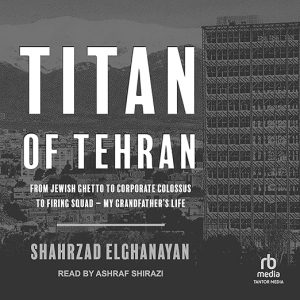
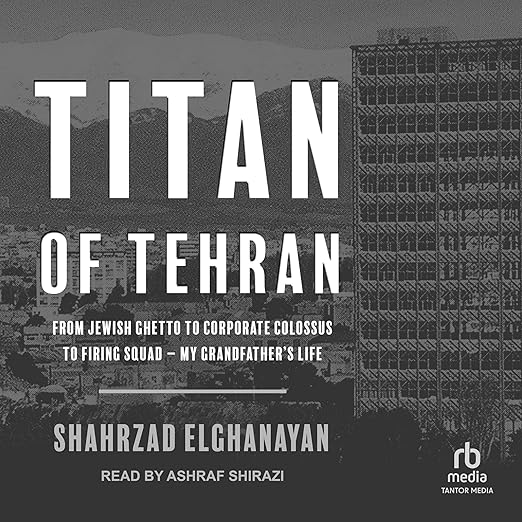
Habib Elghanian, the titan of the title, was the first civilian executed during Iran's 1979 revolution, and this audiobook is his granddaughter's account of how a boy from Tehran's Jewish quarter ended up in front of a firing squad. Shahrzad Elghanayan wrote it. Ashraf Shirazi is credited on the recording, which Tantor Media released in November 2022 at just over seven hours. The description notes that his execution was reported worldwide, on front pages and in broadcast bulletins, and then adds that he nearly disappeared into history anyway.
Elghanian or Elghanayan? One Family, Two Spellings
Fullest of the five accounts here is the October 2022 entry, five stars, which sets out what the book does: an important, untold story of three generations of a remarkable family torn apart by the Islamic Revolution, chronicled by an American journalist born in Tehran who follows her grandfather's life as a self-made industrialist and philanthropist whose support for Jewish causes eventually led to his execution. That reader's closing phrase is worth borrowing whole, calling it a frank but loving portrait of a man and a thoroughly researched rebuke of a regime.
Spelling turns into a genuine obstacle for anyone who wants to read further. The description calls him Habib Elghanian. The author's byline reads Shahrzad Elghanayan. One written response refers to Habib Elghanayan. Two versions of a single family name sit on one page, and a listener who goes looking for the international news coverage the description mentions will need to try both, since a search built on one spelling will not surface material filed under the other.
Elghanayan's method is restraint, and the description says as much directly: an understated style that still leaves her own stake in the story unmistakable. By some distance that is the harder choice. A granddaughter writing about a grandfather killed by a state has every license to be furious on the page, and the decision to hold the temperature down is exactly what allows the reporting to carry the weight instead of the adjectives. The anger is structural rather than stated. Reporting carries it, and the reader supplies the outrage the prose declines to perform.
Biography Suits Listening Better Than History Does
Writing in August 2022, another five-star reader identifies the real achievement here: the book weaves together the story of the Iranian revolution, the plight of Jews across the region, and one very influential figure standing at the center of both. Fascinating and heartbreaking is that reader's whole verdict. The combination is the difficult part, because political history at this scale usually loses the individual, and family memoir usually loses the politics. Holding both steady across seven hours is not a common skill.
Elghanian's business life is the least familiar part of the story and possibly the most interesting. The description credits him with commercial success that was instrumental in modernizing the country, which places him inside Iran's mid-century transformation rather than alongside it, and turns the execution into something more specific than sectarian violence: a new state removing a man who had helped construct the thing it was replacing. That reframing alone justifies the time. A country's first executed civilian being one of its leading builders says something specific about what the revolution intended, and the biography lets that land without announcing it.
Biography of this kind suits listening better than most history does. This is a single life told in order, with one family at its center, rather than a policy history stuffed with committees and dates a listener has to hold in place unaided. The narrative moves the way biography moves, and the settings that anchor it, the Jewish quarter the description calls the edge of the pit, the businesses, the streets of the revolution, stay concrete enough that nobody needs a map open beside them.
Glue on the Pages Cost It a Star
Only a single written response arrived after this recording existed. Tantor Media published the recording on November 29, 2022; the other four carry dates in January, February, August and October of that same year, every one of them ahead of the release. Every judgment in that group belongs to a printed book. What transfers to audio without any loss at all is their verdict on the research and the construction, since both of those belong to the writing rather than to the edition.
Among those four sits a January 2022 entry, four stars, that calls the book important and engaging, then explains the missing star: the copy arrived with glue on the pages, which had to be separated before anything could be read. That is a manufacturing fault on a physical object, recorded permanently against a title now selling a recording. As an illustration of why pooled averages across formats deserve suspicion, it could hardly be clearer.
Scope is worth weighing before you commit. This is one family's passage through a revolution rather than a general history of it, and a listener arriving with no background on the Shah, the 1979 upheaval or Iran's Jewish community will be assembling that context from the story as it moves. The description assumes a reader who already knows roughly what happened. Anyone who does not will finish with a reading list rather than a settled picture. That is not the worst outcome for a biography this compact, but it should be expected rather than discovered.
Written After Release, This Review Frames It Best
The July 2023 five-star entry, the only one posted after this recording appeared, frames the audience accurately: insight into the history of Iran and its Jewish community both before and after the revolution. Anyone whose picture of modern Iran effectively begins in 1979 will find the decades preceding it doing most of the work in these chapters, and that reordering of emphasis is worth more than another retelling of the revolution itself.
Jewish history listeners and readers of family memoir both have a strong claim on this one. So do people who follow Iranian politics in the news and want the human scale underneath the headlines, which the description argues for openly by calling the story painfully relevant to the country's continuing economic, political and social problems. The biography earns that claim rather than merely asserting it.
Readers wanting a comprehensive political history of the revolution should start elsewhere and return to this afterward, and anyone impatient with family memoir will find the granddaughter's presence unavoidable on every page. Restored from the near-oblivion the description says was waiting for him, Habib Elghanian finally gets the kind of hearing that front pages, by their nature, never gave him.