- At its heart: Wehrmacht testimony, German remembrance culture, the reliability of very late memory
- Vibe: Somber and unresolved, an archive rather than a war story
- Short version: Take it for the thirteen voices, and accept that a synthetic reading flattens them toward one.
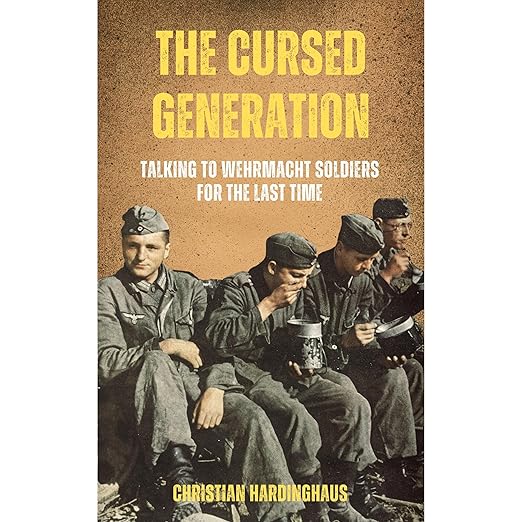
Thirteen men agreed to talk before they died, and this audiobook is what came of it. Christian Hardinghaus, a German historian, spent more than five years interviewing over a hundred surviving witnesses to the Second World War, and The Cursed Generation gathers thirteen of those accounts from soldiers who served on different fronts. Most had kept quiet for decades, out of fear or shame, and agreed to speak only at the end of their lives. The German edition appeared in 2020 and became one of that market's best-selling witness books; this English version was, by the publisher's account, the wish of the interviewees themselves, nearly all of whom have since died.
Closer to an Archive Than to a Narrative
What Hardinghaus has built sits closer to an archive than to a narrative. The interviews were conducted, by the historian's own stated method, without embellishment and without moralizing, and the book keeps that posture. Men describe what they did, what they saw, and what they claim not to have known about the camps. The framing promise on the product page is the one that matters most: a fuller picture of German soldiers without minimizing the crimes of the regime they served. That balance is the entire project.
Richard J. Hrezo, writing at five stars, described the shape of it accurately, the war seen through German combatants' eyes, from their early involvement, through their view of Allied soldiers, to their suffering as captives after the surrender. That arc is what separates the collection from a battle chronicle. Combat occupies less room than the years on either side of it, and the captivity passages carry a bitterness the fighting passages do not.
Thirteen Distinct Men in One Unvarying Register
The listening comes with a condition, though. The reader credited on this edition is a synthetic voice rather than a person, which means thirteen distinct men, plus the historian's connective commentary, arrive in one unvarying register. Testimony collections normally lean on a reader to mark where the historian stops and the witness starts. Here that work falls to the prose alone, and Hardinghaus edits clearly enough to carry it, but you do more sorting yourself than a performed edition would ask of you.
Self-Exculpation and Admission in Four Sentences
The specifics are the reason to spend nine hours here. A pilot shot down and drifting alone in the Mediterranean. The heat of North Africa. The cold and hunger of the Stalingrad cauldron. Bloody Sunday in Bromberg, the Rhine meadow camps, the carnage of D-Day, the Battle of All Souls. Hardinghaus chose interviewees who could speak to different theaters, and the effect is a war that keeps changing shape depending on where a given man happened to be standing.
J-Girl, at five stars, opens with family rather than with the book: a parent who served in the Second World War, and years of struggling to understand how a nation of ordinary people could permit what was done to the Jews. The verdict that follows is careful. The accounts broadened a perspective without forgiving anything, which is close to the most an interview collection can honestly claim for itself. It is also a reminder that the audience for a book like this includes families on the other side of the same war, who have their own reasons for wanting the picture filled in.
The description closes with a line from Wigand, an artillery man at Stalingrad, and it is the sharpest thing anywhere on the page: "Only a few of us were carried away to commit atrocities. But those few were enough to cause great harm. I don't blame myself, though. I'm a man of my time; I did what I thought was right." Self-exculpation and admission inside four sentences. Hardinghaus lets it stand rather than arguing with it, and the collection operates that way throughout.
Whoever Translated This Goes Unnamed
CityLover, one of the two four-star responses, names the problem the method cannot solve: whether these men, even in old age, would conceal their own crimes and those of the people beside them remains a fair question. Nothing in the approach answers it. Hardinghaus interviewed rather than cross-examined, and an account given at the end of a long life rests on what the speaker chooses to say. Anyone needing corroboration will not find it built in.
The selection is the second thing to hold onto. More than a hundred witnesses were interviewed across five years, and thirteen made it into the book. No explanation of that ratio appears on the product page, and the men left out may have been left out for reasons that would change how the thirteen read. The series line, World War II from a German Point of View, carries no volume number either, so where this sits among Hardinghaus's other work is guesswork.
And the source is translated. The German edition came out in 2020; this is the English one, with no translator credited anywhere on the entry. Testimony is a register where word choice does real work, and the gap between a soldier's idiom in German and its nearest English equivalent is exactly what a translator's note exists to address. The prose reads cleanly, which suggests care was taken, but whoever took it goes unnamed.
Marcia Smith Values Plurality Over One Voice
This one is for people who read testimony rather than campaign history: anyone with a German grandfather they never questioned, anyone working on how a country tells its own war story, anyone who has absorbed the Allied version and never heard the other. A four-star response from Marcia Smith valued exactly that plurality, first-hand accounts from various veterans, each with a separate experience and perspective, rather than one representative voice standing in for all of them. Thirteen is a small enough number that the individual men stay distinguishable, which counts for more here than breadth would.
Skip it if you want maps, unit histories, or an argument. Hardinghaus builds no thesis about collective guilt; the material is handed over and the weighing is left to you. Skip it too if a synthetic reading is a deal-breaker, because nine hours of one unmodulated voice is a real commitment. And skip it if you need each account checked against the documentary record, because that verification is not what this book set out to provide.
What stays with me is the ordinariness. Boys who grew up under the Third Reich, who froze and starved and were taken prisoner, and who at the very end wanted the record to include them. The moral questions do not resolve, and Hardinghaus never pretends they will. Taken as testimony, gathered late and offered without varnish, this holds its ground.
A Few Questions About The Cursed Generation
Does the audiobook carry the 38 photographs and drawings the description lists?
No. The print edition advertises 38 original photos and drawings from soldiers' everyday life, and audio has no way to deliver them. Nothing on the product page points to a downloadable companion document either, so the visual half of that promise is simply absent from the listening version.
Does the audiobook hold up in short listening sessions?
Better than most war histories, yes. Each witness occupies a self-contained stretch, so stopping between accounts costs you nothing, and the linking passages carry enough context that a gap of several days does no damage. The structure sits closer to a set of interviews than to one continuous argument.