At a Glance
- Read by: Derek Monaghan reads a text dense with Emirati place names and record-breaking figures, which is the real demand this one makes.
- At its heart: Desert to metropolis, engineering superlatives, economic diversification beyond oil, smart city planning.
- Vibe: Admiring and brisk, closer to a guided tour than to an inquiry.
- Short version: A tidy primer on Dubai's landmarks, told entirely in the city's own preferred terms.
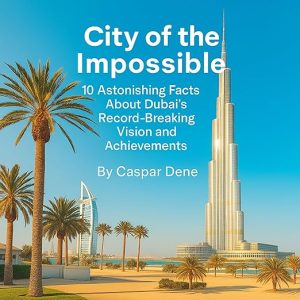
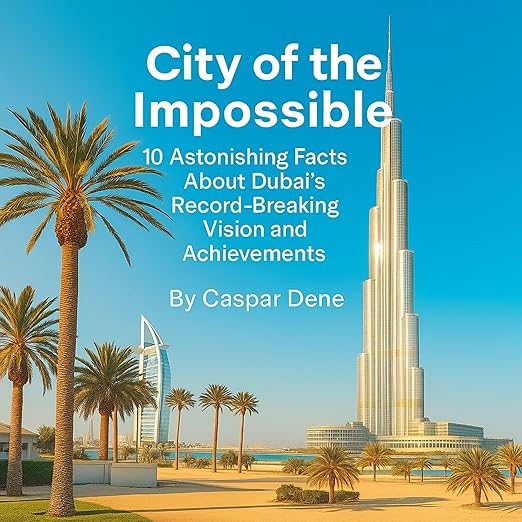
Ninety-three ratings, an average of 5.0, and not one written word underneath any of them: that is the entire public record this audiobook has assembled. Caspar Dene's account of Dubai runs three hours and thirty-five minutes and is built as ten chapters, each anchored to a single achievement, from the Burj Khalifa to the driverless Metro to the man-made island of the Palm Jumeirah. Derek Monaghan reads it. Zentara UK released it in December 2025 and the page has been quiet ever since.
Ten Chapters, Ten Landmarks, Zero Counterweight
Dubai decided that the future is something you build rather than something you wait for, and the copy states that plainly and repeats it often. Everything else in the book is an instance of the same proposition. Desert becomes metropolis, an oil economy becomes a diversified one, a transit system becomes the longest fully driverless network anywhere, and each chapter presents a landmark as further evidence. It is a thesis with ten illustrations rather than an argument carrying any counterweight, and it is worth deciding early whether that is what you wanted.
As a structure that suits a short listen unusually well. Each chapter stands on its own, the facts are concrete, and the sequence moves from architecture to transport to smart city infrastructure to sustainability planning without asking you to hold anything across the gaps. The Vision 2040 urban master plan, the Museum of the Future, the Dubai Frame, the floating villas: all of these arrive as set pieces, and set pieces are the thing audio handles best in a book running this length, where nothing has time to accumulate.
What it is not is analysis. The description sells the book as unpacking the systems and stories behind the spectacle, and it does supply the economic foresight narrative and the planning decisions that followed, but it does all of that in the register of celebration. Human ambition, willpower, audacity, monuments to imagination: these are the copy's own terms. A listener should know going in that this is written in admiration, and that the costs behind construction on this scale sit outside its frame entirely, which is a choice rather than an oversight.
Monaghan's Reading Is a Total Unknown
Brevity is the strongest argument. Most books about a city ask for fifteen hours and a map on the table; this one hands you ten discrete stories and stops, which makes it a genuinely useful primer before a trip, a posting, or a business conversation you would rather not enter blind. You will finish it inside an afternoon and retain the outline, which is more than can be said for most urban histories, particularly if the trip is next week and the reading list is already too long.
Superlatives are easy to hear and hard to picture from a page, which is why this subject carries well spoken: the tallest building in the world, an island visible from space, the longest fully driverless transit system, record-breaking hotels and shopping centers. Dene's decision to give one achievement per chapter turns each of those into a short narrative with a beginning and an end, which is exactly the shape a listener can hold while doing something else with their hands.
Derek Monaghan holds the reading credit, and this is where the empty page becomes a practical problem rather than a curiosity. Ninety-three people have rated this recording and not one has written a sentence about it, so nothing at all is publicly known about how it sounds or how it is paced. On a book carrying names like Sheikh Mohammed bin Rashid Al Maktoum and the Palm Jumeirah alongside a steady stream of figures, that gap is worth closing yourself with the sample before you commit, particularly if pronunciation matters to you.
Ninety-Three Perfect Votes, Zero Written Words
Arithmetic first. For an average of 5.0 to display across ninety-three votes, the deductions across the whole pool cannot total more than about four stars, which is one person awarding a single star or four people awarding four. A title a few months old holding a near-unanimous ninety-three with zero written responses is an unusual combination, and it is not one a careful buyer should file under ordinary social proof without looking twice at where it came from.
Category placement is the second oddity: history, with a Middle East tag, on material that is contemporary urban development. Infrastructure delivered inside the last two decades, a master plan reaching out two more, smart city technology built on AI and connected sensors. The description itself concedes the book is more than a travel or architecture book, which suggests even the person writing the copy was unsure where it belonged. Expect the present tense throughout, not the past.
Marketing register is worth reading as evidence too. The description praises the author's prose in the third person, admires the balance he strikes between heritage and skyline, and closes on a paragraph about creativity, leadership and resilience. That is publisher copy rather than an outside endorsement, and on a page with no reviews whatsoever it is the only voice speaking to you. Weigh it accordingly, and remember that no publisher description has ever called its own book thin or its subject complicated.
Just an Enthusiastic Official Tour of Dubai
Travelers with a trip booked, professionals heading into the region for work, and listeners generally curious about how cities get built at speed are the right buyers. It hands over the landmarks, the numbers and the official story in one sitting, which is precisely what most people want before a first visit and precisely what they will need to supplement afterward. As orientation it does the job efficiently, and the ten-chapter shape means you can revisit one landmark the night before you go and see it.
Readers who want the labor questions, the environmental accounting, or the political economy behind a state-directed building program will not find any of it here. None of that is present, and pretending otherwise would be unfair to a book that never claims to cover it. Nor is this for anyone who already knows the region, since the ten stories chosen are the ten stories everybody already knows, assembled competently and told with obvious enthusiasm, which is pleasant company and not new information.
Take it as an enthusiastic official tour, valuable for exactly that and nothing more, and go looking for the harder questions somewhere this page has no reason to send you.
Is this audiobook a travel guide?
Not in the practical sense. It carries no hotels, restaurants, prices or itineraries. What it gives you is the story behind ten landmarks you are likely to see anyway, which makes it a good companion to a guidebook rather than a replacement for one. Pair it with something that tells you when the Metro runs.
How current is the material?
The release date is December 2025 and the horizon extends to a master plan running two decades ahead, so the forward-looking material sits well beyond the listening. The landmark chapters describe things already standing, which means the book will age on its predictions rather than on its descriptions.
Does the audiobook engage with any criticism of Dubai?
No, and it is better to know that before starting. The description frames the book as a celebration of creativity, leadership and resilience, and the chapters run on that setting from first to last. The questions a skeptical reader would ask about who built all this go unraised, so bring them yourself.
How long is it and how is it divided?
Three hours and thirty-five minutes across ten chapters, one achievement in each, which makes it easy to take in sections. The chapters do not depend on one another, so you can start with the Burj Khalifa or with the Metro and lose nothing at all. Few books on the subject are shorter.