Quick Take
- Narration: David de Vries brings the measured, authoritative register this primary source material demands, suited to the formal, after-action report style of General Raus’s original journals.
- Themes: Armored warfare on the Eastern Front, the relief of Stalingrad, tactical adaptation to extreme conditions
- Mood: Clinical and detailed, with the weight of actual command decisions behind it
- Verdict: A valuable primary source account for serious students of World War II military history, particularly those focused on Eastern Front armored operations.
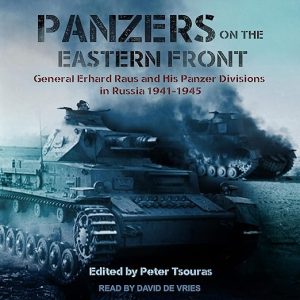
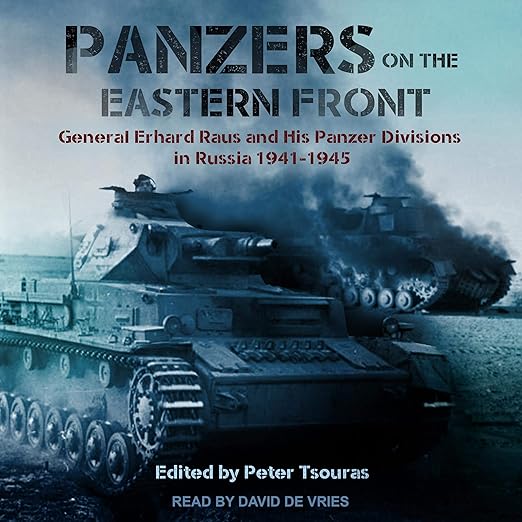
I came to Panzers on the Eastern Front through a longer reading project on the Stalingrad campaign, where most of what I had read came from Soviet or American perspectives. Finding a primary source account by a German panzer commander who was personally involved in the relief effort felt like an important corrective, even knowing that first-person accounts by defeated generals come with their own filters and self-justifications. General Erhard Raus’s journals have an unusual provenance: they were originally written to brief the US Army during the Cold War, which shapes their content in specific ways.
Peter Tsouras edited this collection specifically because Raus was not simply a capable combat commander but a student of armored tactics in the broadest sense. The account concentrates on the German effort to relieve Stalingrad, with Raus commanding the 6th Panzer Division in what turned out to be an ultimately unsuccessful attempt to break the Soviet encirclement. But the journals extend beyond the relief operation to cover a range of tactical situations across the Eastern Front, from the advances toward Leningrad to the grinding experience of Russian winters.
Our Take on Panzers on the Eastern Front
The most valuable dimension of these journals is the tactical granularity. Raus writes about bridgehead operations, about facing KV-1 tanks with inadequate anti-tank weapons, about the brutal effect of the Russian winter on men, machines, and the tactical options available to commanders. One reviewer notes that the journals indirectly disprove the myth of German technical superiority, which is a significant observation: Raus frequently describes improvisation under constraint rather than the efficient, well-equipped force of popular imagination.
The original purpose, briefing the US Army, gives the journals a somewhat formal, report-like quality. This is not memoir in the literary sense. Raus is less interested in conveying subjective experience than in analyzing tactical decisions and their consequences. That approach will suit some readers and frustrate others. The reviewer who described the writing as stiff Euro-style was not wrong; this is professional military writing, not narrative prose.
Why Listen to Panzers on the Eastern Front
David de Vries narrates with the measured authority the material requires. The formal register of the journals benefits from a narrator who does not try to dramatize what is already dense with the weight of actual events. The result is a recording that respects the source material without making it more entertaining than it is. For the audience this book is aimed at, that is the right call.
Tsouras’s editorial framing provides context that Raus’s original journals naturally lacked, situating the tactical accounts within the broader arc of the Eastern Front campaign. That framing is particularly useful for listeners who know the broad outlines of the Stalingrad campaign but want to understand what it looked like from the perspective of a divisional commander in the field.
What to Watch For in Panzers on the Eastern Front
The Cold War context of the original writing matters. These journals were produced for a specific audience, American military planners interested in Soviet operational methods, and that purpose shapes what Raus chose to include and how he framed it. Readers should not expect the kind of personal reckoning or moral reflection that characterizes the best memoir writing from this period. Raus is analytical throughout, and the question of German culpability for the broader conflict is entirely outside the scope of what he was asked to write.
The book is also organized around discrete operations and tactical situations rather than as a continuous narrative of Raus’s career. This is useful for reference purposes but can create a somewhat episodic listening experience that requires the listener to hold a larger map in mind.
Who Should Listen to Panzers on the Eastern Front
Military history readers with a specific interest in Eastern Front armored operations and the Stalingrad campaign will find this an essential primary source. Those looking for a narrative history of World War II or an introduction to the Eastern Front should start elsewhere. This is specialist material, detailed and formally written, and it rewards readers who arrive with existing context for what they are hearing.
Frequently Asked Questions
Why were Raus’s journals originally written for the US Army rather than as a memoir?
After the war, the US Army commissioned accounts from defeated German commanders as part of the Foreign Military Studies program, seeking operational and tactical insights relevant to a potential conflict with the Soviet Union. This Cold War framing explains the analytical rather than personal tone of the journals.
Does the account cover only Stalingrad or the full Eastern Front?
The account concentrates on the Stalingrad relief effort but also covers other operations, including the advances toward Leningrad, and uses multiple tactical situations to illustrate broader principles of armored and mobilized warfare. It is organized thematically by operation and tactical scenario.
How does David de Vries handle the formal, report-like style of the original journals?
De Vries reads with appropriate authority and restraint, matching the formal register of the source material. He does not dramatize or editorialize, which is the right approach for primary source military writing. Listeners expecting narrative storytelling will find the tone deliberately spare.
Does the book challenge the popular image of German military superiority on the Eastern Front?
Implicitly, yes. Raus’s accounts of facing Soviet armor with inadequate resources, of improvising under severe winter conditions, and of the limits of German tactical doctrine against determined Soviet resistance paint a picture at odds with the myth of effortless German military efficiency.