The Short Version
- Performance: Robin Miles brings commanding warmth to this family history, grounding the generational scope with vocal authority that suits the book's ambition perfectly.
- What it covers: Architectural legacy, Black American resilience, generational family history
- Feel: Celebratory but unflinching, with genuine historical weight
- Our call: A Scientific American Favorite of 2025 that earns that recognition by treating one family's architecture as a lens on the full arc of Black American history.
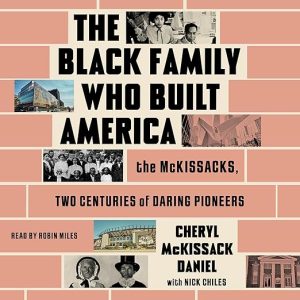
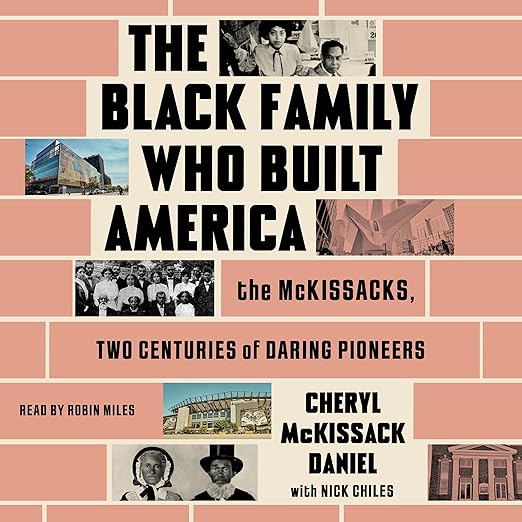
Cheryl McKissack Daniel's The Black Family Who Built America is one of the more ambitious family history audiobooks released in recent years, and Robin Miles's narration is a substantial reason why it works as well as it does. The story of the McKissack family spans from the enslavement of Moses McKissack I in West Africa through his emergence as a craftsman on a North Carolina plantation, through the Civil War and Reconstruction, through the discrimination and violence of the Jim Crow era, and into the contemporary moment where McKissack and McKissack stands as the leading Black-owned design and construction firm in the United States. Daniel, who is CEO and president of the firm and a direct descendant of Moses, knows this story intimately and writes it with the authority of someone who has lived inside its consequences.
From Bondage to JFK Airport and Beyond
The central achievement of this book is how it holds architectural history, family biography, and American racial history in the same frame without reducing any of them. The McKissacks did not simply survive the conditions of American life and happen to build things along the way. The building was itself a form of survival, and then of resistance, and then of excellence pursued under conditions designed to prevent it. Daniel makes this argument not through rhetoric but through specifics. Moses learns a craft in bondage that his children will carry into freedom. The family settles in Tennessee and establishes a foothold in the building trades despite rampant discrimination. The projects accumulate: the Morris Memorial Building, Capers C.M.E. Church, eventually John F. Kennedy International Airport and Philadelphia's Lincoln Financial Field. Each project is not just an architectural commission. It is an installment in a story about what it means to build something that outlasts the conditions in which it was created.
Reviewer Darriel Collins described this as an extraordinary work of history, legacy, and truth-telling, tracing five generations of a family that built one of the most influential Black-owned construction and engineering firms in the country. The Scientific American Favorite of 2025 designation confirms that its ambition has been recognized across a range of intellectual communities. The rating of 4.8 across 135 listeners reflects genuine enthusiasm from readers who brought real investment to the material. Reviewer Craig G., writing from New York, noted how the book gave identity to numerous sites he passes regularly, which is exactly the kind of re-contextualization this kind of history produces at its best.
Miles Moves Between Testimony and Exposition
Robin Miles is one of the most versatile and accomplished narrators working in audiobook today, and she is superbly cast here. The material demands a narrator who can move between historical exposition, personal testimony, architectural description, and the kind of reflective generational reckoning that Daniel undertakes in her role as both author and family member. Miles handles all of these registers with a command that makes the book's structural ambitions feel natural rather than strained. Her voice carries the kind of earned gravity that intergenerational histories require without ever becoming solemn to the point of distance.
At eight hours and thirty-six minutes, the book gives Daniel enough room to develop each era of the family's story with genuine texture rather than summary. This is not a compressed overview. It is a full narrative, and the length is necessary for the material to do what it needs to do. The book's intersecting claims about perseverance, the specifics of how discrimination operated in the building trades, and what it meant to maintain standards of excellence when the system was actively working against you need room to accumulate. Daniel provides that room and uses it well across every chapter.
Internal Resilience Over Systemic Critique
Daniel is writing as both a family member and the current leader of the firm, and that dual position occasionally colors the narrative in ways worth noting. The book is celebratory in its orientation, and it does not extend its scrutiny equally in all directions. The focus is on what the McKissack family built and how they sustained it, which means the book is more concerned with internal resilience than with systematic critique of the external forces that constrained them. Those external forces are documented and named, but they are context for the family's achievements rather than the primary subject. Readers looking for a sociological or political history of race in the construction industry will find this book speaks to that history obliquely rather than directly.
The five-generation scope also means that some eras receive richer treatment than others. The earlier chapters, covering Moses and the post-Civil War generation, are particularly strong. The later chapters on more recent decades are somewhat compressed by comparison, which may reflect the comparative difficulty of rendering contemporary history with the same narrative distance as the more remote past.
Skip It Only for Critical Distance
This audiobook is essential for anyone interested in African American history, architectural history, or family biography as a form of social documentation. Listeners who have walked past McKissack-built structures in New York, Nashville, Philadelphia, or any of the other cities where the firm has worked will find the book dramatically reshaping how they understand those spaces. History readers with a broad interest in Reconstruction, the early twentieth century, and the long arc of Black entrepreneurship in America will find this one of the more complete and satisfying accounts available. Skip it only if you approach the subject wanting critical distance that the author, as a family member, cannot fully provide. For everyone else, Robin Miles's narration and Daniel's extraordinary story make this one of the most compelling architectural audiobooks in recent memory.
A Few Questions About The Black Family Who Built America
Do I need a background in architecture or construction to follow this audiobook?
No specialized knowledge is needed. Daniel presents the family's architectural work in accessible terms, focusing on the cultural and historical significance of each project rather than technical details. The book is as much a family and American history as it is an architecture story.
Is The Black Family Who Built America audiobook more of a celebration of the family or a critical history?
It is primarily celebratory. Daniel writes as both family member and firm CEO, so the orientation is toward recognizing achievement and resilience. The historical obstacles the McKissacks faced are documented with specificity, but the book's emotional center is admiration rather than critique.
How does Robin Miles's narration suit this particular audiobook?
Miles is exceptionally well-matched to the material. She handles the full range of tones the book requires, from historical exposition to personal family testimony, with authority and warmth. Her narration gives the generational scope a unified emotional coherence that would be harder to achieve with a less versatile narrator.
Does this audiobook cover the McKissack family's work on specific well-known buildings?
Yes. The book documents multiple named projects, including the Morris Memorial Building, Capers C.M.E. Church, John F. Kennedy International Airport, and Philadelphia's Lincoln Financial Field, among many others. Several listeners have noted that the book re-contextualizes buildings they pass regularly in their own cities.