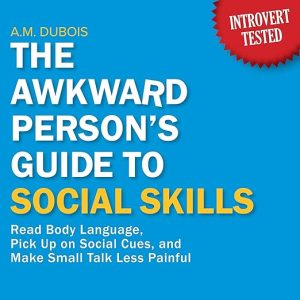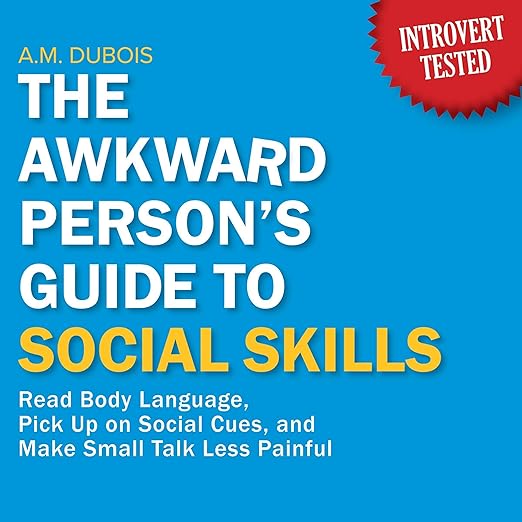
A joke falls flat, a one-word text reply sits there like an unsolved riddle, an introduction goes blank halfway through: this audiobook opens by naming the exact small humiliations that make socializing feel like a language everyone else already speaks fluently. The Awkward Person's Guide to Social Skills is built for what its own subtitle calls the anxiously overthinking human, offering bite-sized tips and deliberately relatable examples rather than clinical theory, aimed at teens, young adults, and what the synopsis calls late-blooming adults still figuring out conversation as they go. Rickel Hayes narrates, and across four hours and twenty-three minutes, A.M. Dubois works through compact, chapter-by-chapter guidance on starting conversations, reading one-word replies, and surviving small talk without the constant pressure to be effortlessly charming.
Rickel Hayes Narrates Like He Means One Person
Hayes brings a warmth to this material that avoids the false, performative cheerfulness self-help narration often falls into, and that distinction matters enormously for content built specifically around social anxiety. Reviewer William Bowden puts it plainly: 'reading this book felt like talking to someone who truly understands social anxiety.' Bowden also singles out 'the humor' for making the material 'less intimidating' and says the relatable examples left him feeling less alone rather than judged. Reviewer Smiley describes the book as 'a game changer' for 'those of us who sometimes feel that they were the only person not given the textbook on how to navigate the world as a social being,' a specific, vivid way of naming a very common but rarely articulated anxiety. Hayes reads the material as though speaking to one specific listener rather than a broad category of awkward people, a choice that gives the humor room to land without ever feeling like it is punching down at its own audience. Calling the book, and by extension its reader, awkward directly, rather than reaching for a softer euphemism, is itself a meaningful choice: it front-loads the self-deprecating humor that runs through the whole guide and signals early that this is not going to be a clinical or condescending treatment of social anxiety. Hayes's comedic timing deserves particular credit for how the book's self-deprecating jokes land without ever undercutting the more sincere reassurance sitting right next to them in the same paragraph; that balance, funny but never dismissive of genuinely difficult feelings, is a harder needle to thread in audio than on the page, where a reader controls their own pacing through a punchline. The synopsis's specific inclusion of 'late-blooming adults' alongside teens and young adults is a meaningful acknowledgment that social skill-building is not something everyone finishes in adolescence, and the book's tone never condescends to an older listener still working through the same basic conversational anxieties a teenager might have.
Specific Steps Instead of Vague Reassurance
The book's real strength is refusing the two easy failure modes self-help in this space usually falls into: cold clinical detachment or relentless, exhausting positivity. Reviewer A. Merlo describes chapters that are 'compact, easy to read, and something that can be easily skimmed.' That structure suits returning to specific sections whenever anxiety about an upcoming social situation flares up, rather than one linear front-to-back listen. Bowden specifically praises that the book 'didn't just tell me practice makes perfect,' instead giving 'specific, doable steps for starting conversations.' That is a fair distinction between vague reassurance and actual practical guidance. That reference-style structure, chapters built to be revisited individually rather than absorbed once, translates well to audio specifically, since Hayes's consistent, grounded tone makes it easy to drop back into any single chapter without needing to remember what came immediately before it. The book's closing promise, communication skills for how to talk to anyone, is a bigger claim than the bite-sized chapter structure might suggest at first, and Dubois backs it up by covering a genuinely wide range of specific situations rather than staying narrowly focused on, say, only romantic small talk or only professional networking. The synopsis promises 'zero pressure to be charming on command,' and that framing matters as much as any specific tip inside the book, since so much social anxiety comes from exactly that pressure to perform effortlessly; by naming and dismissing that expectation upfront, Dubois removes some of the anxiety about the book itself before a listener even reaches the practical chapters. The examples throughout lean toward being 'slightly-too-relatable' by design, per the synopsis's own description, rather than sanitized or hypothetical, which is very likely why reviewers describe recognizing themselves so specifically in the scenarios rather than just nodding along generically.
Breadth Over Depth, and No Clinical Claims
Depth is not really the ambition here; breadth and reassurance are, and listeners hoping for a rigorously researched, clinically sourced treatment of social anxiety should recalibrate expectations toward something more conversational and anecdotal. At four hours and twenty-three minutes, this covers a lot of specific, bite-sized scenarios rather than building one sustained argument, which suits its stated goal of being a reference guide but means the content stays intentionally light rather than exhaustive on any single topic. The humor-forward approach that Bowden and others praise will not land for every listener; some readers wanting a more clinical or academic treatment of social anxiety specifically may find the tone too casual for what they are looking for. This is squarely a beginner-to-intermediate confidence-building guide rather than a specialized resource for diagnosed social anxiety disorder, so listeners with more serious clinical needs should treat it as a supplement rather than a substitute for professional support. Listeners dealing with one particular recurring social challenge specifically, workplace conflict, dating anxiety, family gatherings, may find the general framework more useful than any single chapter's narrow advice.
Modeling the Calm It's Trying to Teach
Socially anxious listeners, especially teens and young adults still building basic conversational confidence, are exactly who this was written for, and Hayes's specific, non-categorical delivery style reinforces that intimacy rather than working against it. Late-blooming adults, the audience the synopsis names directly, alongside anyone who has ever frozen mid-introduction or stared at a one-word text reply too long, will likely recognize themselves somewhere in the compact, skimmable chapters A. Merlo describes. Listeners who want to revisit specific chapters before a nerve-wracking event, a first date, a networking mixer, a family gathering, will get real practical value from the book's bite-sized, reference-friendly structure. Anyone seeking clinically rigorous treatment for diagnosed social anxiety should pair this with professional support rather than relying on it alone, since its strength is warmth and accessibility rather than clinical depth. A fitting logic underlies delivering social-skills coaching through audio specifically: hearing Hayes model a warm, natural conversational rhythm throughout the book is itself a small, ambient demonstration of the kind of ease the content is trying to teach, something a purely text-based version could only describe rather than actually model.
- Read by: Rickel Hayes reads with a warmth that avoids false cheerfulness, treating the listener as a specific person rather than a category.
- At its heart: social anxiety and overthinking, practical conversation skills, self-compassion over self-improvement pressure
- Vibe: Warm, funny, and quietly reassuring
- Short version: An accessible, bite-sized confidence-builder for anxious listeners, best treated as a supplement rather than clinical treatment.
Is this audiobook based on clinical research into social anxiety?
Not primarily. It leans conversational and anecdotal rather than clinically sourced, so listeners with diagnosed social anxiety should treat it as a supplement to, not a substitute for, professional support.
Can I listen to this audiobook in short sections rather than all at once?
Yes, and that seems to be the intended use. Reviewer A. Merlo describes chapters as compact and easily skimmed, designed to be revisited individually before specific anxious social situations.
Is this audiobook aimed at teens, adults, or both?
Both. The synopsis specifically names teens, young adults, and what it calls late-blooming adults as its intended audience, and Rickel Hayes's narration treats all of them as one specific listener rather than separate categories.
Does this audiobook rely on humor to cover serious social anxiety topics?
Yes, reviewer William Bowden specifically credits the humor with making the material 'less intimidating,' though the jokes support rather than replace the book's specific, doable conversational advice.