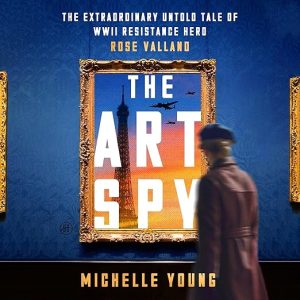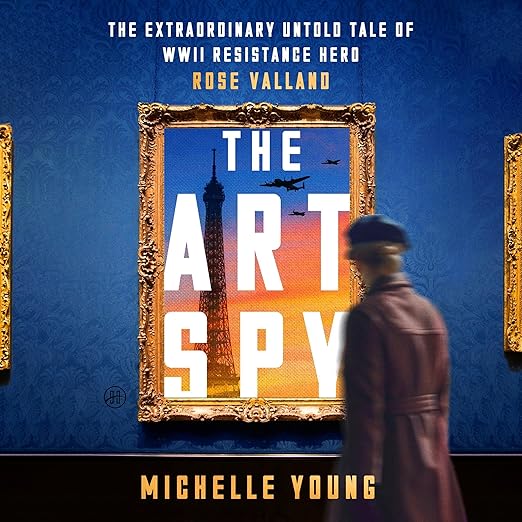
Rose Valland watched Paris burn from the windows of the Jeu de Paume on August 25, 1944, and the question this audiobook keeps returning to is a simple one: would the museum curator survive long enough to tell anyone what she had spent years secretly documenting? Michelle Young's The Art Spy answers that question across eleven hours and fifty-one minutes, chronicling how a quiet, unassuming curator infiltrated the highest levels of Nazi art looting in occupied Paris while passing intelligence to the French Resistance. It arrives with an unusually long list of 2025 honors already attached, including Library Journal and Publishers Weekly best-book recognitions, and the audiobook mostly earns them.
Two Interlocking Stories, Valland and Rosenberg
What Young accomplishes here is less a single spy story than two interlocking ones. Valland's espionage inside the Jeu de Paume, where she came face to face with Hermann Göring himself, runs alongside the story of Alexandre Rosenberg, a young Free French soldier fighting toward Paris whose father had been the exclusive art dealer for Picasso, Matisse, Georges Braque, and Fernand Léger before the Nazis stripped the family of everything, their collection, their nationality, their gallery, their home. Reviewer Resort Reader singles out both threads as extensively researched, describing Young's handling of Rosenberg's wartime experience as a genuine achievement in its own right rather than a subplot bolted onto Valland's story.
The comparisons the synopsis invites, a female Monuments Man, the spirit of Hidden Figures, the sweep of The Rape of Europa, are ambitious ones to set for any narrative history, but the source material genuinely supports them. Pre-war Paris arrives fully populated with Picasso, Josephine Baker, Coco Chanel, and Frida Kahlo before the occupation strips that glamour away scene by scene, and the contrast between those two Parises, the one lost and the one Valland fought to preserve evidence of, is where the book's emotional weight actually lives.
Longlisted by the City Valland Fought to Protect
The book arrives trailing an unusually specific run of 2025 recognitions for a work of narrative nonfiction. Library Journal and the New York Public Library both named it among their best books of the year, Hyperallergic included it among its favorite art books, and it was longlisted for the American Library in Paris Book Award specifically, a detail that carries extra weight given the book's subject is a French museum during the Nazi occupation. That longlisting, from an institution located in the very city Valland was fighting to protect, reads as more than a generic accolade.
The roll call of pre-war cultural figures the synopsis invokes, Picasso, Josephine Baker, Coco Chanel, Frida Kahlo, signals just how much ambition this book has for scene-setting before the occupation narrows everything down to Valland's museum and Rosenberg's advancing unit. That opening breadth means the first stretch of the book functions almost as a group portrait of a cultural moment about to be destroyed, which pays off emotionally later but does ask for patience from listeners eager to reach the espionage plot directly.
Bennett Moves From Sprawling Fantasy to Dense Nonfiction
Erin Bennett narrates, and this is territory she has already proven herself in. She previously handled the same WWII narrative nonfiction register on this exact title, and her broader catalog spans everything from The Wandering Inn's sprawling fantasy cast to dense organizational nonfiction, evidence of a narrator comfortable moving between registers rather than one who found a single lane and stayed there. Here she handles the atmospheric pre-war Paris chapters and the tension of the occupation years through pacing and register rather than any heavy-handed tonal signaling, which keeps the transitions between eras from feeling jarring across eleven-plus hours.
Unprotected, Undercover, and Working Entirely Alone
Reviewer Jacob Albee makes a point worth taking seriously for anyone who reads a lot of WWII narrative nonfiction: he notes that careful readers of this genre tend to speed toward the author's note and endnotes, and that Young has extended endnotes available on her own website beyond what fits in the book itself. That is a real signal of research depth behind a book that, per Jacob Albee, reads with the pace of a thriller novel rather than a dry academic account, a combination that is genuinely difficult to pull off and one this production largely achieves.
Calling Valland a female Monuments Man, as the synopsis does, is doing real interpretive work rather than borrowing a familiar title's cultural cachet. The actual Monuments Men were a mixed team of Allied officers working somewhat openly, with military backing, to recover looted art after liberation. Valland's position was the opposite: unprotected, undercover, working alone inside the very institution doing the looting, for years, with no guarantee anyone would ever believe or credit what she had documented. The comparison sets up an expectation the book then complicates in a genuinely interesting way.
Nazi-Era Looting Terms Move Quickly for Newcomers
Reviewer Swimmer549 offers the most useful caveat among this book's reviews, noting the book will be best enjoyed by someone who already knows something about art and art history. Names like Braque and Léger, and the mechanics of Nazi-era art looting and restitution, move quickly, and listeners with zero background in the period's art world may occasionally need to pause and look something up rather than absorb every reference in real time.
Because this is a dual-track narrative, Valland's espionage and the Rosenberg family's loss and eventual reckoning, listeners expecting a single, tightly focused thriller should recalibrate expectations. The book earns its comparisons to sweeping narrative histories precisely because it refuses to simplify into one thread, but that structural choice means the momentum occasionally resets as the focus shifts between Valland's museum and Rosenberg's advancing unit.
Art History Here Is Load-Bearing Throughout
WWII history listeners who gravitate toward overlooked or under-told stories are the clear audience, especially anyone who has already read or listened to Hidden Figures or The Rape of Europa and wants a title working the same overlooked-heroine territory. Art history enthusiasts will get an extra layer of reward from the Braque, Léger, and Picasso material that a general listener might have to work slightly harder to place in context.
Skip this one if art history genuinely holds zero interest, since that subject matter is not incidental background here, it is load-bearing throughout. Skip it too if a single-thread, tightly paced thriller is specifically what's wanted rather than a dual narrative that occasionally splits its attention between two protagonists. For listeners drawn to real, meticulously documented WWII heroism, though, this is one of the stronger entries in that genre this year.
Does this audiobook cover both Rose Valland's espionage and the Rosenberg family's story equally?
Yes. The Art Spy runs as a dual-track narrative, following Valland's work inside the Nazi-occupied Jeu de Paume alongside Alexandre Rosenberg's journey as a Free French soldier whose family lost their entire art collection and home.
Is The Art Spy audiobook based on real historical documents?
Yes. The synopsis states it draws on troves of previously undiscovered documents, and one reviewer notes the author maintains extended endnotes on her own website beyond what appears in the book itself.