In Brief
- Narration: Nina Simon self-narrates with the authority of someone who has lived the argument, bringing the case studies to life with specific institutional knowledge that a hired narrator simply could not replicate.
- Themes: Community belonging, institutional relevance, the gap between insiders and outsiders
- Mood: Warm and intellectually energizing, practical without being dry
- Verdict: Anyone who runs a cultural organization, community program, or public-facing institution and wonders why their audience keeps shrinking will find this audiobook uncomfortably clarifying.
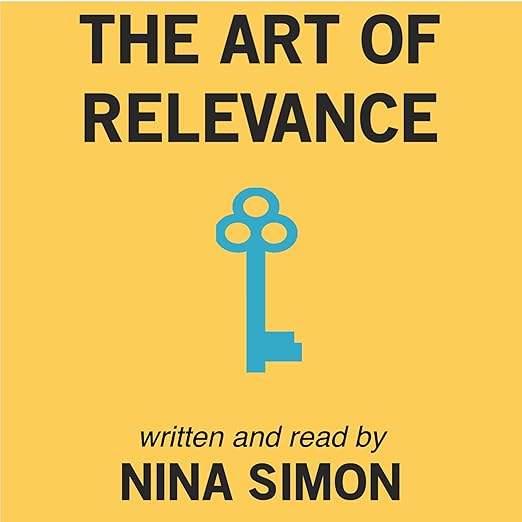
Nina Simon's The Art of Relevance audiobook sat in my queue for weeks before I finally gave it the focused attention it deserved. When I did, I listened to all of it in two sessions, not because Simon's prose is page-turning in the conventional sense, but because the argument she builds is structured like a very good diagnosis: once you understand what the problem actually is, you cannot stop wanting to hear what to do about it. The central claim is not complicated, but it is harder to sit with than it sounds. Relevance is not about popularity. It is about whether your work unlocks meaning for the people you most want to reach, and most cultural institutions are better at locking it away than opening it up.
Standing Outside a Locked Door
Simon has built her credibility the hard way. She turned the Santa Cruz Museum of Art and History into a genuine community hub through grassroots participation, an institutional turnaround that Smithsonian Magazine recognized by calling her a museum visionary. That practical authority grounds every abstraction in this audiobook. When she talks about the difference between shallow connection and genuine meaning-making, she is not theorizing from a distance. She is describing decisions she made in real rooms with real budgets and real resistance from boards and donors who were not sure the experiment would work. The stakes were institutional survival, which gives the framework a credibility that purely theoretical writing about community engagement rarely achieves.
The framework she introduces, the insider-outsider distinction, is the most clarifying idea in the book. Cultural institutions tend to optimize for insiders, people who already understand the implicit codes, the aesthetic assumptions, the reasons why the thing on the wall matters. Outsiders are not stupid or uninterested. They are simply standing outside a locked door. Simon's argument is that relevance is the act of building a door they can open, not lowering standards, not dumbing down, but creating genuine points of entry. That reframing is worth the four hours and forty-nine minutes of runtime on its own. It is also one of those ideas that you cannot un-see once it has been named; every cultural institution you subsequently encounter gets filtered through the insider-outsider lens.
Simon Knows Where the Emphasis Belongs
The self-narration is the right call for this material. Simon's voice carries the cadence of someone who has given versions of this talk many times, which is not a criticism. It means she knows exactly where the emphasis belongs, where to let a case study breathe, and where to push through theoretical sections that might otherwise feel abstract. One reviewer called the book very tempting in its approach to deep cultural or aesthetic territory, noting Simon's ability to make strong arguments without becoming condescending. That balance is easier to achieve in a lecture format than in prose, and Simon treats the audio version with the same audience-consciousness she preaches throughout the text.
The case studies are the spine of the audiobook. Simon pulls examples from museums, libraries, parks, community theaters, and faith communities, which means the principles translate across a wide range of institutional contexts. The breadth is intentional: relevance is not a museum problem or a library problem. It is a problem any organization faces when it stops asking whether the people it claims to serve actually feel served. Each example is specific enough to be convincing and general enough to illuminate the principle at work behind the particular situation she is describing.
Optimism That Might Read as Naive
At under five hours, this is a relatively compact audiobook for the scope of its ambitions. Simon is efficient, which is a virtue, but it means some of the case studies are treated briefly when you might want more operational detail. The rags-to-relevance examples are compelling precisely because they describe messy, real-world institutional change, and occasionally the book gestures toward a transformation that deserved more unpacking. Readers looking for a detailed implementation manual may want to supplement with Simon's other writing, particularly The Participatory Museum, which goes deeper into specific methodologies.
The argument also assumes a certain institutional goodwill, a leadership structure that is at least open to being challenged. Listeners working in organizations where the culture of irrelevance is entrenched and defended may find the book clarifying about the diagnosis but frustrating about the prognosis. Simon is realistic about resistance but broadly optimistic about change, which is both the book's strength and the one place where the analysis could use more friction from counterexample. That optimism feels earned when you know the Santa Cruz transformation actually happened, but it may read as naive to listeners in more resistant environments.
Measuring Meaning, Not Just Reach
This audiobook is essential listening for anyone in a leadership or curatorial role at a cultural institution, community organization, nonprofit, or public-service environment. It will also resonate with marketers and communications professionals who are tired of engagement metrics that measure reach without measuring meaning. Those who work in contexts that already prioritize community co-creation may find the argument familiar, but Simon's framing and examples still provide useful vocabulary for conversations with skeptical colleagues or boards. Anyone who wants a substantive read on organizational purpose that does not feel like a business school case study will find Simon's voice a welcome alternative to the genre's usual register. That combination of rigor and genuine accessibility is rare in writing about institutional culture and community engagement.
Questions Listeners Ask
Does The Art of Relevance audiobook cover nonprofit marketing strategy or is it more philosophical?
It lands in the productive middle ground between both. Simon provides practical frameworks and specific case studies grounded in real institutional change, but the book is organized around an argument about what meaning and relevance actually mean, not a step-by-step marketing manual. Both the philosophical and practical readers will find value, though those wanting detailed tactical templates may want supplementary resources.
Is this audiobook useful if you work outside museums and cultural institutions?
Yes, deliberately so. Simon explicitly addresses libraries, parks, churches, afterschool programs, and community theaters alongside museums. The insider-outsider framework she develops is applicable to any organization that serves a public and wonders why that public does not feel more invested.
How does Nina Simon's self-narration affect the audiobook experience compared to a professionally cast narrator?
It strengthens it considerably. The credibility of the argument rests partly on Simon's direct experience leading institutional change, and her narration carries that authority in a way a proxy voice would struggle to replicate. She speaks with the confidence of someone who has defended these ideas in difficult rooms.