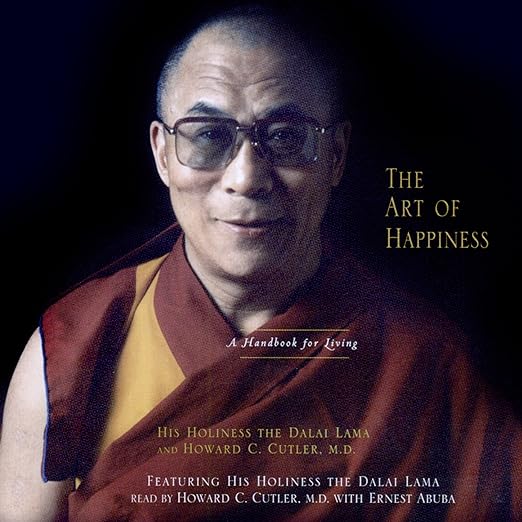
- Voice: Howard C. Cutler narrates his own collaboration with the Dalai Lama, which creates an unusual and fitting dynamic, the book is structured as a dialogue, and hearing the psychiatrist read his own questions and observations preserves the conversational texture.
- Big ideas: Happiness as a trainable mental state, compassion, the meeting of Buddhist and Western psychology
- Atmosphere: Calm and grounding, intellectually engaged without being dense, genuinely open
- Worth it?: One of the rare self-help audiobooks that earns its claims through philosophical depth rather than rhetorical assertion, the 2000 publication date has not diminished its relevance.
I returned to The Art of Happiness during a period when I was finishing a long batch of business and career audiobooks, books about persuasion, leadership, and performance, and the shift in register was almost physical. The Dalai Lama is not trying to make you more effective. He is trying to help you figure out what effectiveness is actually for. That distinction matters more than I expected it to when I queued it up.
The format is unusual and worth explaining: psychiatrist Howard C. Cutler spent several extended sessions with the Dalai Lama over multiple years and structured the book as a distillation of those conversations, organized thematically rather than chronologically. Cutler narrates his own text, which means the book is presented from his perspective, as a Western psychiatrist trying to translate Buddhist insight for a secular, largely non-Buddhist audience. This framing is part of what makes the book so persistently readable.
Where This One Lands
The book's central claim is that happiness is not primarily a product of external circumstances but a product of mental training, and that the human mind can, through sustained practice, be oriented toward happiness as a default state rather than as a reaction to events. The Dalai Lama's own life is the evidence: a man who has lost his country, lived in exile for decades, and watched the systematic destruction of his culture, who gives an unconditional yes when asked if he is happy. This is not presented as miraculous or beyond reach. It is presented as the result of a practice that anyone can undertake.
What Cutler adds, and what makes this book more interesting than a transcribed series of interviews, is his function as a skeptical interlocutor. He pushes back on concepts that seem abstract or implausible from a Western psychological framework, and the Dalai Lama responds not with irritation but with genuine engagement. This exchange creates the book's best moments.
The Best Parts of The Art of Happiness
Reviewer Mykle McKiernan notes that the Dalai Lama's guidance is spiritual without drifting into abstraction, and this precision is one of the book's defining achievements. The concepts, compassion, equanimity, the distinction between pleasure and happiness, are introduced through specific stories and scenarios rather than doctrinal pronouncements. This is why the book has found readers outside Buddhist tradition since its publication in 1999.
Cutler's narration preserves the dialogue structure more effectively than an external narrator could. When he reads his own questions and reactions, the intellectual honesty of those moments comes through, the passages where he admits that a concept makes intellectual sense to him but he cannot yet feel its truth are among the most useful in the book, because they give permission for the gradual nature of any genuine shift in perspective.
What Gives Us Pause
The section on compassion deserves particular attention, specifically the passage about extending compassion to people who have wronged you or whose actions you find harmful. Reviewer Konrei flags this as the hardest part of the book's argument to fully accept, and that is accurate. The Dalai Lama is explicit that this form of compassion is not easy, he has been practicing Buddhism for over seven decades and still finds it requires effort. The honesty about difficulty is more useful than any promise of ease would be.
The book's 2000 publication date is visible in occasional references to contemporary events that are now historical, but the psychological and philosophical content is entirely unaffected by its age. Happiness and suffering have not been updated.
The Right Listener for The Art of Happiness
This is for listeners who want a philosophy of happiness grounded in something older and more carefully tested than most self-help frameworks. It works equally well for those with no background in Buddhism and for those with existing practice. Readers who have found themselves skeptical of Western positive psychology's reliance on simple habit formation may find the Buddhist framework, with its emphasis on sustained practice and the transformation of the mind itself, more satisfying.
Those looking for quick practical techniques and structured exercises will find the book more philosophical than prescriptive. The guidance is real but requires translation into personal practice rather than providing a step-by-step protocol.
Good to Know
How does the 2000 publication date affect the audiobook's relevance today?
The philosophical and psychological content is entirely durable, the book addresses happiness, compassion, and suffering, none of which have been significantly revised since 2000. Occasional references to specific contemporary events are now historical but do not undermine the arguments. Listeners should be aware that the production quality reflects its era.
What is the relationship between this book and the Dalai Lama's other audiobooks, is this the best starting point?
This is widely considered the most accessible entry point into the Dalai Lama's thought for Western secular audiences, specifically because Cutler's framing mediates between Buddhist philosophy and contemporary Western psychology. Listeners who find this compelling may want to follow it with The Book of Joy, which documents a similar dialogue between the Dalai Lama and Archbishop Desmond Tutu.