Quick Take
- Narration: Michael Scherer handles a fifteen-hour devotional biography with appropriate gravity, his pacing suits the material’s spiritual register without tipping into hagiographic performance.
- Themes: religious transplantation, devotion and determination, East-meets-West spirituality
- Mood: Reverent and absorbing, rich in historical texture
- Verdict: A deeply felt portrait of one of the twentieth century’s most unlikely religious entrepreneurs, compelling whether or not you have any prior connection to the Hare Krishna movement.
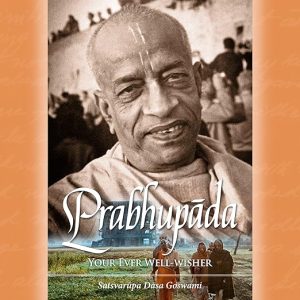
I came to this one without any prior relationship with the Hare Krishna movement. My entry point was purely biographical: the story of a man in his seventies arriving in New York City in 1965 with almost nothing, determined to transplant an entire tradition of bhakti yoga from India to the West. Whatever one makes of the theology, the human story is extraordinary. By the end of fifteen hours with Michael Scherer’s narration, I had a genuine sense of A. C. Bhaktivedanta Swami Prabhupada as a person, which is the central test of any biography in audio form.
Satsvarupa Dasa Goswami, writing as one of the earliest devotees and drawing on Prabhupada’s own words and extensive interviews with those who knew him in both India and the West, produces a portrait that manages to be admiring without becoming merely reverential. The biography earns its affection through specificity rather than through rhetorical elevation, and that makes a meaningful difference across a long listen.
Our Take on Prabhupada: Your Ever Well-Wisher
The book’s central subject is what reviewer Shantiq calls starting a second life at 65 and for 12 years running around flat-out like a top executive and company boss. That framing captures something essential. Prabhupada founded ISKCON in 1966, took the Hare Krishna movement around the world, established centers and ashrams across multiple continents, and wrote or dictated over sixty books. He did this while in his seventies, in declining health, in a culture radically different from the one that formed him. The biography traces that journey with enough historical and personal detail to make the scale of the achievement legible rather than merely impressive-sounding.
What Goswami does well is resist the temptation to present Prabhupada as simply exceptional. The book conveys both his extraordinary drive and his very human frustrations, his negotiations with institutional resistance, and the particular strangeness of arriving in a city like New York with a spiritual mission that must have seemed incomprehensible to most people he encountered.
Why Listen to Prabhupada: Your Ever Well-Wisher
All three available reviews are five stars, and they come from listeners with different relationships to the material. J’s review praises the compassion and kindness with which Prabhupada is depicted. Shantiq, the UK reviewer, explicitly notes it is an excellent read whether you even have interest in Krishna consciousness or not, and that is an important signal. The biography functions as a portrait of focus, determination, and the mechanics of building a religious institution from scratch, which has relevance well beyond the specific tradition.
Michael Scherer’s narration at fifteen hours and fifty-one minutes is the kind of long-form commitment that suits dedicated biographical listening. He does not dramatize the material, which is exactly right for a devotional biography that does not need theatrical enhancement. The Bhaktivedanta Book Trust as publisher signals a high standard of care for the text itself.
What to Watch For in Prabhupada: Your Ever Well-Wisher
The biography is authorized in the sense that Goswami is a devotee writing from within the tradition. That is not a disqualifying condition, but it does mean the critical distance a secular biographer might bring is not fully present. The portrait of Prabhupada is affectionate and admiring throughout, and listeners expecting balanced engagement with the controversies that surrounded ISKCON in the years after Prabhupada’s death will not find that here. This is a celebration as much as an examination, and it is worth going in with that understanding.
Who Should Listen to Prabhupada: Your Ever Well-Wisher
Essential for anyone with an existing connection to the Hare Krishna tradition, and genuinely engaging for listeners interested in twentieth-century religious history, the mechanics of spiritual transplantation across cultures, or the biographical study of extraordinary determination. Those looking for a critical assessment of ISKCON or of Prabhupada’s legacy in its full complexity will need to supplement this with external sources.
A note on duration: at fifteen hours and fifty-one minutes, this is a significant time investment, and listeners should approach it with that expectation. Biographical treatments of religious figures can feel exhausting at that length if the writing is hagiographic and repetitive. This one sustains attention because Goswami’s access to primary sources – both Prabhupada’s own words and direct testimony from early devotees – keeps the narrative grounded in specific moments rather than generalized praise. The length feels earned rather than padded.
Frequently Asked Questions
Do I need to know anything about the Hare Krishna movement before listening?
No prior knowledge is required. The biography contextualizes Prabhupada’s mission and the tradition of bhakti yoga clearly enough that a complete newcomer can follow. One reviewer specifically noted that the book is rewarding even for listeners with no interest in Krishna consciousness.
How does Michael Scherer’s narration handle the devotional and theological content?
Scherer reads with appropriate gravity without performing reverence. He handles Sanskrit terms and titles with care, and his pacing across fifteen hours is steady. The narration serves a listening experience that rewards sustained attention rather than quick absorption.
Is this an authorized biography, and does that affect its reliability?
Yes, Goswami is a devotee who knew Prabhupada personally and writes from within the tradition. The biography is deeply admiring and does not engage critically with post-Prabhupada controversies within ISKCON. For readers wanting a purely devotional portrait, that is a strength. For readers wanting historical balance, supplementary sources are advisable.
Is the book accessible to listeners outside the Hindu or Vaishnava tradition?
Reviewers from outside the tradition have found it accessible and engaging as a human story. The biography is primarily a portrait of extraordinary determination and religious entrepreneurship, which has broad appeal. Theological concepts are explained contextually as they arise.