
In Brief
- Performance: Lawrence Richardson delivers the material with the measured gravity it demands, navigating between ancient historical sources and contemporary cultural analysis without breaking stride.
- What it covers: Ancient Mesopotamian deities as modern cultural forces, spiritual warfare, America's moral transformation
- Feel: Prophetic and urgent, occasionally breathless in its scope, written for believers ready to find patterns
- Our call: Compelling as spiritual drama for readers within Cahn's tradition; unconvincing as history or cultural analysis for those outside it, and the book makes no real attempt to bridge that gap.
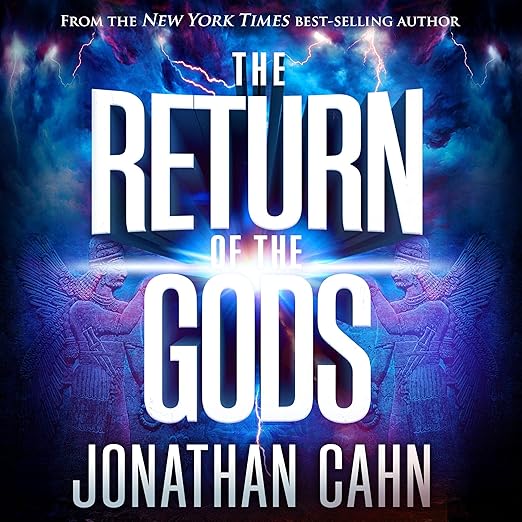
Jonathan Cahn occupies a particular space in religious publishing: a writer whose books function as theological thrillers, building elaborate structures of correspondence between ancient biblical patterns and contemporary events. I came to The Return of the Gods having reviewed his earlier The Harbinger, and my experience there prepared me for what this book does and does not attempt. It is not a work of academic history. It is an exercise in typological reasoning aimed at Christian readers already disposed to find its conclusions credible.
Lawrence Richardson narrates with the kind of controlled authority the material demands. Cahn writes in short chapters, each revealing a new piece of a pattern, and Richardson sustains the cumulative tension of that structure across eight and a half hours without losing the thread.
The book's thesis is that the ancient Mesopotamian deities, specifically a trinity Cahn calls the Possessor, the Enchanter, and the Destroyer, never ceased to exist as spiritual forces and have now returned to operate through modern cultural movements. Cahn argues, through layers of typological correspondence, that contemporary phenomena including the erosion of traditional gender categories, addiction culture, the sexualization of children through media, and the breakdown of the nuclear family are manifestations of these ancient gods operating in a new cultural medium.
The construction is careful within its own terms. Cahn moves from Sumerian and Babylonian inscriptions to modern Supreme Court rulings with a confidence that requires either acceptance of his theological premises or considerable patience with the distance between evidence and conclusion. For readers within the tradition, believers in spiritual warfare who expect biblical patterns to repeat across history, this is the book's strength. For readers outside it, the gap between ancient texts and modern culture is too wide to bridge on typological correspondence alone.
Why The Return of the Gods Works as an Audiobook
The book works most effectively as spiritual drama. Reviewer WriteReadFred calls it overripe for the times, and that is a useful description: the sense of urgency, the rhetorical buildup, the chapter titles, The House of Spirits, The Avatar, The Deep Magic, are all calibrated for maximum prophetic impact. Richardson's narration amplifies this. The audiobook format suits Cahn's rhythmic, building argument, the accumulation of pattern upon pattern is more immersive as a spoken sequence than as a printed text.
Reviewer BuckBran describes the book as confirming beliefs they held intuitively but lacked the framework to articulate, and this is likely the experience Cahn's ideal listener will have. The book does not attempt to persuade skeptics. It speaks to and for a specific theological community, and within that community it has found a wide and grateful audience.
Weak Spots in The Return of the Gods
The book makes a number of claims about the timing of Supreme Court decisions that are presented as evidence of supernatural coordination. These are among the book's most specific and testable assertions, and they are also the most dependent on the reader's willingness to accept the interpretive framework. The dates and decisions are real; whether they constitute evidence of divine pattern rather than coincidence is the interpretive question the book cannot resolve for you.
Reviewer Kathryn L. Taylor notes that the book is sometimes very scary and can be hard to read. This is important context: Cahn writes with genuine urgency about spiritual threat, and the material is designed to disturb. Listeners who are sensitive to prophetic content about cultural collapse may find the tone difficult to sustain over eight hours.
The Right Listener for The Return of the Gods
This is for listeners embedded in Christian prophetic tradition who want a coherent, dramatically constructed framework for understanding contemporary cultural change through a spiritual lens. It will be most meaningful for those already familiar with Cahn's previous work, though it functions as a standalone argument.
Listeners who approach cultural and spiritual questions through historical criticism, empirical sociology, or any framework outside Christian typology will find the methodology frustrating. The book is not designed for them and does not pretend to be.







